
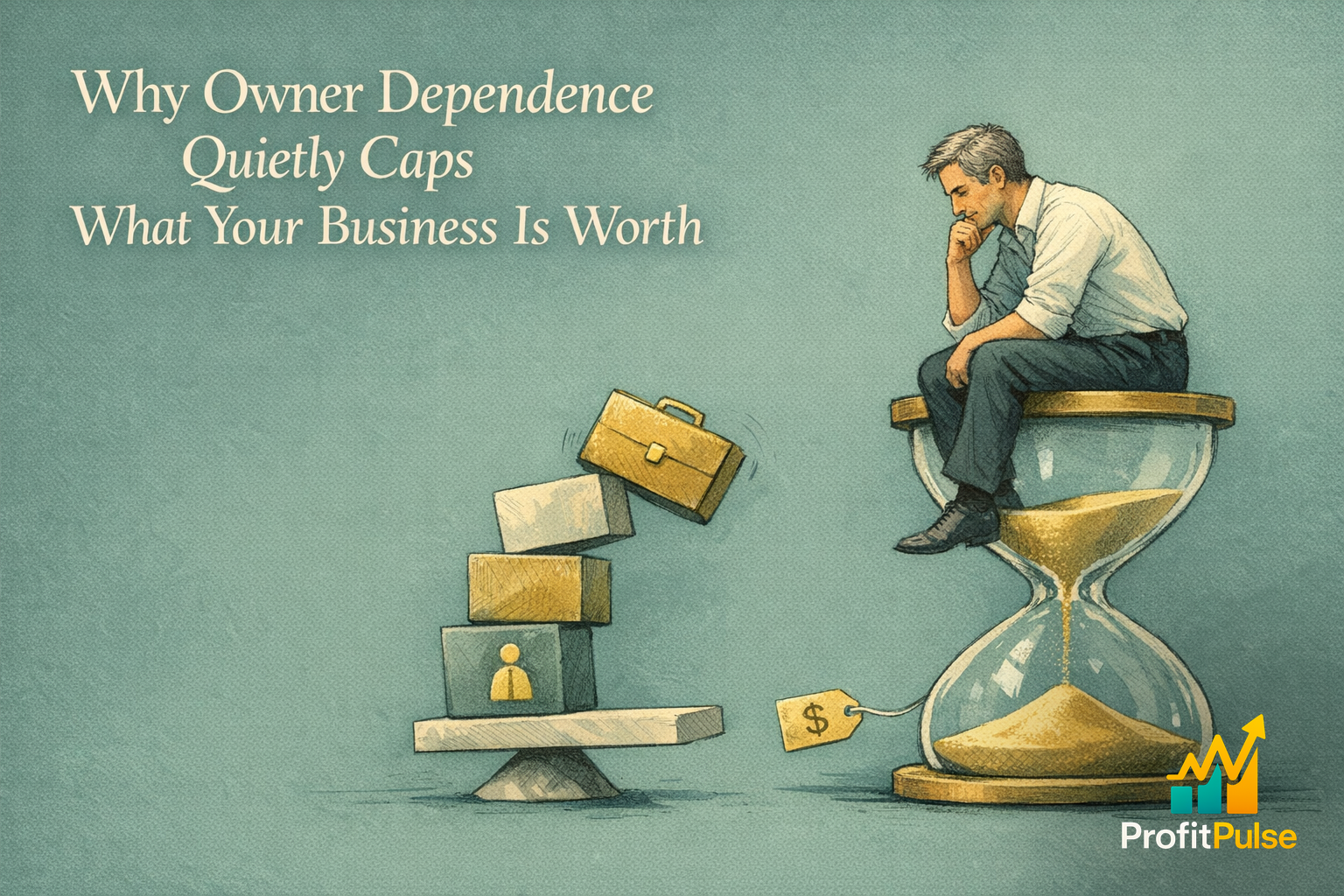
Ask most owners what their business is worth and the conversation goes straight to profit, revenue and the multiple a buyer might apply. Those matter. What rarely comes up, and what a buyer will weigh more heavily than almost anything else, is how much of the business lives in the owner’s head. A business that cannot run a week without you is, in a buyer’s eyes, closer to a well-paid job than a sellable asset.
This is the value detractor owners underrate most consistently. It does not show up in the financials, it feels like a strength while you are running the business, and it is the first thing a serious buyer probes. The good news is that it is also one of the most fixable, and the first steps are smaller than most owners expect.
Why a buyer discounts owner dependence so heavily
A buyer is not purchasing last year’s profit. They are purchasing the reasonable expectation that the profit continues after the current owner leaves. When the relationships, the pricing decisions, the key supplier conversations and the institutional knowledge all sit with one person, that expectation gets shaky the moment that person walks out the door.
So the buyer protects themselves the way any rational buyer would. They discount the price, they structure a long earn-out to keep the owner tied in, or they walk away entirely. None of those outcomes is what the owner had in mind, and all of them trace back to the same root cause. The business was built around the owner rather than around a system that runs without them. A lender weighs the same risk from the other direction, because a business whose performance depends on one irreplaceable person is a harder loan to write, which is why owner dependence quietly raises the cost of capital long before any sale is on the table. Our notes on business valuation go deeper on how these drivers move the number.
The pattern is common and rarely deliberate
Almost no one sets out to build an owner-dependent business. It happens because the owner is capable, because doing it yourself is faster than delegating, and because in the early years there genuinely was no one else. Each of those is a reasonable response to the moment. The trouble is that the habits which built the business are often the ones that cap its value, and the owner is usually the last to see it because from the inside it just feels like being on top of things.
The test is uncomfortable but clarifying. If you took two weeks away with no phone, what would break? The answers point straight at where the business depends on you, and they are usually specific: the one supplier who only deals with you, the quotes only you can price, the client relationships that have never met anyone else. There is often a second layer beneath the obvious one, the decisions no one else even knows are being made, like the gut feel on which jobs to take, the unwritten rule on how far to discount, the supplier you would never use again for reasons only you remember. Each is a thread to be deliberately handed over, and the quieter threads are usually the ones a buyer worries about most, because they are the hardest to replace.
Reducing dependence starts smaller than you think
The work is not a dramatic restructure. It is a steady transfer of decisions, relationships and knowledge out of your head and into the team and the systems. It starts with documenting how the most owner-specific decisions actually get made, then letting someone else make them while you are still there to coach. The first handovers can be small and low-risk on purpose, a single supplier relationship, one category of pricing decision, the second name on an important client account. Each handover does two things at once. It lifts the business a little further from being priced as a job, and it tests whether the knowledge really did transfer or only looked like it did, while you are still present to correct course.
An Exit Readiness Diagnostic scores exactly this, measuring owner dependence alongside the other dimensions a buyer grades, so you can see where you sit and which threads to pull first. The point is not that you are about to sell. It is that a business which runs without you is worth more, raises capital more easily and is simply less stressful to own, regardless of whether a sale ever happens at all.
Owner dependence is the rare value lever that costs nothing to start on and compounds over time. Every decision you hand over today widens the gap between a business priced as a job and one priced as an asset. ProfitPulse works with owners well before any sale to reduce that dependence deliberately, so when the time comes, the value reflects the business rather than the owner. You can read more about how buyers assess this in our guide on what it takes to be sale-ready through an honest indicative valuation.
Frequently asked questions
Why does owner dependence reduce the value of a business?
Because a buyer is purchasing the expectation that profit continues after the current owner leaves. When relationships, pricing decisions and key knowledge all sit with one person, that expectation looks fragile the moment they go. The buyer responds by discounting the price, structuring a long earn-out, or walking away. Our notes on business valuation explain how this single factor moves the number more than owners expect.
How do I know if my business is too dependent on me?
Run the two-week test. If you took two weeks away with no phone, what would break? The answers are usually specific: the supplier who only deals with you, the quotes only you can price, the clients who have never met anyone else. Each one is a thread to hand over. An Exit Readiness Diagnostic scores owner dependence formally so you can see exactly where it sits.
Can reducing owner dependence really increase my sale price?
Yes, often materially. A business that runs without the owner gives a buyer confidence the profit will continue, which reduces the discount and the need for a long earn-out. The same quality also makes capital easier to raise and the business less stressful to own day to day. It is one of the few value levers that costs little to start on and compounds steadily the longer you work at it.
What is the first step to making a business less owner-dependent?
Start by documenting how your most owner-specific decisions actually get made, then let someone else make them while you are still there to coach. Pick the threads the two-week test surfaces and hand them over one at a time. It is not a dramatic restructure. It is a steady transfer of decisions, relationships and knowledge out of your head and into the team and systems, with each handover lifting the value a little.
Does owner dependence matter if I am not planning to sell?
It does. A business that runs without you raises capital more easily, weathers your absence without drama, and is simply less stressful to own. The value lift is real even if a sale never happens. Reducing dependence is one of those rare moves that improves the business on its own terms today while also protecting the number a future buyer would pay. Our thinking on exit readiness covers both angles.
How long does it take to reduce owner dependence before a sale?
It varies with how concentrated the knowledge and relationships are, but most owners need a year or more of deliberate handover to move the dial meaningfully. That is why starting well before a sale matters. Leaving it until a buyer is at the table usually means accepting a discount or an earn-out instead. The earlier you begin transferring decisions, the more the value reflects the business rather than you.
Leave a Reply