
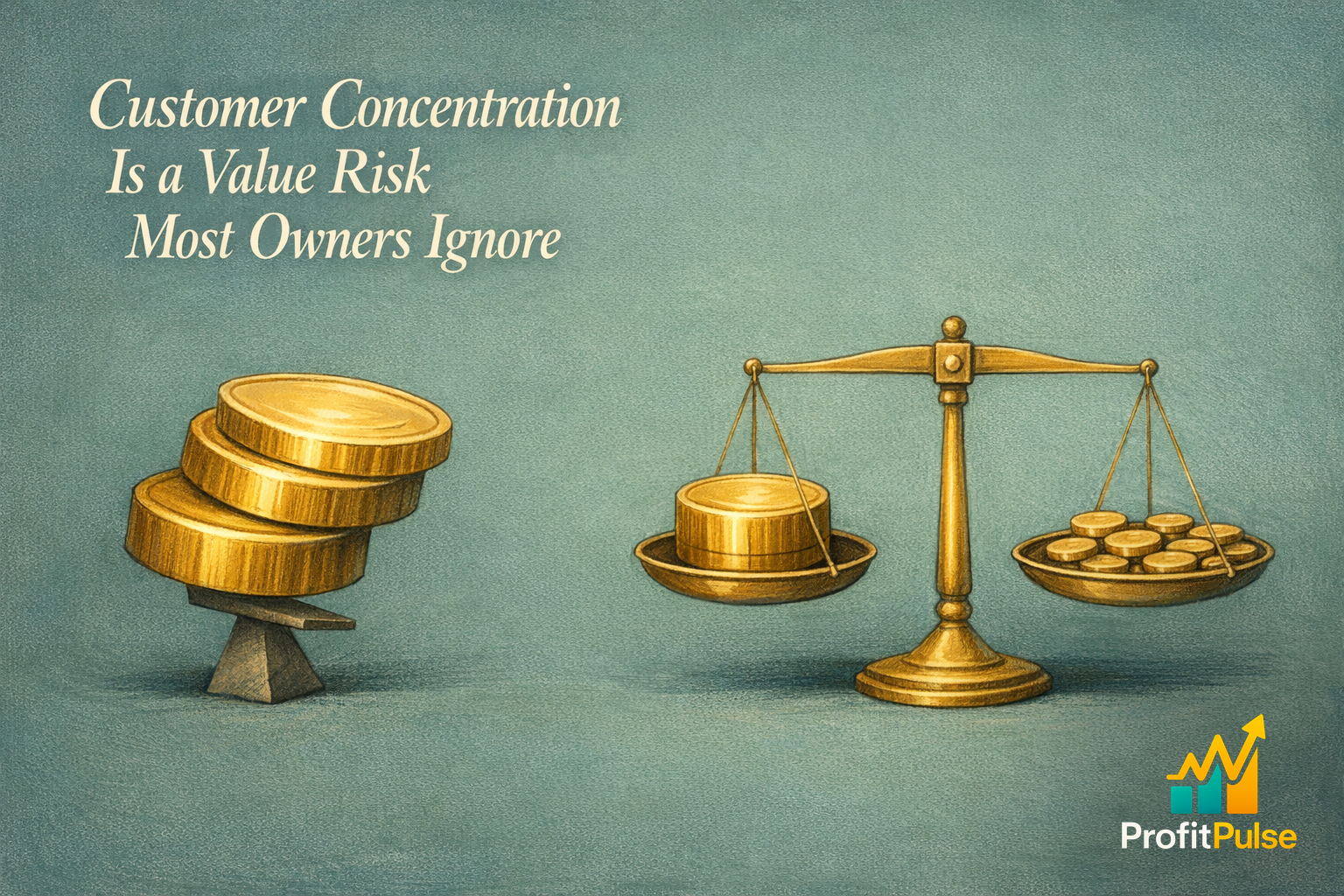
A business with one or two large customers often feels like a business that has it made. The revenue is steady, the relationships are strong, and the work keeps coming. From the inside, customer concentration can look like the reward for doing good work and keeping clients happy. From the outside, where a buyer or a lender sits, it looks like something quite different. It looks like risk.
This is one of the value detractors owners most consistently underweight, because the very thing that feels like stability is the thing a buyer discounts hardest. A profitable, well-run business can carry a strong set of numbers and still attract a lower price purely because too much of its revenue depends on too few customers. The numbers are not the problem. The fragility behind them is.
Why a buyer discounts concentration regardless of the numbers
A buyer is paying for the expectation that revenue continues after the sale. When a single customer accounts for a large share of that revenue, the buyer has to price in what happens if that customer leaves, renegotiates, or simply does not warm to new ownership. The stronger the numbers, the more there is to lose if the key relationship walks, which is why concentration can actually make a buyer more cautious rather than less.
This shows up as a real discount or a deal structured to protect the buyer, often a sizeable earn-out tied to the key customer staying. Neither outcome is what the owner pictured. Both trace back to the same root: the business is excellent but exposed, and the exposure caps the price no matter how good the trading looks. Our notes on business valuation explore how these risk factors move the multiple a buyer is willing to pay.
Concentration hides in more places than the customer list
Most owners picture concentration as a single dominant client, but it shows up in several quieter forms that carry the same risk. A business can be spread across thirty customers and still depend heavily on one industry, so a downturn in that sector takes a slice out of the whole base at once. It can rely on a single referral partner who sends most of the new work, which is a concentration of the pipeline rather than the revenue. It can lean on one supplier whose terms underpin the margin, so a change at their end reshapes the economics overnight.
A buyer reads all of these the same way they read a dominant customer. Each is a single point that, if it moves, moves the business with it. The owner who only counts the top customer by revenue can miss two or three of these other dependencies entirely, and they are precisely the ones a careful buyer will probe in due diligence. Mapping where the business is exposed, across customers, sectors, referral sources and key suppliers, gives a fuller picture than any single number can.
Measuring concentration is the first honest step
Most owners sense their concentration without ever quantifying it precisely, which means they tend to underestimate it. The measurement is straightforward: rank every customer by revenue and by gross margin contribution, and look at what share the top one, two and five represent. The number is often more confronting than the felt sense, particularly when you weight by margin rather than revenue, because the largest customer is sometimes also one of the most expensive to serve.
Seeing it clearly is what makes it actionable. An indicative valuation will surface concentration as a value driver, but the underlying map is useful well before any sale, because it tells you not just how concentrated you are but which customers are genuinely worth protecting and which are large but only marginally profitable. That distinction changes how you think about the whole base, not just the top of it. A large customer who pays late, demands heavy service and squeezes price can carry more risk than reward, and the map makes that visible in a way the revenue ranking alone never will.
Spreading revenue lifts value and resilience together
The work of reducing concentration is the same work that makes a business more durable to own. Broadening the customer base, winning a wider spread of accounts, and reducing the dependence on any single relationship lifts the value a buyer will pay and, at the same time, makes the business far less fragile day to day. The two goals are not in tension; they are the same goal seen from two angles.
It is patient work rather than a quick fix, which is why starting well before any sale matters so much. Concentration that took years to build takes time to unwind, and a buyer at the table is too late to begin. The owners who lift their value most are usually the ones who treated resilience as worth building for its own sake, with the valuation benefit following naturally. Our thinking on exit readiness places concentration alongside the other dimensions a buyer grades, because they tend to move together.
Customer concentration is the rare risk that hides inside a success story, which is exactly why it gets ignored until a buyer names it. Measuring it, then deliberately broadening the base, is one of the most reliable ways to lift both the worth and the resilience of a business at once. ProfitPulse helps owners see their concentration clearly and reduce it on their own timeline, so the value reflects a durable business rather than a fragile one.
Frequently asked questions
Why does customer concentration lower a business valuation?
Because a buyer is paying for the expectation that revenue continues after the sale, and when one customer carries a large share, the buyer must price in what happens if that customer leaves or renegotiates. The stronger the numbers, the more there is to lose if the key relationship walks. It usually shows as a discount or an earn-out tied to the customer staying. Our notes on business valuation explain how this moves the multiple.
How do I measure customer concentration in my business?
Rank every customer by revenue and by gross margin contribution, then look at what share the top one, two and five represent. Weighting by margin rather than revenue often changes the picture, because the largest customer is sometimes one of the most expensive to serve. The number is usually more confronting than the felt sense. An indicative valuation surfaces concentration as a value driver, but the underlying map is useful well before any sale.
What is a safe level of customer concentration for an SME?
There is no single threshold, since it varies by industry and contract type, but the more revenue that sits with one or two customers, the more a buyer will discount the risk. The useful question is less about a magic percentage and more about how exposed the business would be if the largest customer left. Reducing that exposure improves both the price a buyer will pay and the resilience of the business day to day.
Can reducing customer concentration really increase sale value?
Yes, and it lifts resilience at the same time, because the work is identical. Broadening the base and reducing dependence on any single relationship gives a buyer more confidence the revenue continues, which lifts the price, while also making the business less fragile to own. The two goals are the same goal seen from two angles. It is patient work, which is why starting well before any sale is what makes the difference.
Why do owners overlook customer concentration as a risk?
Because it hides inside a success story. A couple of large, loyal customers feels like the reward for good work and steady relationships, so the exposure reads as stability rather than risk. Most owners sense their concentration without quantifying it, which means they underestimate it. It usually only gets named when a buyer or lender raises it, by which point unwinding years of concentration in time to matter is far harder than starting earlier would have been.
How long before a sale should I address concentration risk?
As early as you reasonably can, because concentration that took years to build takes time to unwind. A buyer at the table is too late to begin meaningfully. Broadening the customer base and reducing dependence on a single relationship is patient work that rewards a long runway. Our thinking on exit readiness places concentration alongside the other dimensions a buyer grades, since they tend to improve together over time.
Leave a Reply