
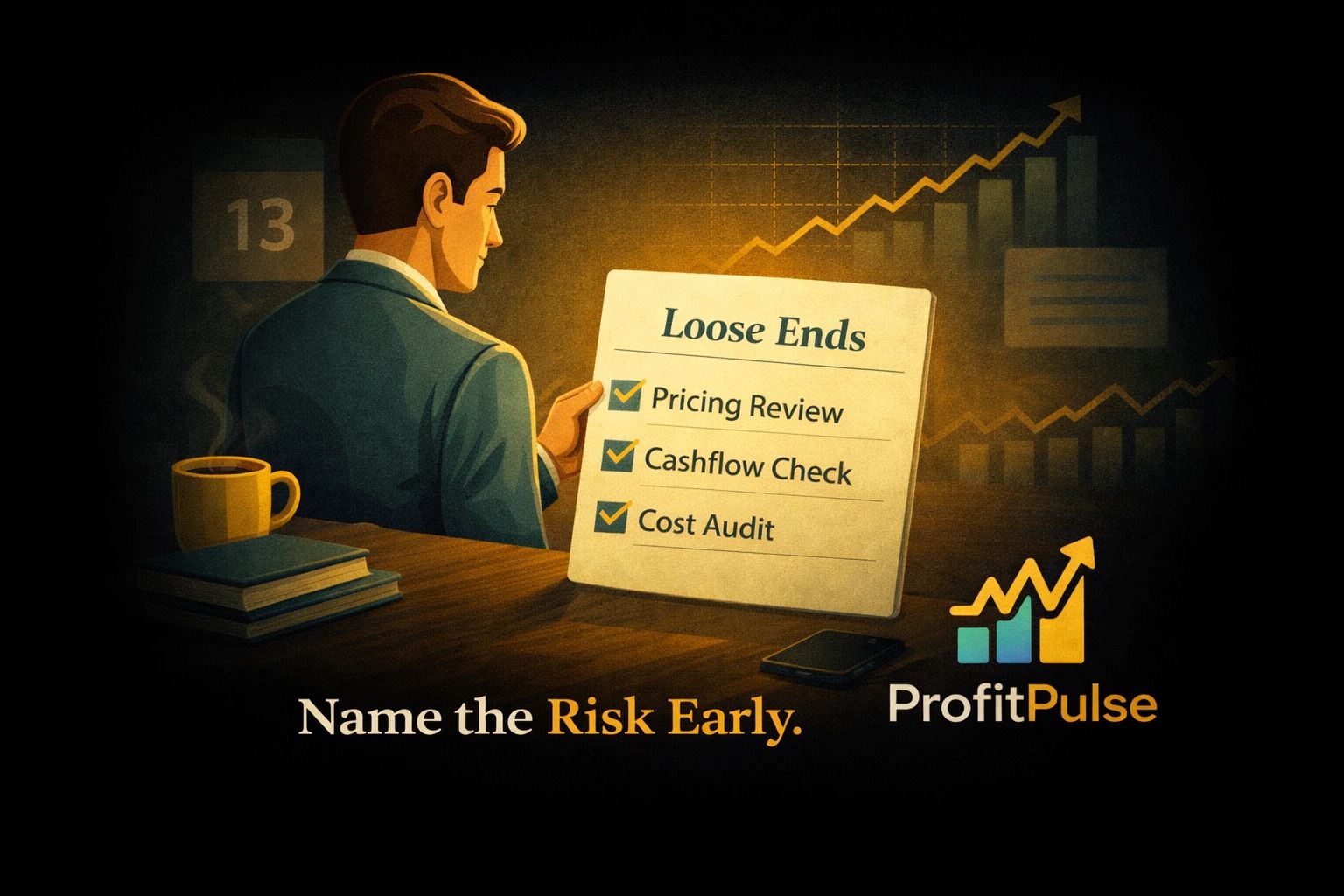
Friday the 13th tends to get people talking. Some treat it like any other day. Others move through it a little more cautiously. Even if you’re not superstitious, there’s something about the date that makes you slightly more aware of risk.
And in business, that pause can actually be useful. Because the risks that affect a business rarely arrive dramatically. They don’t usually show up with warning signs or obvious signals.
More often, they build quietly in the background.
– It might be a margin that’s been tightening slowly over several months.
– A cost structure that’s drifted upward without anyone fully recalculating it.
– A customer relationship that’s functioning but not as smoothly as it could.
– A cashflow pattern that feels tighter than last quarter, but hasn’t been properly reviewed.
None of these feel urgent in isolation. That’s what makes them easy to leave alone. We tend to respond quickly to loud problems. But subtle issues can sit undisturbed for longer than they should, simply because they aren’t disruptive enough to force action.
That’s why I don’t mind days like Friday the 13th. They remind us to pause. Not because something unlucky is about to happen, but because pausing gives us a chance to notice what we’ve been tolerating.
If there’s something in your business that you’ve quietly been meaning to look at, a pricing review, a cost analysis, a workflow bottleneck, a conversation you’ve been postponing, today is as good a day as any to bring it into the open.
Most business pressure doesn’t come from bad luck. It comes from small patterns that compound.
– When pricing isn’t reviewed regularly, margins erode gradually.
– When cashflow isn’t monitored closely, surprises appear at inconvenient times.
– When expectations aren’t clarified, friction builds in relationships.
None of this happens overnight. It builds through inattention, not misfortune. The good news is that the opposite compounds too.
– A simple monthly review of key numbers creates visibility.
– A short weekly check-in reduces decision drift.
– Naming a risk early often removes most of its power.
Structure reduces superstition. The businesses that feel calm and controlled over time aren’t lucky. They’re attentive. They don’t eliminate risk; they bring it into the light early enough to manage it properly.
If today being Friday the 13th makes you slightly more reflective, use that moment productively.
– Close one open loop.
– Review one metric you’ve been ignoring.
– Have one conversation you’ve delayed.
– Clarify one decision that’s been hovering.
It doesn’t need to be dramatic. It just needs to be deliberate. Risk in business is rarely about fate. It’s usually about visibility. And visibility is something you can choose, any day of the year.
Where ProfitPulse fits
At ProfitPulse, we help business owners turn these “care habits” into simple weekly rhythms, tied to numbers, capacity, and cash, so it doesn’t rely on mood or memory. It becomes repeatable.
Book Your ProfitPulse Consultation
If you’re ready to take your business into new heights for 2026, book a complimentary 45min Discovery Call with on of our ProfitPulse experts today.
Frequently asked questions
What are the most overlooked financial risks for an Australian SME?
The risks that hurt SMEs are rarely the dramatic ones. Concentration of revenue in one or two large customers, a single supplier with no backup, key person dependence on the owner, and the absence of any thirteen-week cash flow forecast are the four that quietly damage businesses every year. Each is fixable, but only if you have looked for them.
How do I identify the real risks in my business?
Take ten minutes and answer five questions honestly. What happens if your largest customer leaves tomorrow? What happens if your most important supplier doubles their price? What happens if you are out of action for six weeks? Could you survive ninety days without new revenue? Who else in the business knows where the money is at any given moment? Honest answers usually surface the real exposures.
What is a business risk register and do small businesses need one?
A risk register is a simple document listing the most material risks to the business, the likelihood of each, the financial impact, and the action being taken. SMEs do not need the formal version that listed companies use. A one-page version reviewed every six months is more than most businesses have and almost always exposes risks the owner had stopped noticing.
How often should an SME review its risk exposure?
Once a quarter at minimum, and any time a material change happens, like winning a large contract that suddenly concentrates revenue, or losing a key team member. The review does not need to be long. Twenty minutes with the risk register, the customer concentration report, and the cash flow forecast tells you most of what you need to know.
Does a fractional CFO help with business risk management?
Yes, and it is one of the less-discussed benefits of the arrangement. Fractional CFO support usually starts with a risk audit that surfaces concentration, key person, and cash exposure that the owner had become numb to. The fix is rarely complicated; the value is in someone outside the business asking the questions consistently.
Leave a Reply