
The February habit that builds loyalty without discounts
February gets branded as the month of love. In business, “love” can sound a bit fluffy, until you translate it into something practical: loyalty, repeat work, referrals, patience when things go wrong, and customers who choose you even when you’re not the cheapest.
Most businesses don’t lose customers because the product is bad. They lose customers because the experience becomes slightly inconsistent over time. A slower reply here, a vague quote there, a missed follow-up, a small misunderstanding that never gets cleared up. None of it is dramatic. It’s just enough to make someone quietly shop around next time.
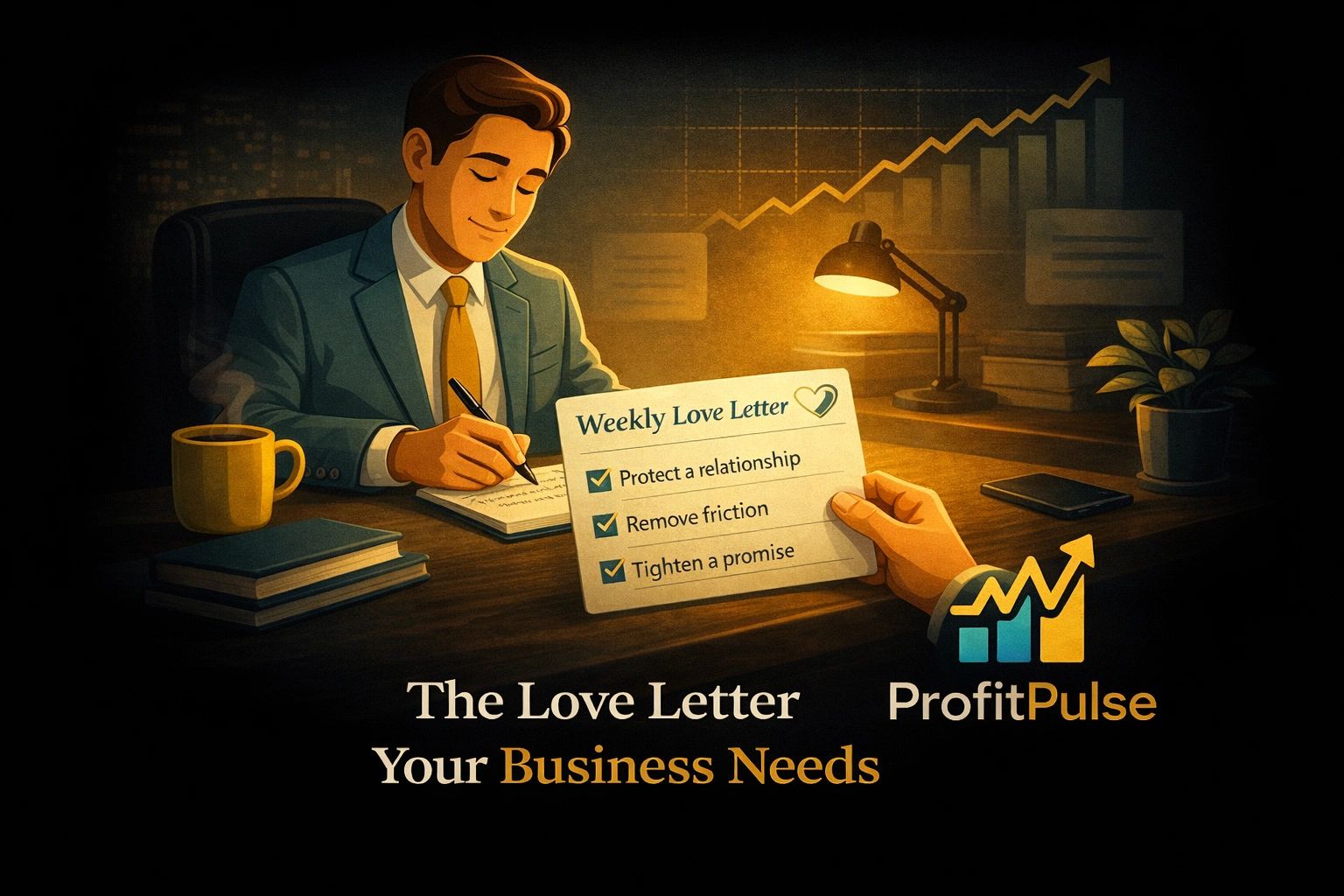
So here’s a simple February idea that tends to pay back all year: write one “love letter” a week to your business.Not a literal letter, a short, structured check-in that forces you to care about the two things customers feel most: clarity and follow-through.
It takes 20 minutes. It’s not sentiment. It’s discipline with a human tone.
Step 1: Pick one relationship to protect this week
Choose one of these:
- your top customer by margin
- your top customer by potential
- your most “at-risk” customer (late payers, complaints, confusing requests)
- your best referral source
Then ask one question: “If I were them, what would I want to feel this week?”
Usually it’s: kept in the loop, respected, not surprised.
Your action can be small: a proactive update, a clearer scope, a “here’s what’s next and when,” or a quick check-in before problems brew. This is how trust builds quietly, through consistency, not grand gestures.
Step 2: Remove one friction point from your delivery
Friction is where love goes to die in business. Not because anyone is careless, but because friction multiplies when the pace picks up.
Pick one recurring friction point:
- quotes that confuse people
- handovers that drop details
- unclear timelines
- late invoicing
- constant “just checking” follow-ups
Then remove one step of uncertainty. Examples: add a one-page “what to expect” note to every quote, standardise your timeline language, or create a simple handover checklist. These aren’t “systems projects.” They’re tiny upgrades that make customers feel looked after.
Step 3: Tighten one promise you keep making
Most businesses carry “invisible promises” they didn’t mean to make:
- “We’ll get back to you quickly”
- “We’re on top of it”
- “It’ll be ready soon”
When those promises are vague, customers get anxious, and anxiety looks like chasing, complaints, or dropping off.
This week, choose one promise and make it concrete. Instead of “soon,” say “by Thursday 3pm.” Instead of “we’ll follow up,” say “I’ll call you Tuesday morning with the next step.”
Clarity is a form of care. It reduces mental load for your customer, and it reduces rework for you.
Why this matters
This isn’t about being overly “nice.” It’s about building a business that people feel safe buying from, because it’s predictable, clear, and well-run.
The interesting part: these small habits usually lift margins too. When you reduce confusion, you reduce time-waste. When you keep promises clearly, you reduce rework. When you protect relationships proactively, you reduce churn.
Where ProfitPulse fits
At ProfitPulse, we help business owners turn these “care habits” into simple weekly rhythms, tied to numbers, capacity, and cash, so it doesn’t rely on mood or memory. It becomes repeatable.
And on Friday the 13th, we’ll take a fun angle on the flipside.
Book Your ProfitPulse Consultation
If you’re ready to take your business into new heights for 2026, book a complimentary 45min Discovery Call with on of our ProfitPulse experts today.
Frequently asked questions
How do I build customer loyalty without discounting?
Discounting buys transactions, not loyalty. The habits that actually retain customers are consistent communication, proactive problem-solving, and showing up with useful information before being asked. A simple quarterly check-in note that is genuinely useful builds more loyalty than any discount programme, because it signals that you are paying attention to the customer rather than to the sale.
What is the cost of acquiring a new customer compared to retaining one?
In most Australian SMEs, acquiring a new customer costs four to seven times more than retaining an existing one. Despite this, marketing budgets in owner-led businesses skew heavily towards acquisition and almost ignore retention. Reversing this balance is one of the cheapest profit improvements available to most businesses.
How do I generate more referrals from existing clients?
The most reliable way is to ask, after a moment when the client has clearly experienced value. Most owners feel awkward about asking and so never do, which means their best referrers stay silent. A short, specific request, made at the right moment, converts at much higher rates than passive referral programmes or referral bonuses.
Does discounting damage long-term profitability?
Yes, in two ways. It trains customers to wait for the next discount before buying, which means your full-price revenue falls. And it anchors them to a lower price as the new normal, which makes future increases feel like price gouging. Businesses that maintain price discipline through cycles consistently outperform those that chase volume with discounts.
What simple habits build customer loyalty for service businesses?
Send a useful update note quarterly. Remember the last conversation and reference it in the next one. Solve a small problem the customer did not ask you to solve. Apologise promptly when you get something wrong and overcorrect on the fix. These are not strategies; they are the basic courtesies that most businesses have stopped practising.
Leave a Reply