
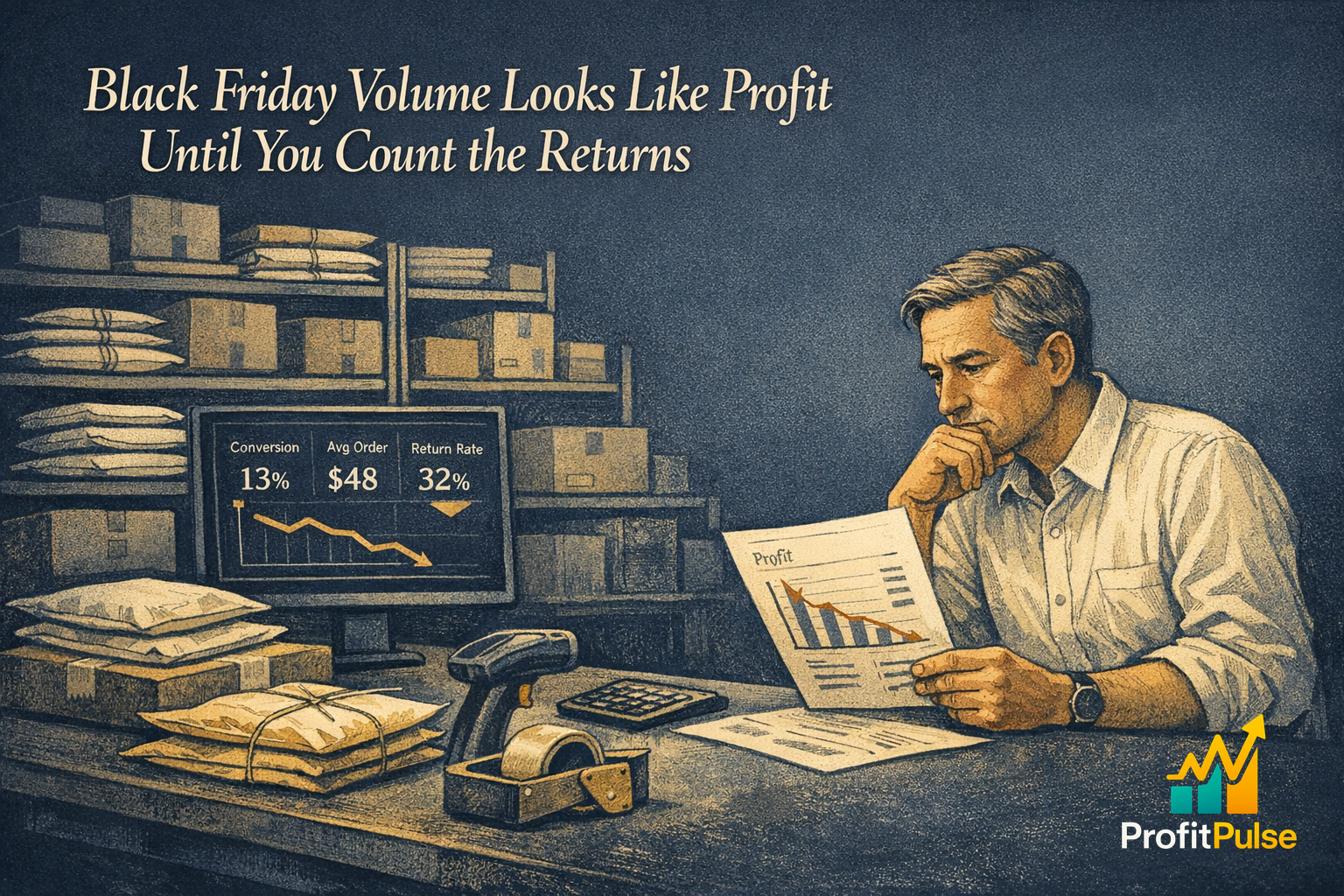
Black Friday produces the most exciting dashboard of the year for an online retailer. Orders climb by the hour, the revenue figure races ahead, and for a few days the business feels like it has cracked something. The figure that matters most, though, is not on that dashboard, and it does not settle until weeks later when the shipping has been paid, the payment fees have cleared, and the returns have come back. By then the excitement has moved on, and so has the chance to have run the numbers properly.
The gap between Black Friday revenue and Black Friday profit is wider than almost any other trading event, because nearly every cost that erodes an online margin scales with the volume the event creates. More orders mean more shipping, more payment processing, more discounting baked into the offer, and more returns landing in December. Revenue is the easy number to celebrate. Contribution margin per order is the one that tells you whether the celebration was earned.
The pattern across online retailers is not that the sale was a mistake. It is that the sale was measured on the wrong line.
Count the costs that scale with the order
Contribution margin per order is what is left after the costs that move with each order are taken out. The product cost is the obvious one. The less obvious ones are where Black Friday margin disappears. Fulfilment cost rises with volume and often rises further when the warehouse is under pressure. Payment fees take their percentage on the discounted price, not the full one. The discount itself is a direct cut to margin on every unit. Stack these together on a heavily promoted order and the contribution that looked healthy at full price can be slim or negative.
The return rate is the cost that hides the longest. A return is not just a refund. It is the outbound shipping already spent, the inbound shipping to get it back, the handling to inspect and restock, and sometimes a product that cannot be resold at full price. On a promotional order with a thin contribution to begin with, a single return can wipe out the margin on several sales beside it.
Volume bought with acquisition cost is not free
Many Black Friday orders are won with spend, and customer acquisition cost belongs in the same honest calculation. An order acquired through paid advertising at a cost the full-price margin could absorb may not survive once the promotional discount is also taken out. Chasing average order value with bundles and thresholds helps, but only if the bundle protects contribution rather than simply lifting the headline order size with more discounted product.
This is the work a Product and Service Line Profitability review does, ranking each line by contribution margin so the promotion is built around the products that can carry a discount and still earn. Our wider insights return to this because volume measured on revenue alone is one of the most common ways a strong-looking month banks a weak result.
The discounted customer is not always the customer you wanted
There is a longer cost to a Black Friday sale that the order-level numbers miss entirely, and it shows up in who the event brings through the door. A customer who arrives only for the deepest discount, buys once, and never returns at full price is a different proposition from one who discovers the brand on promotion and comes back. The first is a single thin transaction dressed up as growth; the second is genuine acquisition. The event total treats them identically, yet their value to the business over the following year could hardly be more different.
This is why the strongest online retailers look past the event week to what happens after it. The questions worth asking are how many of the Black Friday buyers placed a second order at full margin, and how the repeat rate from promotional traffic compares with the rate from everyday traffic. If the discounted cohort rarely returns, the event is buying revenue rather than customers, and the acquisition cost behind it is even harder to justify than the order-level margin suggested. A promotion judged only on its own week can look like growth while quietly training a slice of the market to buy from you only when you are cheapest.
Measure the event on the right line
None of this argues against running the event. It argues for judging it by contribution margin per order rather than by the revenue dashboard, so next year’s offer is built on what actually earned. The order that looks like profit and the order that is profit are not always the same order, and the difference only shows once shipping, fees, discounts and returns are all counted. You can see how this fits the broader work on the services overview.
Brisbane online retailers compete in the same national promotional window as everyone else, which is why we watch the sector closely across Brisbane. The revenue spike is real. Whether it was profitable is a different number, and it is the one worth knowing.
If your peak revenue looks strong but the profit never quite follows, ProfitPulse helps online retailers read contribution margin per order so the volume earns its place.
Frequently asked questions
What is contribution margin per order for an online retailer?
It is what remains from an order after the costs that move with it are removed, including product cost, fulfilment, payment fees and the discount itself. Unlike revenue, it shows whether an order actually earned. On a heavily promoted Black Friday order, the contribution that looked healthy at full price can be slim or negative once every variable cost is counted. It is the line that tells you if the volume was worth having.
Why is Black Friday revenue a misleading measure of success?
Because nearly every cost that erodes an online margin scales with the volume the event creates. More orders mean more shipping, more payment fees, more baked-in discounting and more returns landing in December. Revenue races ahead on the dashboard while the costs settle weeks later. Judging the event on revenue alone is measuring it on the wrong line. A profitability review shows what the volume actually contributed.
How do returns affect the profit on a Black Friday sale?
A return is far more than a refund. It is the outbound shipping already spent, the inbound shipping to bring it back, the handling to inspect and restock, and sometimes a product that cannot be resold at full price. On a promotional order with thin contribution to begin with, a single return can wipe out the margin on several sales beside it. Return rate is the cost that hides longest after the event.
Should customer acquisition cost be counted in Black Friday margin?
Yes. Many Black Friday orders are won with paid advertising, and that acquisition cost belongs in the honest calculation. An order acquired at a cost the full-price margin could absorb may not survive once the promotional discount is also removed. Leaving acquisition cost out makes the event look more profitable than it is. Counting it shows which volume genuinely earned and which simply moved discounted product at a loss.
Do Black Friday customers come back at full price afterwards?
Some do and some do not, and the difference decides whether the event built customers or just revenue. A buyer who discovers the brand on promotion and reorders at full margin is genuine acquisition; one who only ever buys at the deepest discount is a single thin transaction. Watching the repeat rate from promotional traffic against everyday traffic shows which you attracted. Our insights return to measuring customers over a year, not a week.
How can online retailers protect margin during Black Friday?
By building the promotion around the products that can carry a discount and still earn, rather than discounting across the board. Ranking each line by contribution margin shows which can absorb the cut. Bundles and order thresholds help lift average order value, but only when they protect contribution rather than just inflate the headline order with more discounted product. The aim is volume that earns, not volume that merely looks impressive.
How should I judge whether a Black Friday promotion worked?
By contribution margin per order, measured once shipping, fees, discounts and returns are all counted, not by the revenue dashboard during the event. The order that looks like profit and the order that is profit are not always the same. Judging the event on the right line means next year’s offer is built on what actually earned, so the volume justifies the discount rather than disguising a weak result.
Leave a Reply