
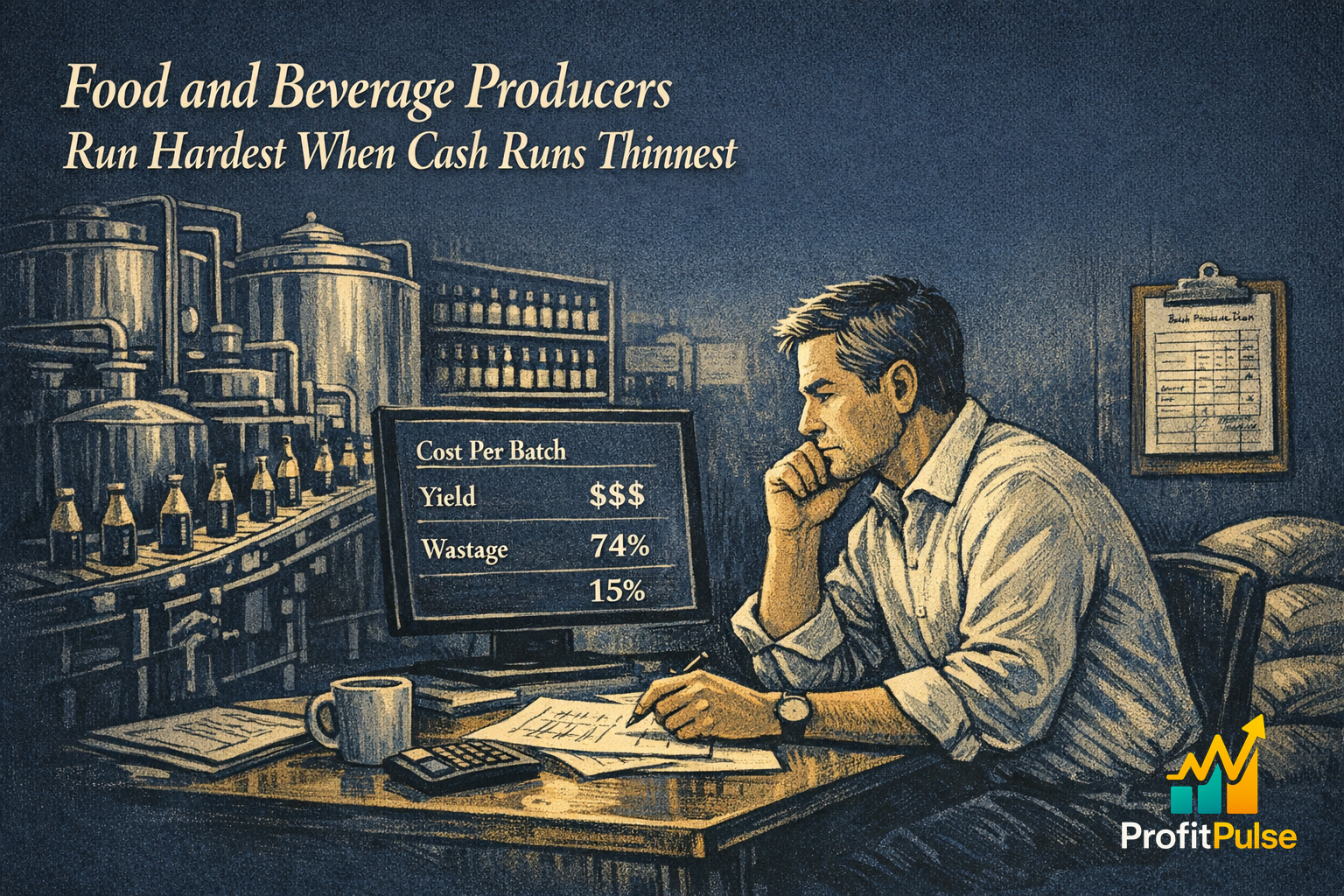
For food and beverage producers, December is the cruel month. Demand is at its highest, which means production runs flat out, ingredient orders are at their largest, and the wages bill climbs to cover the extra shifts. Money is going out the door faster than at any other point in the year.
The money coming back in tells a different story. The stockists who take your product onto their shelves are running on payment terms that often stretch further over the holidays, not shorter. So you pay for the inputs now, in full, and you wait for the retailers to pay you in January or February. The gap between those two events is where producers get caught.
This is not a sign of a weak business. A strong, growing producer feels this gap more acutely than a stagnant one, because growth amplifies the timing mismatch. Understanding it is the first step to managing it.
The Timing Mismatch Is Structural
Look at the mechanics. Your cost of goods produced peaks in the weeks before Christmas, as you build batches to meet orders. Ingredient inflation has likely pushed your input costs up over the year, so each batch ties up more cash than it did last December. Then there is the shelf-life write-off risk: produce too much and the unsold stock becomes a loss, produce too little and you leave revenue on the table. Batch costing decisions made in November determine the cash position you sit in come January.
None of this shows up cleanly in a profit figure. You can have a genuinely profitable December on paper and still hit a cash trough in mid-January when the wages and supplier payments for that big production run fall due before the retailer money has landed. Profit and cash are not the same thing, and in this industry the gap between them is widest exactly when you are busiest.
The payment terms themselves deserve a hard look. A producer often accepts a stockist’s standard terms without ever testing them, and over the holidays those terms can quietly extend as the retailer’s own accounts team thins out. Sixty days on paper becomes seventy-five in practice. Knowing the real, observed payment behaviour of each major stockist, rather than the headline term, is what lets you forecast the inflows honestly instead of optimistically.
Model the Trough Before You Hit It
The producers who handle this well are not the ones with the most cash. They are the ones who saw the trough coming. A Profit & Cash Diagnostic maps both sides of the problem at once: where margin is leaking, often through yield variance and write-offs, and where the timing risk sits across a thirteen-week forecast. That second part matters most right now, because it tells you the depth and the date of the January low point before you reach it.
Once you can see the trough, the options open up. You can stage supplier payments, tighten the terms you offer smaller stockists, or arrange a short facility to bridge the specific weeks where committed payments exceed expected receipts. What you cannot do is manage a gap you have not measured. Our guide to cash flow discipline covers the habits that keep this from becoming an annual surprise.
There is a quieter benefit to modelling the trough early. It changes how you negotiate. A producer who knows exactly which fortnight the cash dips lowest can ask a key supplier for an extra two weeks on a single invoice with precision, rather than asking for a vague favour. Lenders and suppliers both respond far better to a specific, evidenced request than to a general one, and that specificity only comes from having done the forecasting first.
A Pattern Across Queensland Producers
We see this rhythm across food and beverage producers in Queensland, from boutique drinks makers to specialty food manufacturers. The peak that should feel like a reward instead feels like a squeeze, because the cash mechanics work against the producer at the busiest moment. The fix is not to slow down. Slowing down to ease the cash gap usually costs more than the gap itself, because it surrenders the very revenue the peak exists to capture. The better move is to see the timing clearly enough to fund the gap on your terms rather than the bank’s.
One framing helps producers act sooner. The cash tied up in a single large pre-Christmas run is not lost, it is simply committed and waiting to convert. Seeing it that way turns a vague sense of tightness into a concrete, time-bound question: how many weeks until this specific run pays back, and can the business comfortably carry it until then? Answered honestly, that question usually points to a small, targeted intervention rather than a wholesale change, which is exactly the kind of measured response a busy month calls for.
If your production is running hard right now and the January cash position is more guess than forecast, that is precisely the picture ProfitPulse helps producers bring into focus before the trough arrives.
Frequently asked questions
Why do food producers run low on cash during their busiest months?
Because production costs peak before Christmas while retailer payments stretch into January or February. You pay for ingredients, extra shifts and larger batches in full, then wait weeks to be paid. A growing producer feels this timing mismatch more, not less, since growth amplifies it. Our cash flow discipline guide covers the habits that stop this becoming an annual surprise.
Can a food production business be profitable but still run out of cash?
Yes, and it is common in this industry. You can have a strong December on paper and still hit a cash trough in mid-January when wages and supplier payments for the big run fall due before retailer money lands. Profit and cash are different things, and the gap between them is widest exactly when you are busiest. Modelling the trough in advance is what prevents the surprise.
How does yield variance affect a food producer’s margin?
Yield variance is the difference between the output a batch should produce and what it actually yields. When yield slips, your cost of goods produced rises per unit sold, quietly eroding margin even when sales look healthy. Combined with shelf-life write-offs, it is one of the main reasons a busy production month converts to weaker profit than expected. Tracking it batch by batch is the only way to catch it early.
What is a profit and cash diagnostic for a food producer?
It maps two problems at once: where margin is leaking, often through yield variance and write-offs, and where the timing risk sits across a thirteen-week cash forecast. For producers, the second part is decisive because it shows the depth and date of the January low point before you reach it. You can see what it covers on our services page. Knowing the trough is what lets you fund it on your terms.
How can a Queensland food producer bridge the holiday cash gap?
Once you have modelled the trough, the options open up. You can stage supplier payments, tighten terms with smaller stockists, or arrange a short facility to cover the specific weeks where committed payments exceed expected receipts. The key is sequence: measure first, then fund. What you cannot manage is a gap you have not quantified, which is why the forecasting work comes before any financing decision.
Why does batch costing matter for managing December cash?
Batch costing tells you exactly what each production run ties up in cash, including ingredient inflation that has likely lifted input costs over the year. Decisions made in November about how much to produce determine the cash position you sit in come January. Overproduce and you carry write-off risk; underproduce and you leave revenue behind. Accurate batch costs let you plan the run against the cash you will actually have.
Leave a Reply