
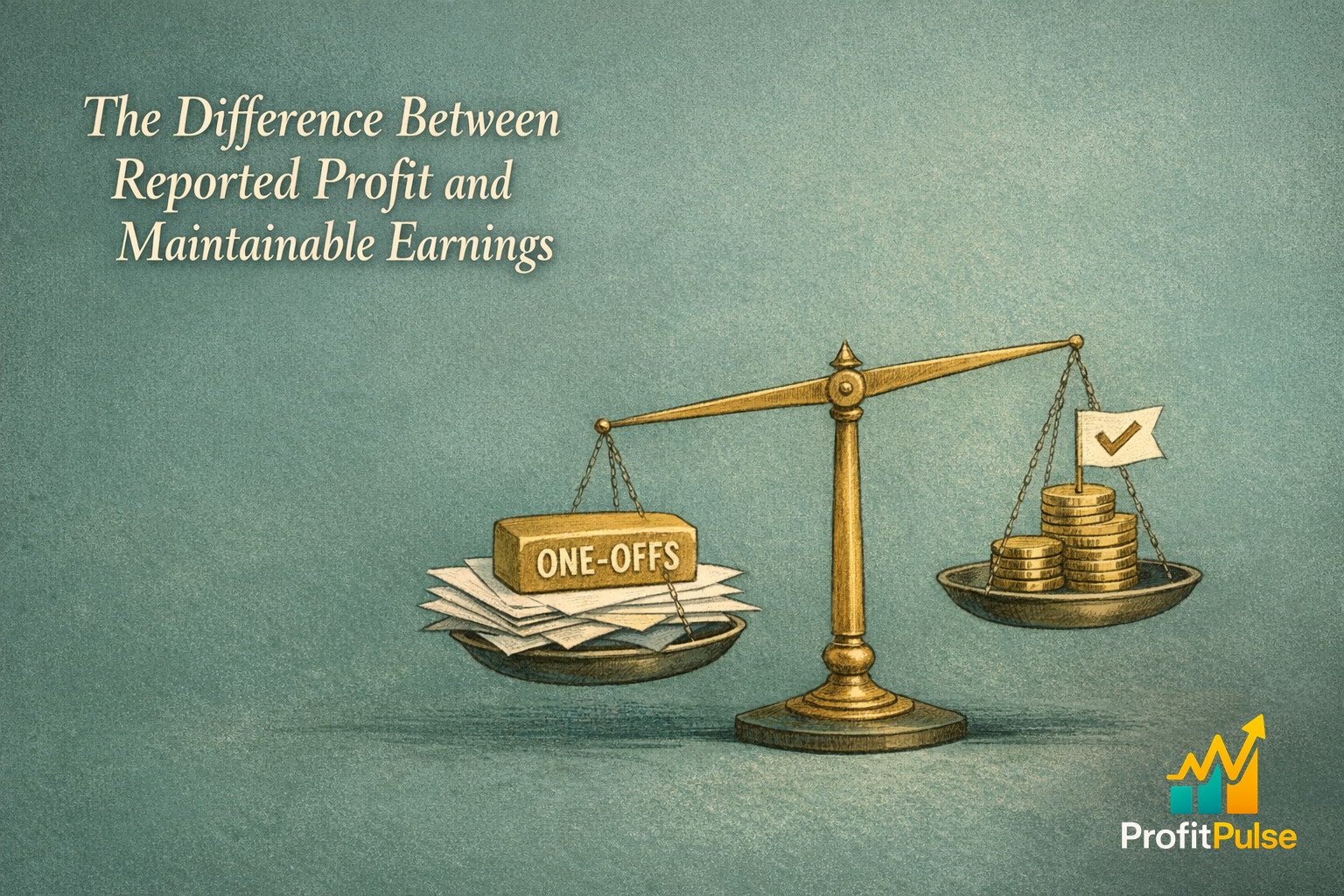
When an owner thinks about what their business is worth, the number that usually comes to mind is last year’s profit multiplied by something. The instinct is sound, but the input is wrong. A buyer does not pay for the profit the P&L reported. They pay for the profit the business can reliably repeat, year after year, once the one-off items and owner-specific arrangements are stripped out. That figure has a name. It is maintainable earnings, and it is the number that actually sets the price.
The gap between reported profit and maintainable earnings is where a lot of valuation surprises live. Sometimes it works in the owner’s favour, when genuine business expenses run through the accounts that a buyer would not carry. Sometimes it works against them, when the reported profit was flattered by something that will not happen again. Either way, the headline figure on the tax return is the start of the conversation, not the end of it.
What gets normalised, and why
A buyer, or a valuer working on the owner’s side, normalises the earnings to find the true underlying profit. One-off items come out first. A bumper year driven by a single large contract that has now ended, an insurance payout, a property sale, a cost that will not repeat, all of these distort the picture. The buyer wants the recurring engine, not the year that happened to include an unusual event.
Then come the owner add-backs. Many owner-led businesses run legitimate expenses through the company that reflect the owner’s circumstances rather than the business’s true cost of operating. An above-market salary, a below-market salary, a vehicle, travel, family on the payroll in roles a buyer would fill differently. Normalising these to a market footing shows what the business would earn under ordinary ownership, which is what a buyer is actually purchasing.
The salary adjustment is the one owners most often get wrong in their own favour, and it deserves care. If you pay yourself little and work in the business full time, a buyer will add back a full market salary for the role you actually perform, which reduces maintainable earnings. If you pay yourself well above market and do relatively little, the excess comes back as an add-back that lifts it. The honest version of this exercise costs the work the business genuinely requires at market rates, regardless of what the current owner happens to draw. A normalisation that quietly assumes the new owner will work for free is the kind a buyer unpicks in the first meeting.
Why this changes the price more than owners expect
Maintainable earnings matter because they get multiplied. If a business sells on, say, four times maintainable earnings, then every dollar of normalisation moves the price by four dollars. A defensible add-back that lifts maintainable earnings by fifty thousand dollars can lift the valuation by two hundred thousand. The reverse is equally true. A one-off item that inflated last year’s profit, if a buyer spots it and you have not, comes off at the same multiple.
This is why the work of identifying and evidencing the normalisations matters so much, and why it should be done before a buyer does it for you. An add-back you can document and defend lands as a legitimate adjustment. The same add-back asserted without evidence in the middle of a negotiation lands as wishful thinking, and tends to get discounted along with the owner’s credibility. Understanding your own business valuation drivers ahead of time is what keeps you in control of that conversation.
The multiple itself is the other half of the equation, and it is not fixed. Two businesses with identical maintainable earnings can be worth quite different amounts, because a buyer pays a higher multiple for earnings that are less risky to inherit. Revenue spread across many customers rather than concentrated in one, a business that runs without the owner in every decision, recurring rather than one-off income, all of these lift the multiple a buyer is willing to apply. So the price is maintainable earnings multiplied by a number that the shape of the business itself influences, which means there are two levers to work on, not one.
Knowing your number before anyone asks
The owners who negotiate well are the ones who already know their maintainable earnings and can walk a buyer through how they got there. They are not surprised by the normalisation process because they ran it on themselves first. That preparation also tends to surface the things worth fixing, the items that depress maintainable earnings today but could be cleaned up well before a sale.
An Indicative Business Valuation does this groundwork. It normalises the earnings, applies recognised methodologies, and names the biggest value drivers and detractors in the business, so the owner sees the real number rather than the headline one. For anyone thinking about a sale in the next few years, knowing maintainable earnings now is also the starting point for lifting it, which is the substance of genuine exit readiness. The earlier you know your number, the more you can do to improve it before it matters.
Frequently asked questions
What are maintainable earnings in a business valuation?
Maintainable earnings are the profit a business can reliably repeat year after year, once one-off items and owner-specific arrangements are normalised out. A buyer does not pay for the profit the P&L reported, they pay for the recurring engine underneath it. That means stripping out unusual events and adjusting owner add-backs to a market footing. The result is what the business would earn under ordinary ownership, which is the figure that actually sets the price.
Why don’t buyers just pay a multiple of last year’s reported profit?
Because last year’s reported profit may include things that will not repeat or expenses specific to the current owner. A bumper year driven by a contract that has ended, or a profit flattered by an insurance payout, does not reflect the recurring earnings a buyer is purchasing. Equally, owner expenses run through the accounts may overstate the true cost of operating. Buyers normalise the figure to find what the business reliably earns, and that becomes the basis for the price.
What are owner add-backs and how do they affect valuation?
Owner add-backs are legitimate expenses run through the company that reflect the owner’s circumstances rather than the business’s true operating cost. An above or below-market salary, a vehicle, travel, or family in roles a buyer would fill differently. Normalising these to a market footing shows what the business would earn under ordinary ownership. Because they are multiplied in a valuation, a defensible add-back can move the price significantly. Understanding your valuation drivers early keeps you in control.
How much can normalising earnings change my business’s price?
More than most owners expect, because maintainable earnings get multiplied. If a business sells on four times maintainable earnings, every dollar of normalisation moves the price by four dollars. A defensible add-back lifting earnings by fifty thousand can lift the valuation by two hundred thousand. The reverse applies too. A one-off item that inflated last year’s profit, if a buyer spots it, comes off at the same multiple. The evidence behind each adjustment is what makes it hold.
Should I work out my maintainable earnings before selling?
Yes, and well before. Owners who negotiate well already know their maintainable earnings and can walk a buyer through how they got there, so they are not surprised when the buyer runs the same process. Doing it first also surfaces the items depressing earnings today that could be cleaned up before a sale. An Indicative Business Valuation does this groundwork and names the biggest value drivers and detractors.
What is the difference between an indicative and a formal valuation?
An indicative valuation gives a clean, defensible estimate using recognised methodologies, suitable for owner planning and understanding your value drivers. A formal valuation is a fuller, compliant report suitable for sale negotiations, shareholder disputes or other situations where the number must stand up to scrutiny. Most owners start with the indicative version to understand their maintainable earnings and what moves them, then commission a formal one when a transaction is genuinely on the table.
How early should I think about exit readiness?
Earlier than feels necessary. Knowing your maintainable earnings now is the starting point for lifting it, and most of the levers take time to work. Cleaning up the items that depress earnings, reducing owner dependence and building repeatable revenue all happen over years, not weeks. The owners who sell well started preparing long before the sale. Treating exit readiness as ongoing work rather than a pre-sale scramble is what protects the final price.
Leave a Reply