
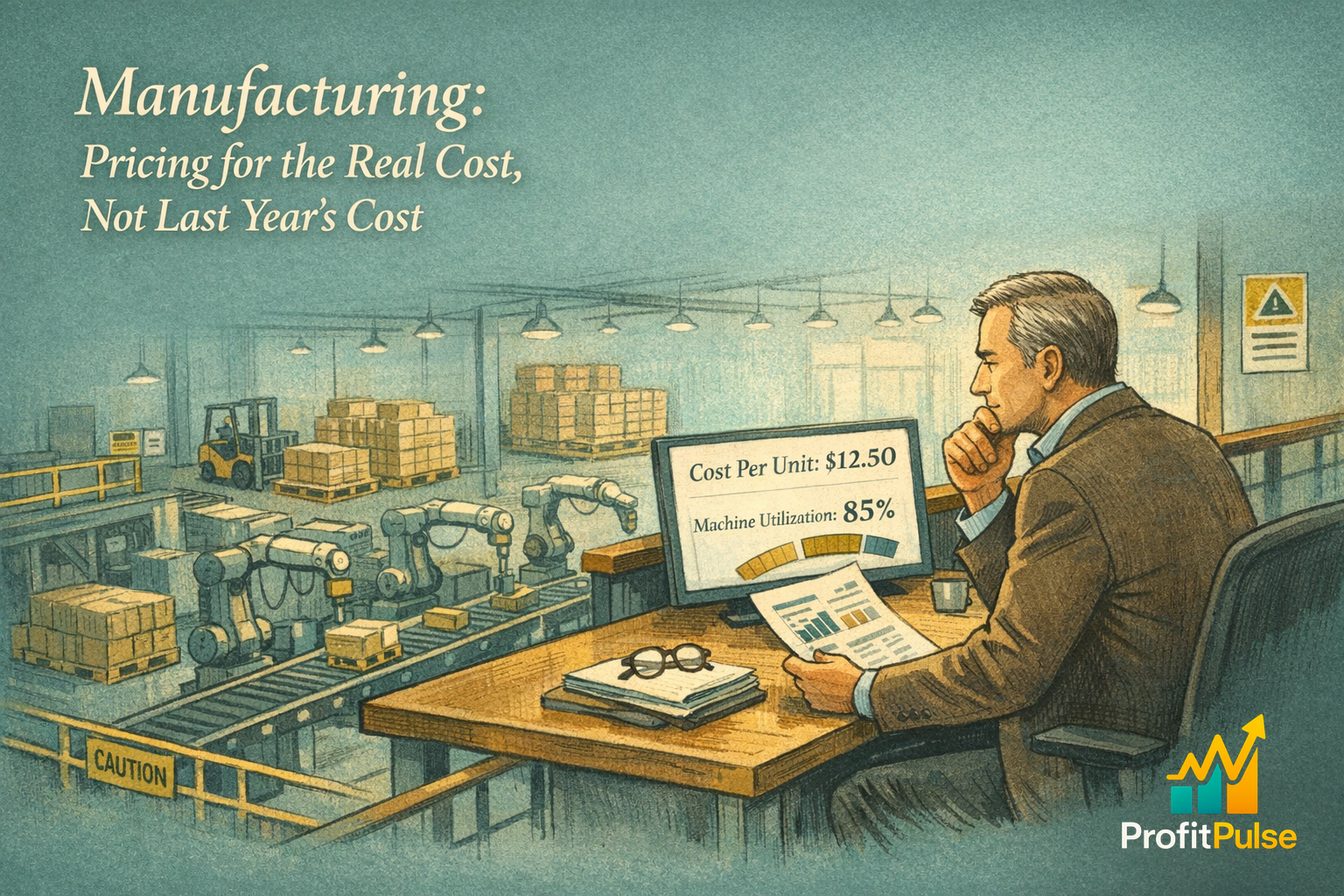
A manufacturer’s price list is one of the most expensive documents in the business to leave alone. Prices set against last year’s input costs keep selling at last year’s economics, even after materials, energy and freight have all moved underneath them. The product ships, the customer is happy, the order books look full, and the margin on each unit is quietly thinner than the spreadsheet still believes.
This is not about a single price rise. It is about a simple question. Do your prices reflect what it costs to make the product today, or what it cost to make it the last time anyone rebuilt the costing? For many Queensland producers, those two numbers have drifted apart, and the drift compounds order by order until a profitable-looking job barely covers its own contribution margin.
The trouble with standard costing that has aged
Most manufacturers price off a standard cost, a built-up figure for materials, labour and overhead recovery per unit. Standard costing is a sound discipline. The risk is that the standard ages. Material prices update, energy contracts reset, freight moves, and unless the standard is rebuilt to match, the price that sits on top of it is anchored to a cost that no longer exists.
Input cost inflation does not announce itself evenly. A resin or steel input might jump while packaging holds steady. Energy might step up at the next contract while labour drifts. Because the changes are uneven, a flat price increase across the whole range tends to overcharge on the stable lines and still undercharge on the ones that moved most. Rebuilding from current cost is what tells you where the real pressure sits.
Labour is the line that ages most quietly of all. A standard built on last year’s hourly rates and last year’s run speeds keeps assuming a unit takes the time and the wage it used to. But award movements, the cost of holding skilled people, and a product mix that has shifted towards more labour-intensive lines all change the real labour content per unit. A standard that has not absorbed those changes will keep blessing prices that the floor can no longer deliver at, and the gap shows up as a busy plant that somehow does not convert its activity into profit.
Overhead recovery is where margin hides
The other half of the picture is overhead recovery. Standard costs spread fixed overhead across expected volume. If volume shifts, or if the overhead base itself has grown, the recovery rate baked into your prices may be recovering less than it should. A unit that looks profitable on direct cost can be underwater once it carries its fair share of an overhead base that has quietly expanded.
The trap deepens when volume falls. The same overhead spread across fewer units means each unit has to carry more, so the recovery rate that was correct at last year’s volume is now under-recovering at this year’s. A producer can hold its prices steady, lose no customers, and still watch margin erode purely because the factory is running below the volume the standard assumed. Reading recovery against actual rather than budgeted volume is what surfaces this before it shows up in a disappointing year-end result.
Setting a price floor, the level below which an order does not earn its keep, depends entirely on getting these numbers current. Without a true price floor built from today’s input cost and today’s overhead recovery, it is impossible to know which orders are genuinely profitable and which are being subsidised by the others. Plenty of full order books are quietly carrying loss-making lines that the owner would never knowingly accept.
Rebuilding prices from current cost
The practical work is to rebuild the costing from the ground up using current input prices, then test the existing price list against it line by line. The result is rarely a uniform rise. It is a map of where margin has eroded most, which products can absorb a correction without losing the customer, and which lines should be repriced, reworked or retired.
A Pricing Reset does exactly this for a manufacturer. It rebuilds the cost base, reads customer profitability and price tolerance, and recommends a defensible change grounded in the real economics rather than a flat percentage. The aim is a price list that reflects what production actually costs now, so that a full factory translates into a full bank account rather than just a busy one.
The end of the third quarter is a sensible point to check that your prices have kept pace with your costs this financial year, before the input picture moves again. Building this rebuild into a regular rhythm is the kind of margin discipline that keeps a producer ahead of its input curve rather than chasing it. ProfitPulse works with Queensland manufacturers on exactly this rebuild, and our wider insights library covers the thinking that sits behind durable pricing.
Frequently asked questions
How do I know if my manufacturing prices have fallen behind my costs?
Rebuild your standard cost using current input prices, then test your existing price list against it line by line. If the rebuilt cost is materially higher than the cost your prices were set against, your margin has eroded. The drift is usually uneven because materials, energy and freight move at different times. That unevenness is the clue. A profitable-looking product can barely cover its contribution margin once the costing is brought up to date.
Why is a flat percentage price increase a problem for manufacturers?
Because input cost inflation is uneven. One material might jump while packaging holds steady, energy might step up while labour drifts. A flat increase across the whole range overcharges on the lines that stayed stable and still undercharges on the ones that moved most. The result keeps some customers paying more than the change justifies while leaving the genuinely eroded lines underwater. Rebuilding from current cost shows where the real pressure sits.
What is overhead recovery and how does it affect pricing?
Overhead recovery is how your fixed costs are spread across expected production volume and built into each unit’s price. If volume shifts or the overhead base grows, the recovery rate baked into your prices may be recovering less than it should. A unit that looks profitable on direct cost alone can be underwater once it carries its fair share of an expanded overhead base. Getting recovery current is essential to setting a true price floor.
What is a price floor and why does a manufacturer need one?
A price floor is the level below which an order does not earn its keep, built from today’s input cost and today’s overhead recovery. Without one, it is impossible to know which orders are genuinely profitable and which are being subsidised by the others. Plenty of full order books quietly carry loss-making lines the owner would never knowingly accept. A current price floor turns that invisible problem into a clear decision on each order.
Can a Queensland manufacturer raise prices without losing customers?
Usually yes, when the change is built on real economics rather than a flat figure. The work is to read customer profitability and price tolerance alongside the rebuilt cost, then correct prices where they have eroded most and where the relationship can absorb it. Some lines can take a correction without the customer flinching, others need reworking or retiring. ProfitPulse works with Queensland manufacturers on exactly this kind of defensible reset.
How often should a producer rebuild its standard costing?
At least annually, and sooner when a major input moves sharply. Standard costing is a sound discipline, but its value depends on the standard staying current. Material prices update, energy contracts reset and freight shifts, and a standard that has not been rebuilt anchors your prices to a cost that no longer exists. Checking it at the close of the third quarter, before the input picture moves again, is a sensible rhythm, and a structured pricing review can carry the rebuild for you.
Leave a Reply