
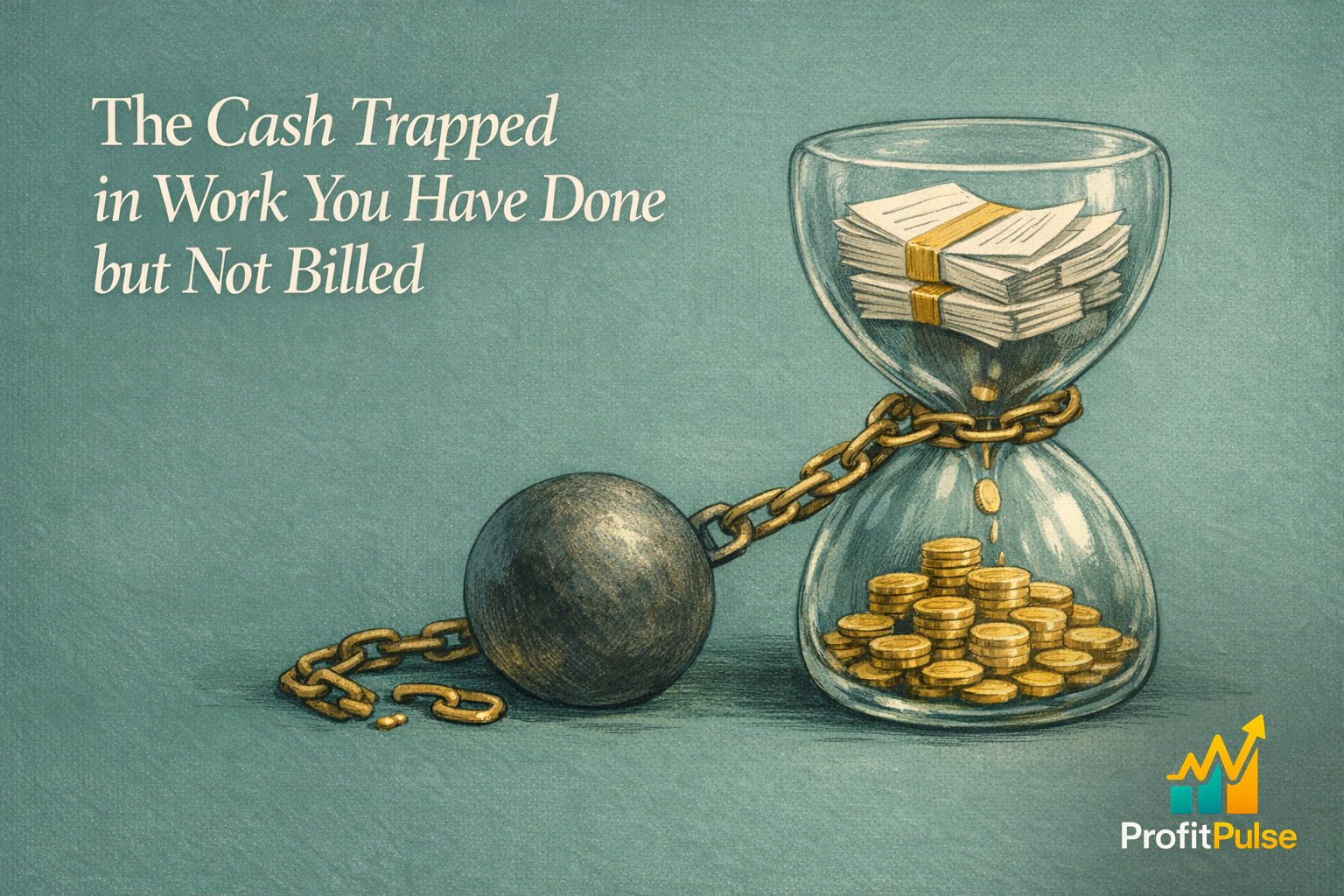
Ask most owners where their cash is and they will point to the bank account, the debtors, maybe the stockroom. Few will point to the work that has been done but not yet billed, and that is precisely where a large amount of cash quietly sits. Every hour worked, every job part-completed, every project that is delivered but not invoiced represents money the business has already spent and not yet recovered.
Work in progress is real cash. The wages were paid, the materials were bought, the time was spent. The only thing missing is the invoice. Until that invoice goes out and gets paid, the business is funding the gap from its own pocket, and the wider that gap, the more cash the business needs simply to keep running at the same size.
The silent drain nobody measures
What makes unbilled work dangerous is that it never appears as a problem. There is no overdue invoice flashing red, no supplier chasing payment. The work is going well. The team is busy. And yet the bank balance does not reflect the activity, because the activity has not been converted to cash. Owners feel this as a vague tightness that does not match how busy they are.
The gap between doing work and billing for it is often longer than anyone intends. A job finishes but the invoice waits for the admin run at month end. A project hits a milestone but nobody raises the claim until the next review. A variation gets agreed verbally and billed weeks later, if at all. Each delay is a few days of cash, and across a year they add up to a permanent slice of the business’s working capital locked in limbo.
It helps to put a rough number on it, because the abstraction is part of why the problem persists. Take the average value of work sitting unbilled at any moment and you have the amount the business is funding on the work in progress line alone, before a single debtor is counted. For many service and project businesses that figure is larger than the overdraft, and it is sitting there earning nothing while the owner worries about the very facility that the trapped cash could have made unnecessary. Naming the number is usually the moment the billing cycle stops feeling like admin and starts feeling like cash management.
Shortening the gap between work and payment
The cash is recovered by attacking the gap at both ends. Bill sooner and bill more often. A business that invoices weekly instead of monthly halves the average wait before work becomes cash, without changing a single thing about how it trades. Progress claims raised the day a milestone is hit, rather than at the next admin cycle, pull cash forward by weeks.
The same discipline applies to variations and extra work. The longer a variation sits unbilled, the more likely it is to be forgotten, disputed or quietly absorbed. Billing it promptly, while the work is fresh and the client remembers agreeing to it, protects both the cash and the margin. None of this requires charging more. It requires charging faster.
The structural fix sits alongside the behavioural one. The terms you set govern how soon work can even be billed. Stage-based billing on longer jobs, deposits on work that ties up materials, and milestone claims written into the engagement from the start all move cash forward without a single difficult conversation, because the client agreed to the rhythm when they agreed to the work. A business that bills weekly but only after a job is fully complete is still carrying weeks of work in progress that better-structured terms would have released.
This is the heart of a Working Capital Unlock, which maps the cash trapped in work in progress, debtors and the billing process, then sets out a prioritised list of moves to release it. The work in progress line is often where the largest single release sits, precisely because it is the one nobody was watching. Releasing it does not cost the business anything. It simply collects sooner what the business has already earned.
Why this matters more as you grow
The faster a business grows, the more cash gets trapped in unbilled work, because every new job adds to the pile before any of it converts. Growth that outruns billing is a classic reason a profitable business runs short of cash. The profit is real, but it is sitting in work in progress rather than in the account, and the business has to fund the difference.
Tightening the billing cycle is one of the cleanest sources of cash a business has, because the money is already yours. You are not borrowing it or chasing new sales for it. You are simply closing the gap between earning and collecting. That is the foundation of genuine cash flow discipline, and it is usually the first place we look when an owner says they are busy but the cash never quite arrives.
If your team is delivering well but the bank balance does not reflect it, the gap is worth measuring before anything else. ProfitPulse helps owners find and release the cash sitting in unbilled work, and our broader insights library covers the wider working capital picture it sits within.
Frequently asked questions
What is work in progress and why is it cash?
Work in progress is work you have done but not yet billed. The wages were paid, the materials were bought, the time was spent, and the only thing missing is the invoice. Until that invoice goes out and gets paid, the business is funding the gap from its own pocket. So work in progress is real cash, already spent and not yet recovered. The wider the gap, the more cash the business needs just to keep running.
Why does my business feel tight on cash when we are busy?
Often because the activity has not converted to cash yet. Busy means work is being done, but if billing lags behind delivery, that work sits in work in progress rather than in the bank. Owners feel this as a tightness that does not match how busy they are. The fix is usually not more sales but faster billing. A Working Capital Unlock maps exactly where the cash is trapped and how to release it.
How can I release cash trapped in unbilled work?
Attack the gap at both ends. Bill sooner and bill more often. A business that invoices weekly rather than monthly halves the average wait before work becomes cash, without changing how it trades. Raise progress claims the day a milestone is hit, not at the next admin run. Bill variations promptly while the work is fresh. None of this charges the client more, it simply collects sooner what you have already earned.
Why does growth make the cash problem worse?
Because every new job adds to the pile of unbilled work before any of it converts to cash. Fast growth means more work in progress at any given moment, so the faster you grow, the more cash gets trapped. This is a classic reason a profitable business runs short of cash. The profit is real, but it sits in work in progress rather than the account, and the business has to fund the difference. Tightening billing is the cleanest response.
Is invoicing weekly really better than monthly for cash flow?
For most service and project businesses, yes. Monthly billing means work done in the first week of a month waits up to five or six weeks before the invoice even goes out, then waits again for payment terms. Weekly billing halves the average delay before work becomes cash. It is one of the simplest changes an owner can make, and building it into a regular rhythm is core cash flow discipline.
What happens to variations that get billed late?
They tend to be forgotten, disputed or quietly absorbed. The longer a variation sits unbilled, the harder it is to recover, because the client’s memory of agreeing to it fades and the connection to the work weakens. Billing variations promptly, while the work is fresh and the agreement is recent, protects both the cash and the margin. Late billing on extra work is one of the quietest ways margin leaks out of a busy business.
Leave a Reply