
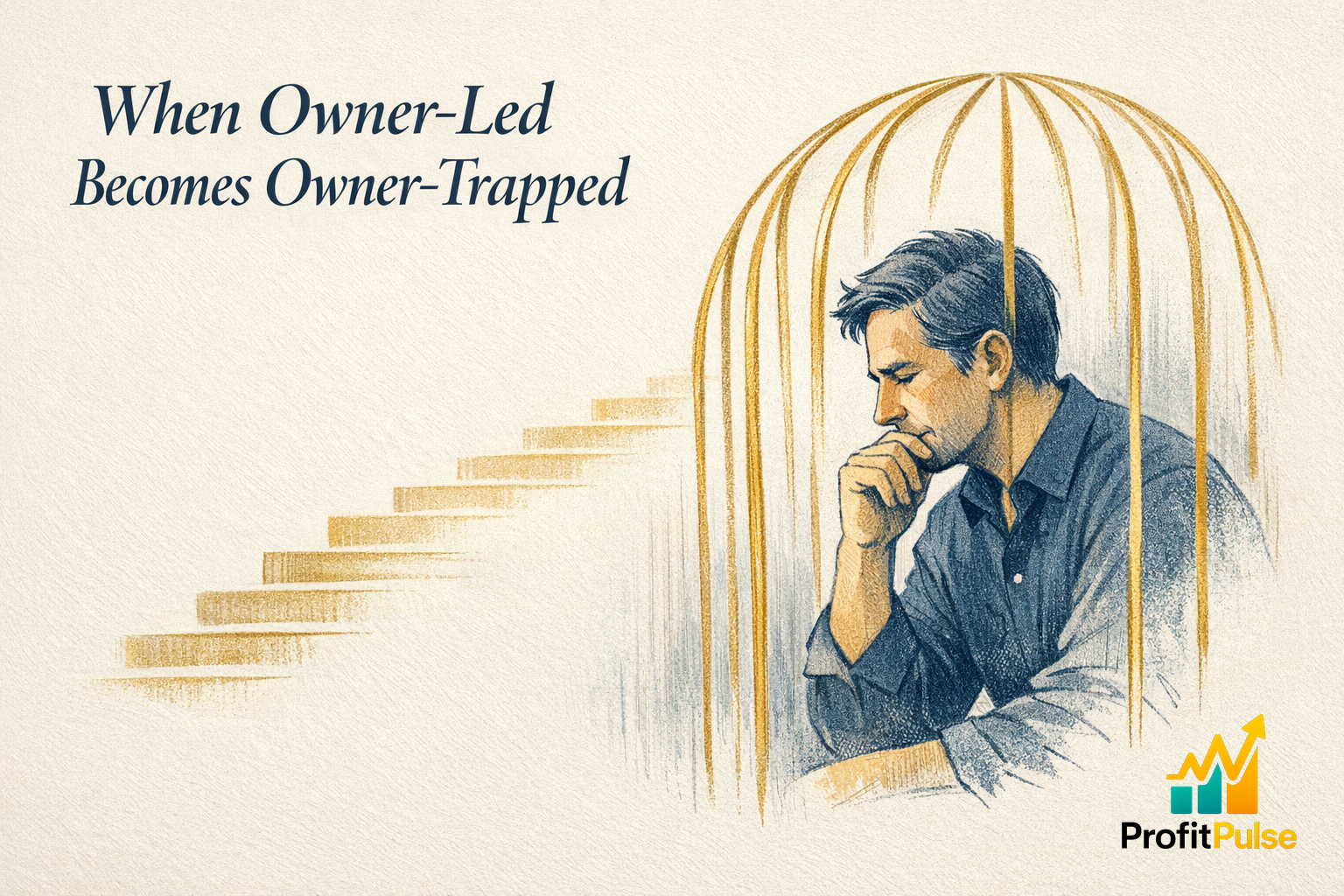
There is a moment in the life of a growing business where being owner-led starts to feel less like an advantage and more like a trap. In the early days, the owner makes every financial call because they should, because nobody knows the business better and the decisions are simple enough to hold in one head. Then the business grows, the decisions multiply, and the same instinct that built the business begins to consume the person who built it.
The trap is subtle because it is built from good habits. The owner who checks the numbers, signs off the pricing, manages the bank relationship and watches the cash did all the right things to get here. The problem is that the business has outgrown the bandwidth of a single person doing all of it, and the owner is now the bottleneck on the very decisions that matter most.
The signs of owner-trapped
You can usually feel it before you can name it. The financial decisions pile up and get made late, or get made fast because there was no time to think. The owner is across everything and on top of nothing. Strategic questions, the ones about where to invest, how to fund the next stage, whether the margins support the growth, keep getting pushed aside by the operational ones that shout louder.
What makes this hard is that the owner cannot simply hand it off. The financial decisions of a growing business require judgement and context that a junior hire does not have. So the owner keeps doing them, not out of control issues but out of necessity, and the deeper the business grows the deeper they get pulled in. Being owner-led quietly becomes being owner-trapped.
There is a cost to this that rarely appears in any account. It is the decisions that never get made at all. The pricing review that has been needed for six months but keeps slipping. The underperforming product line nobody has had time to confront. The funding conversation that would open the next stage of growth but never reaches the top of the list. These are not small omissions. They are the highest-value work in the business, and they are precisely the work that loses every contest with the operational urgency of the day. An owner-trapped business is not failing on the decisions it makes. It is quietly paying for the ones it never gets to.
Senior support is how you scale judgement, not surrender it
The way out is not to remove the owner from the financial conversation. It is to add a senior financial partner who can carry the weight alongside them. A Fractional CFO Partnership puts an experienced finance person at the table on a recurring basis, someone who can own the model, run the numbers, prepare the decisions and bring the owner a clear recommendation rather than a blank page.
This is the distinction that matters. A fractional CFO does not replace the owner’s judgement. They scale it. The owner stays the decision-maker on every call that shapes the business, but arrives at each decision having had the analysis done, the options framed and the implications worked through. The owner steps back from doing the financial work without stepping back from controlling its direction. If the role itself is unfamiliar, the guide to what a fractional CFO does is a good place to understand the shape of it.
It is worth being clear about the boundary with the compliance side too, because the two are often confused. Your bookkeeper and accountant keep the records accurate and the lodgements clean, which is exactly their function and the foundation everything else rests on. A fractional CFO works on the layer above that, taking the accurate numbers and turning them into the forward decisions about pricing, funding, investment and growth. One keeps the business legitimate. The other helps the owner decide where it goes next. Adding the second has nothing to do with any shortcoming in the first.
Why fractional fits the owner-led business
A business in this position rarely needs, or can justify, a full-time chief financial officer on an executive salary. What it needs is senior judgement at the right cadence, monthly for some, weekly when a raise or a board cycle demands it. Fractional support meets the business where it is, giving it the seniority of a CFO without the fixed cost of one, and scaling the involvement up or down as the business moves through its stages. Owners who want to understand the economics can look at the cost of fractional support directly.
The deeper value is what it returns to the owner. Time to work on the business rather than only in it. Confidence that the financial decisions are being made with proper analysis rather than in the gaps between everything else. And the room to be the owner the business needs at this size, which is rarely the same as the one who did everything at the start. If the financial decisions have started to outpace your time, that gap is exactly what a fractional partnership is built to close.
Frequently asked questions
What does owner-trapped mean for a growing business?
Owner-trapped is when growth pulls the owner so deep into financial decisions that they become the bottleneck on the very things that matter most. In the early days the owner makes every call because they should. As the business grows, the decisions multiply, and the same instinct that built the business starts to consume the person who built it. The owner ends up across everything and on top of nothing, with strategic questions losing to operational ones.
How is a fractional CFO different from hiring a full-time one?
A fractional CFO gives a growing business senior financial judgement at the right cadence without the fixed cost of a full-time executive. Most owner-led businesses cannot yet justify a full-time CFO salary, but they do need the seniority. Fractional support meets the business where it is, monthly for some and weekly when a raise or board cycle demands it, scaling up or down as the business moves through its stages. The guide to what a fractional CFO does explains the role.
Will a fractional CFO take financial decisions away from me?
No. A fractional CFO scales your judgement rather than replacing it. You stay the decision-maker on every call that shapes the business, but you arrive at each decision having had the analysis done, the options framed and the implications worked through. They own the model and prepare the decisions, then bring you a clear recommendation rather than a blank page. You step back from doing the financial work without stepping back from controlling its direction.
What are the signs I need senior finance support?
You can usually feel it before you can name it. Financial decisions pile up and get made late, or get made fast because there was no time to think. Strategic questions about where to invest or how to fund the next stage keep losing to operational ones that shout louder. You are across everything and on top of nothing. When the financial decisions consistently outpace your time, that gap is what a fractional partnership is built to close.
Why can’t I just hire a junior to handle the financial decisions?
Because the financial decisions of a growing business require judgement and context that a junior hire does not yet have. Handing them down without that seniority means the decisions either come back to you or get made without the necessary depth. This is why so many owners stay trapped, doing the work themselves out of necessity rather than choice. Senior support carries the weight alongside you, which a junior role cannot, while still leaving you in control of direction.
How much does fractional CFO support cost an Australian SME?
It depends on the cadence and scope the business needs, from a monthly management rhythm through to weekly involvement during a raise or board cycle. The point of the fractional model is that you pay for senior judgement at the level the business actually requires, rather than carrying a full-time executive salary before you need one. Owners who want to understand the economics can look at the cost of fractional support directly to see how the tiers work.
Leave a Reply