
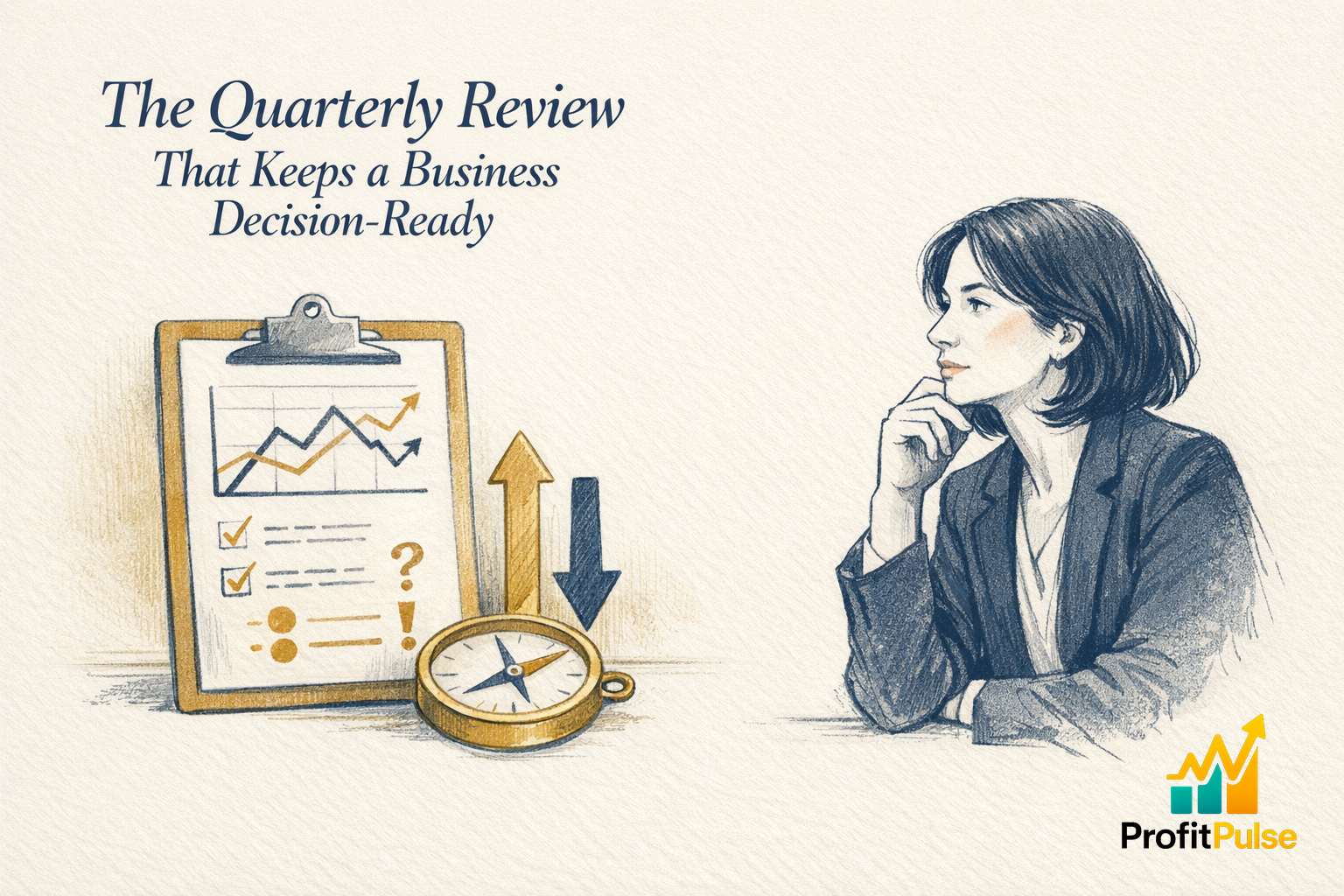
Most owner-led businesses do not lack a plan. They lack a rhythm for checking the plan against reality often enough to do anything about it. The plan gets written, usually with energy, in the first weeks of the financial year. Then the year happens, the plan sits in a folder, and by the time anyone looks again the gap between intention and result is too wide to steer back.
The fix is not a better plan. It is a quarterly review held with enough discipline that it actually changes what the business does next. As the final quarter of the financial year opens, this is a good moment to look at why that ninety-day rhythm matters more than the document it reviews.
Variance is where the real information lives
A plan tells you what you expected. The quarter that just finished tells you what actually happened. The space between the two, the variance, is the most useful information a business produces, and most of it goes unread. Revenue came in under plan, but why? Margin held but cash tightened, so where did it go? A line of cost crept up quietly across three months and nobody flagged it because no one was comparing.
Reviewing variance properly is not about assigning blame for a miss. It is about understanding the gap well enough to respond. Sometimes the plan was wrong and needs adjusting. Sometimes the execution drifted and needs correcting. Sometimes something changed in the market and the whole approach needs rethinking. You cannot tell which without sitting down every ninety days and reading the difference honestly.
There is a craft to reading variance that separates a useful review from a number-checking exercise. A variance is only meaningful once you know whether it is a timing difference, a permanent shift or a one-off. Revenue under plan because a large order slipped into next quarter is a different problem from revenue under plan because demand has softened, even though both show the same red figure. The work is in asking, for each material gap, whether it will reverse on its own, whether it signals a trend, or whether it was a single event unlikely to repeat. That distinction is what turns variance from a report into a decision.
A practical way to keep that honest is to write a one-line explanation against each material variance before the meeting ends, not after. The act of putting the reason into words exposes the gaps in understanding that a number on its own conceals. A line that reads that revenue is down because a large order slipped into the following month can be acted on; a line that simply says revenue is down and will recover usually means nobody yet knows why. Forcing the explanation onto the page, in plain language, is what separates a review that genuinely informs the next quarter from one that notes the result and moves on.
Three risks and three opportunities, looking forward
A good quarterly review does not only look backward. The more valuable half is forward-looking: naming the three risks most likely to hurt the business in the next quarter and the three opportunities most worth pursuing. This is deceptively simple and quietly powerful, because it forces a small number of clear priorities out of the noise.
When a business names its top three risks each quarter, the ones that would otherwise become a crisis get attention while they are still small. When it names its top three opportunities, the ones that would otherwise be missed in the busyness get resourced. That short, repeated discipline is what keeps a business decision-ready, able to move when something appears rather than reacting once it is already a problem. A structured fractional CFO partnership often brings exactly this cadence to a business that has the ambition but not yet the rhythm.
The discipline of holding to three on each side is part of what makes it work. A list of fifteen risks is just anxiety written down; nobody acts on it. Forcing the choice to three means ranking, and ranking means deciding what actually matters most in the next ninety days rather than cataloguing everything that could conceivably go wrong. The same applies to opportunities. Three that get genuine attention and resourcing will move the business further than a dozen that get a mention and no follow-through. The constraint is the point, because it converts a vague awareness into a short list someone owns.
The habit that separates planning from wishing
A plan you write once and review at year end is closer to a wish than a strategy. A plan you check against reality every ninety days, adjust where needed, and use to set the next quarter’s priorities is a steering instrument. The difference between the two businesses is not intelligence or ambition. It is the presence or absence of a rhythm.
This is the logic behind a Financial Health Check held quarterly: a structured review against the plan, variance analysis, three forward risks and three opportunities, every ninety days, so the business stays steerable instead of drifting. It does not need to be elaborate to work. It needs to be consistent. For owners who feel the year tends to get away from them, the quarterly review is usually the smallest change that makes the largest difference, and there is more on building that kind of financial rhythm across our insights library.
Frequently asked questions
What should a quarterly business review actually cover?
Two things. First, variance: how the quarter just finished compared to the plan, and crucially why, so you understand whether the plan was wrong, execution drifted or the market changed. Second, a forward view: the three risks most likely to hurt the business next quarter and the three opportunities most worth pursuing. Together they turn the review from a backward-looking report into a steering instrument that changes what the business does next.
How often should a small business review its financial plan?
Every ninety days is the rhythm that works for most owner-led businesses. Annual reviews leave the gap between intention and result too wide to steer back, while monthly reviews can get lost in noise. A quarterly cadence is frequent enough to catch a drift while it is still small and infrequent enough to see a genuine trend. The discipline matters more than the elaborateness; consistency is what makes it work.
Why is variance analysis important for business decisions?
Because the gap between what you planned and what happened is the most useful information a business produces, and most of it goes unread. Variance tells you whether revenue softness was a market shift or an execution issue, where cash went when margin held, and which costs crept up unnoticed. Reading it honestly every quarter lets you respond while there is still time, rather than discovering the problem at year end.
What is a quarterly financial health check for a business?
It is a structured ninety-day review against the business plan, combining variance analysis with three forward-looking risks and three opportunities, so the business stays decision-ready. It keeps the plan alive as a steering instrument rather than a document that gets written once and filed. You can read more about how this cadence works in our guide to what a fractional CFO does and the rhythm they bring.
How does a fractional CFO keep a business decision-ready?
Largely by installing and holding a rhythm the business would otherwise let slip. A fractional CFO partnership brings the quarterly review discipline, the variance reading and the forward risk and opportunity scan to businesses that have the ambition but not yet the cadence. The value is less in any single insight and more in the consistency, which is what keeps the business steerable rather than reactive across the year.
What is the difference between a business plan and a steering instrument?
A plan written once and reviewed at year end is closer to a wish than a strategy. A plan checked against reality every ninety days, adjusted where needed and used to set the next quarter’s priorities becomes a steering instrument. The difference between the two businesses is rarely intelligence or ambition; it is the presence of a rhythm. The quarterly review is the smallest change that usually makes the largest difference.
Leave a Reply