
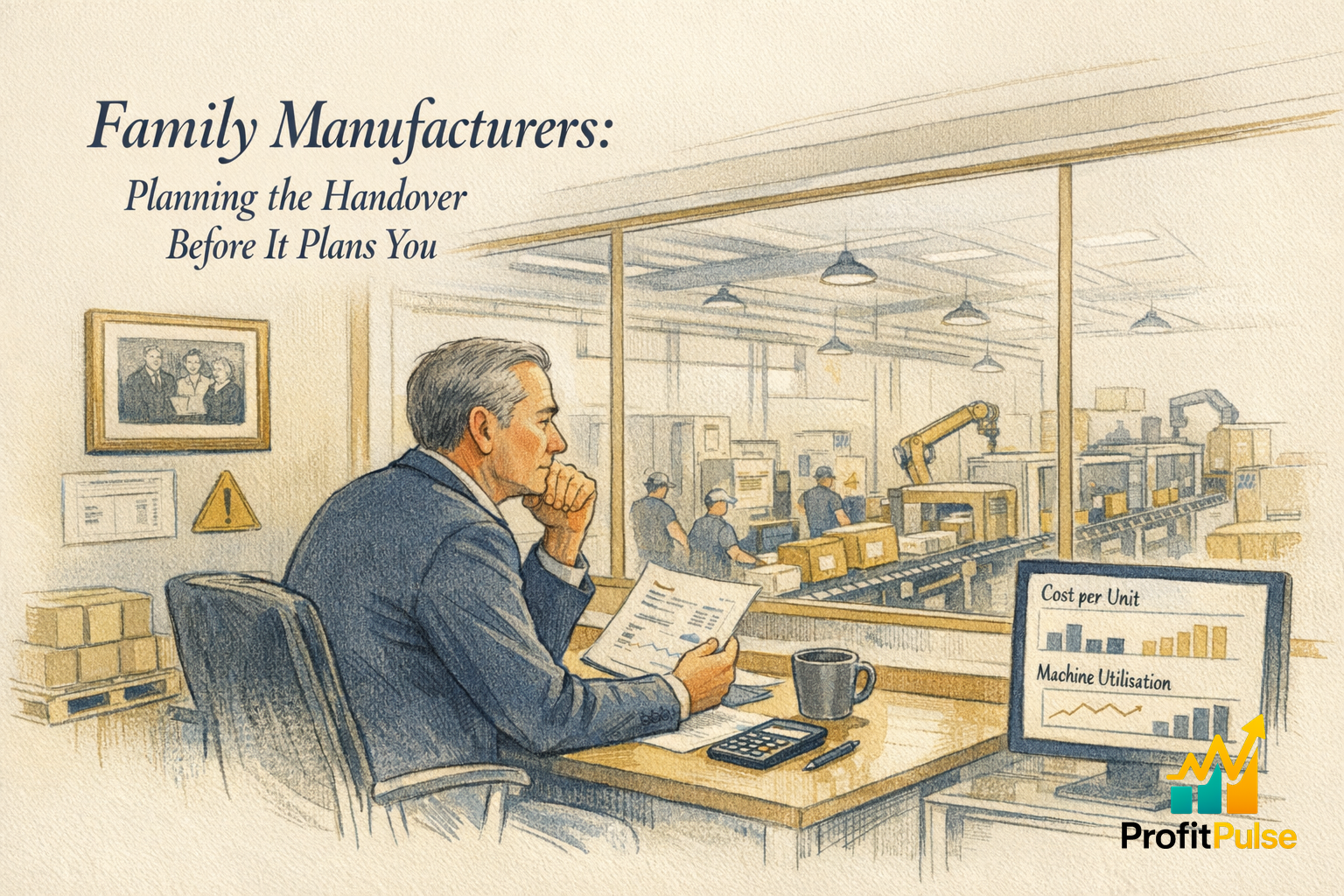
On the International Day of Families, it is worth looking honestly at something many family-owned manufacturers carry without naming it. The business runs beautifully because a particular person, often the founder or a long-serving family member, holds the whole operation in their head. The supplier relationships, the production quirks, the pricing logic, the customer history. It works, and it has worked for decades. That is exactly the problem.
A business that depends on one person knowing how everything runs is a business with a quiet ceiling on its value. The day a buyer, a lender or the next generation looks closely, the question is not how good the business is. It is how much of it walks out the door when that person does. For family manufacturers, that question tends to arrive just as EOFY conversations turn toward the future.
Owner dependence is the value cap nobody mentions
Key-person risk is one of the most common detractors on business value, and family manufacturers carry more of it than most. The knowledge that makes the business run is real and hard-won, but if it lives only in one person’s experience, a buyer treats it as a risk to be discounted rather than an asset to be paid for. The same applies to a lender assessing the business and to a son or daughter being asked to take it on.
The pattern is not a criticism of the person at the centre. It is simply what happens when a business grows around an individual’s judgement over many years. Overhead recovery, supplier terms, the reasoning behind a long-standing pricing decision, all of it can be sound and still be invisible to anyone but the person who built it. Making that knowledge visible is where value protection begins. A buyer is not paying for how well the business runs today. They are paying for the confidence that it will keep running once the founder steps back, and that confidence only exists where the knowledge has been made to transfer.
Start documenting before the conversation is urgent
The work of reducing owner dependence is not dramatic, and it does not happen in a single push. It is the steady documenting of how the business actually runs, so the next generation or a future buyer inherits a system rather than a set of stories. Which suppliers matter and why, how production decisions get made, where the margin actually sits, what the pricing logic is built on. Written down, this knowledge becomes transferable, and transferable knowledge is what a buyer or a successor can rely on.
An Exit Readiness Diagnostic is a natural starting point here, because it scores the business across the dimensions a buyer cares about, with owner dependence among the most important for a family operation. Seeing where the risk actually sits, rather than assuming it is everywhere or nowhere, lets a family direct its effort to the places that move value most. Often the dependence is concentrated in two or three areas rather than spread evenly, and naming them turns a vague worry about succession into a short, practical list of things to write down and hand over.
The documenting does not have to be a formal project, and it rarely lands well when it is treated as one. It works best as a steady habit, capturing how a decision was made while the decision is being made. Why this supplier over that one, how a quote gets priced, what to watch when a production run goes wrong. Written down as they happen, these become the operating knowledge a successor leans on rather than the questions they are left guessing at. The founder is usually surprised how much of it has never been said aloud, simply because it never needed to be. Naming it is not a sign the business is winding down. It is what gives the next person a fair chance of running it as well as it has been run, and it is the quiet difference between a business that keeps its full value through a handover and one that loses a slice of it the moment the founder steps back.
The handover that is planned beats the one that is forced
Succession planning in family manufacturing tends to happen in one of two ways. Either it is planned deliberately over years, with knowledge transferred and the next generation prepared, or it is forced suddenly by a health event, a falling-out or an unexpected offer. The planned version protects both the value and the family. The forced version too often does damage to both.
Starting now, before EOFY conversations turn toward the future, means the handover is something the family shapes rather than something that shapes the family. The groundwork sits within genuine exit readiness, and family manufacturers across Queensland who begin early consistently find they have more options and more value than those who wait for the conversation to become urgent. ProfitPulse works with family-owned businesses to reduce key-person risk while there is still time to do it well.
Frequently asked questions
Why does succession risk lower the value of a family business?
Because a buyer or lender treats knowledge that lives in one person’s head as a risk to be discounted, not an asset to be paid for. When the supplier relationships, pricing logic and production know-how walk out the door with the founder, the business is worth less to anyone inheriting it. Owner dependence is one of the most common detractors on value. Reducing it is central to genuine exit readiness for a family operation.
How can a family manufacturer reduce key-person risk before a handover?
By steadily documenting how the business actually runs, so a successor inherits a system rather than a set of stories. Which suppliers matter and why, how production decisions get made, where the margin sits, what the pricing logic rests on. Written down, that knowledge becomes transferable, which is exactly what a buyer or the next generation can rely on. An Exit Readiness Diagnostic shows where the dependence actually sits so effort goes where it counts.
When should a family business start succession planning?
Years before it becomes urgent. Succession in family manufacturing tends to happen one of two ways: planned deliberately over time, or forced suddenly by a health event, a falling-out or an unexpected offer. The planned version protects both the value and the family. Starting now, before EOFY conversations turn toward the future, means the handover is something the family shapes rather than something that shapes the family on someone else’s timing.
What is owner dependence and why does it matter for value?
Owner dependence is the degree to which a business relies on one person’s knowledge and judgement to run. It matters because a buyer pays for what transfers, not for what stays in the founder’s head. A highly dependent business carries a quiet ceiling on its value, regardless of how well it performs. Making the founder’s knowledge visible and transferable is one of the surest ways a family manufacturer can lift the price a future buyer will pay.
How can a Queensland family manufacturer prepare for a handover?
Begin documenting the business while the founder is still actively running it, so knowledge transfers calmly rather than under pressure. Score the operation against the dimensions a buyer cares about, with owner dependence high among them, to see where the real risk sits. Family manufacturers across Queensland who start early consistently find they have more options and more value than those who wait for the succession conversation to become urgent.
Is documenting how the business runs really worth the effort?
Yes, because transferable knowledge is what a buyer or successor can rely on, and reliance is what they pay for. The supplier reasoning, the margin logic and the production decisions that live in one person’s experience are sound but invisible until written down. Once documented, they shift from a discount in a buyer’s mind to an asset on the table. The effort is modest against the value it protects and the smoother handover it allows.
Leave a Reply