
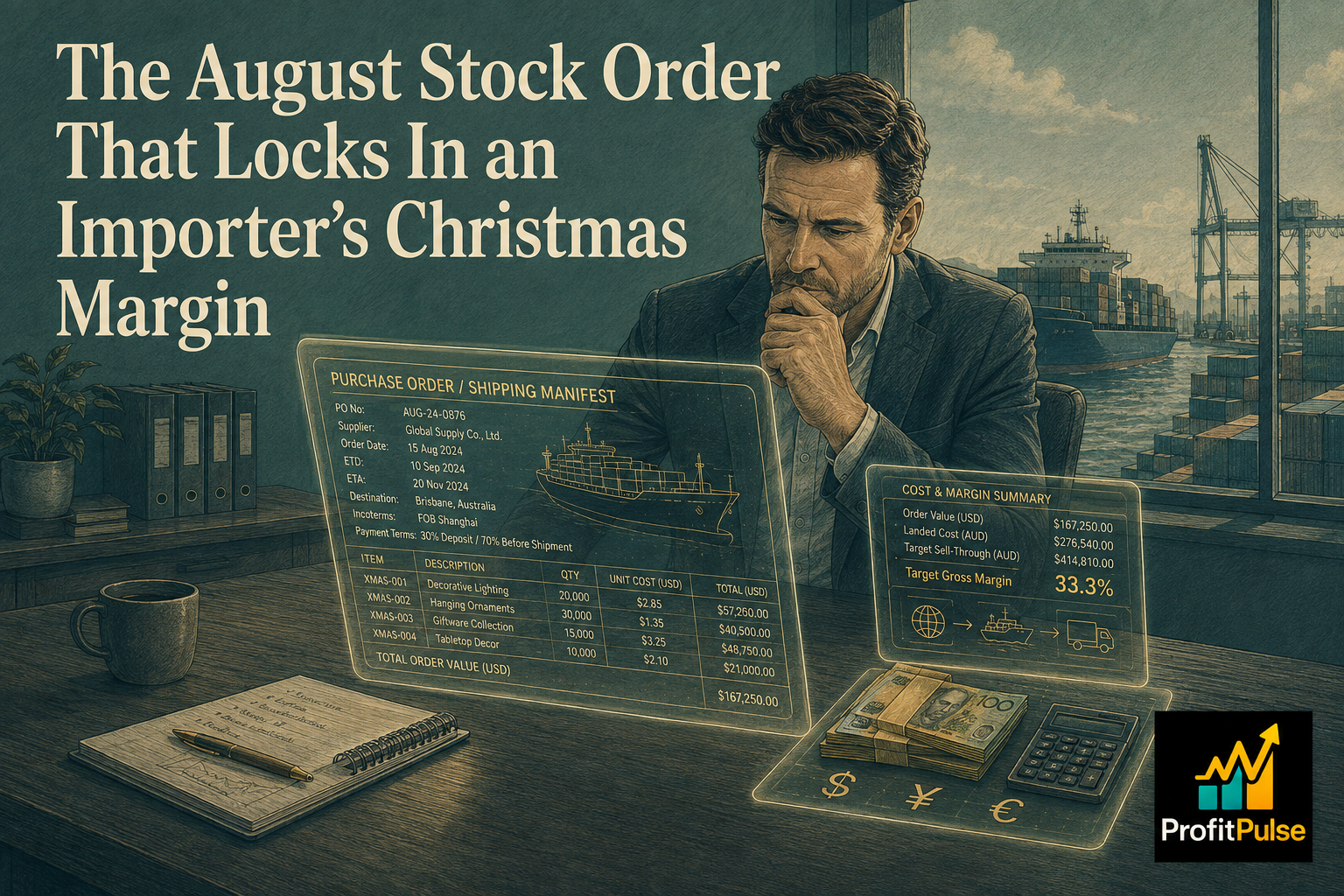
For import-reliant retailers, wholesalers and online sellers across the east coast, August is Christmas planning month in every sense but the calendar one. Bulk stock orders for the Christmas trading period are placed now, months ahead of the shelves filling, because production time in the country of origin, international sea freight and Australian customs clearance routinely add up to eight to twelve weeks before goods land at an Australian port. December’s margin, in other words, is not decided in December. It is largely decided this month.
Most importers know this intellectually. Fewer treat it as a financial planning event rather than a purchasing one. The purchase order that goes out this week fixes the foreign currency cost of the goods. What happens to the Australian dollar between now and the date payment is actually made, weeks or sometimes months later, moves the landed cost of that same stock without anyone touching the order again.
The businesses that come out of the Christmas trading period with the margin they modelled are rarely the ones who got lucky on the exchange rate. They are the ones who treated the currency exposure as something to manage at the point of ordering, not something to discover at the point of reconciling.
Why the Margin You Report in December Was Decided in August
Landed cost is built from several moving parts stacked on top of each other: the FOB price agreed with the supplier, international freight, customs duty and GST at the border, and the exchange rate used to convert the foreign currency invoice into Australian dollars. Only one of those numbers, the exchange rate, tends to get any ongoing attention, mostly because it is the one reported in the news each night. Freight rates, supplier pricing and duty classifications move just as often, sometimes more, and rarely get revisited between the order being placed and the goods arriving. A business that locks in its retail or wholesale pricing based on the landed cost it modelled in August, then absorbs whatever combination of those four numbers actually lands by November, is running its Christmas margin as a passenger rather than a driver.
The Retail Price Was Already Fixed Before the True Cost Was Known
The complication most importers run into is timing. Retail prices, whether printed in a catalogue, agreed with a wholesale customer or listed on a marketplace, are typically locked in well before the landed cost of the Christmas stock is fully known. If the Australian dollar weakens, freight capacity tightens into peak season, or a supplier’s FOB price moves between the deposit and the balance payment, the cost side changes after the price side has already been committed. There is rarely a straightforward way to pass that shift on to the customer mid-season without damaging the relationship or the sale. The margin absorbs it instead, quietly, and the first place it usually becomes visible is the January reconciliation, well after the trading period that mattered most has closed.
A Simple Discipline That Protects the Margin Before the Order Is Placed
The businesses that manage this well treat currency exposure as a policy decision made before the order goes out, not a number checked after the invoice lands. That typically means agreeing, in advance, what proportion of a Christmas order gets covered through a forward contract or similar arrangement at the time of ordering, so the exchange rate used in the landed cost model is the rate that will actually apply, not a guess. It also means reviewing supplier and freight terms with the same discipline applied to any other major cost line, rather than treating them as fixed simply because they always have been. A Treasury and FX Setup engagement, which establishes a hedging policy, a review of the FX provider currently being used, and a monthly treasury rhythm the team can run without outside help, is built for exactly this pattern. It is a modest piece of financial infrastructure against the amount of margin it typically protects across a single Christmas order cycle.
Why This Is a Cash Flow Story as Much as a Margin Story
Christmas stock orders also tie up working capital well before any of it converts back to cash. Deposits are paid in winter, balances are paid before or on shipment, duty and GST fall due at the border, and the stock itself sits in a warehouse for weeks before a single sale happens. For businesses managing this rhythm without a forward cash view, the margin exposure described above compounds with a working capital squeeze that peaks at exactly the wrong moment, right before the trading period meant to fund the first quarter of the new year. An ongoing rhythm on margin and cash together, mapped against the order and payment calendar rather than the financial year, is what turns this from a seasonal scramble into a manageable, repeatable cycle. A rolling cash flow forecast built around the actual payment dates for this year’s Christmas order is the simplest version of that discipline.
None of this requires predicting where the Australian dollar will sit in November. It requires deciding, before the order is placed, how much of that uncertainty the business is prepared to carry and how much it would rather remove. For importers across Brisbane and the wider east coast placing Christmas orders this month, that decision is worth making deliberately rather than by default. A discovery call is a reasonable place to start that conversation before the next purchase order goes out.
Frequently asked questions
Why does today’s exchange rate affect a Christmas stock order landing in November?
Most Christmas stock is ordered and invoiced in a foreign currency months before it lands, but the Australian dollar cost of that invoice is only fixed once payment is actually made or a hedge is put in place. If the exchange rate moves between the order date and the payment date, which is common over an eight to twelve week import cycle, the landed cost changes even though nothing about the order itself has changed.
What exactly is landed cost and how does it differ from a supplier’s quote?
A supplier’s quoted price, usually FOB or ex-works, covers the goods leaving the origin country. Landed cost adds everything required to get that stock sale-ready in Australia: international freight, marine insurance, customs duty, GST at the border, and the exchange rate used to convert the foreign currency invoice. Two importers buying identical stock at the same FOB price can end up with materially different landed costs depending on freight terms and how the currency exposure was managed.
Should a small Australian importer use a forward contract to manage currency risk?
A forward contract locks in an exchange rate for a future payment date, which removes the uncertainty between placing a Christmas order and settling the supplier invoice. It suits businesses with predictable, recurring foreign currency payments more than those with occasional or highly variable orders. A Treasury and FX Setup review is the usual starting point, since the right approach depends on order size, payment terms and how much currency risk the business can comfortably absorb.
How far ahead should Australian retailers order Christmas stock from overseas suppliers?
Production time at the origin factory, international sea freight and Australian customs clearance typically add up to somewhere between eight and twelve weeks, sometimes longer during the pre-Christmas freight peak. Most import-reliant retailers and wholesalers place their bulk Christmas orders across July, August and September to land stock in time for November trading, which means the commercial decisions that determine this year’s Christmas margin are largely already being made.
Why does my landed cost keep changing after I’ve already paid the supplier’s invoice?
Freight rates are often confirmed closer to the shipping date rather than at the time of order, customs duty can be reassessed on inspection, and if only part of the currency exposure was covered in advance, the remaining balance still moves with the exchange rate at the time it is actually paid. Each of these can shift the final landed cost after the purchase decision feels settled.
How can a fractional CFO help an importer manage seasonal cash flow and currency risk?
A fractional CFO partnership typically brings the ordering, payment and landing calendar together into one forward view, so currency exposure, freight cost movement and working capital needs are managed as one connected picture rather than three separate surprises. For import-reliant businesses, that oversight usually earns its cost back through better-protected margin on a single Christmas order cycle alone.
What is the best way to forecast cash flow around a large seasonal stock order?
Map every payment date against the order, not the financial year: supplier deposits, balance payments, freight and customs charges, then the expected sale dates once stock lands. A rolling cash flow forecast built around those actual dates shows the funding gap between paying for Christmas stock and collecting from Christmas sales well before it becomes a problem.
Leave a Reply