
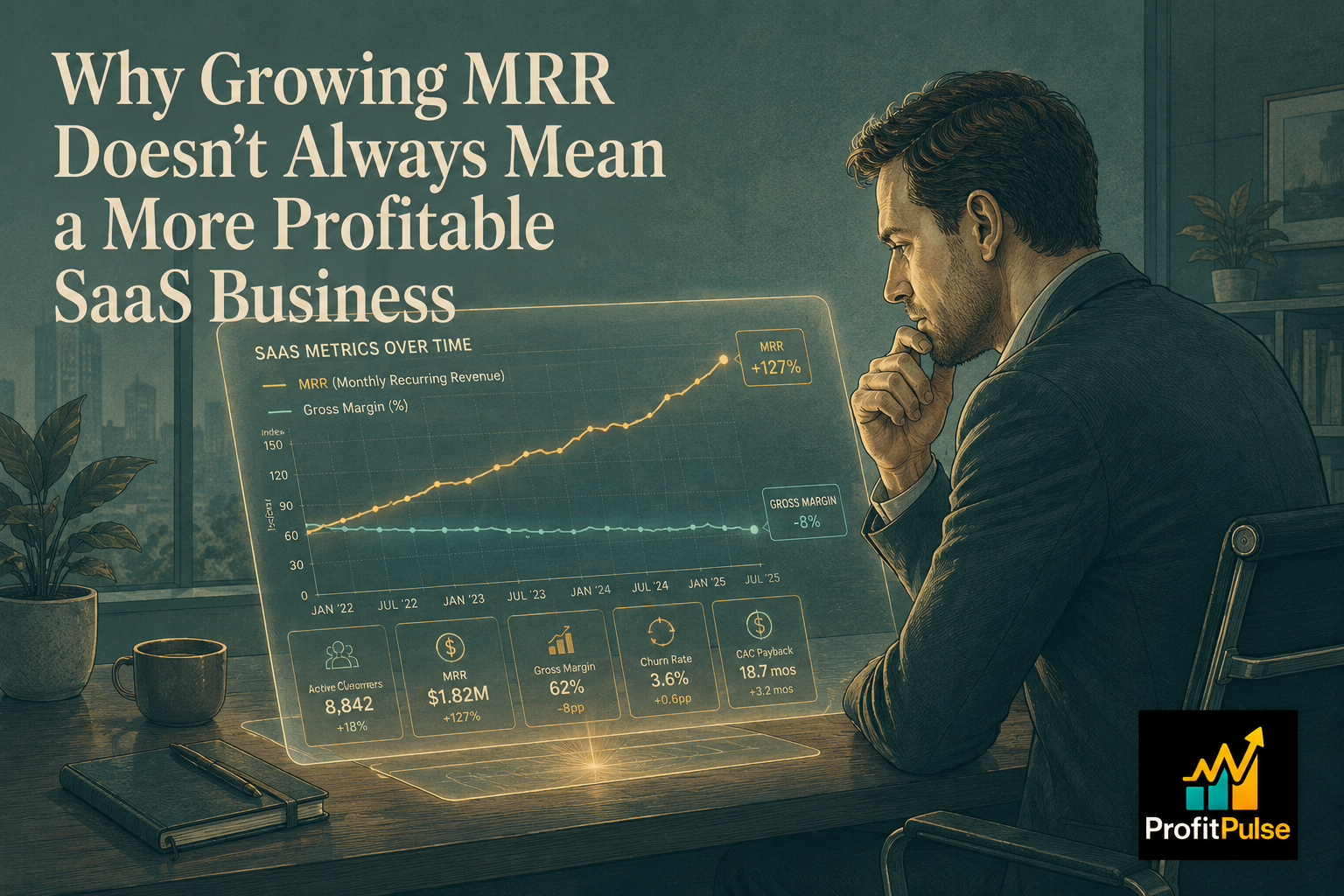
Monthly recurring revenue is the number every software business reports on, and for good reason. It is clean, it is predictable, and it compounds in a way few other revenue models can match. It is also, on its own, a poor guide to whether the business is becoming more profitable or quietly becoming less so.
This is a pattern we see often with technology and SaaS businesses in the one million to thirty million dollar revenue range. MRR climbs steadily, the board pack looks strong, and gross margin, the number that actually funds growth, support and the next hire, has been sliding for two or three quarters without anyone naming it. By the time it shows up in the bank balance, it has usually been building for a while.
Support Cost Scales With Customers, Not With Revenue
Customer success and support headcount tends to grow with the number of logos on the books, not with the size of the monthly recurring revenue line. A business that wins ten new mid-market accounts adds ten new implementation conversations, ten onboarding sequences and ten sets of support tickets, regardless of whether those accounts are paying premium or entry-level pricing. As the customer base broadens, especially down-market or into more complex enterprise accounts, the cost to serve each dollar of revenue rises even while the top line keeps climbing.
This is rarely visible in a single monthly board pack, because the change happens gradually, one cohort of new customers at a time. It tends to surface only once someone sits down and allocates support and success cost back to the customer segment that generated it, rather than treating it as one shared overhead line sitting below the revenue figure.
Hosting and Infrastructure Rarely Stay Fixed the Way the Model Assumes
Most SaaS pricing is set on a flat per-seat or per-tier basis, while the underlying infrastructure cost moves with usage, data storage, API calls and compute. When adoption deepens inside existing accounts, usage climbs faster than the invoice does, and the gross margin on that customer quietly compresses without a single pricing decision being made. Few businesses model this at the point of setting price, and fewer still revisit it once usage patterns change.
The Payback Period Hiding Behind a Growing Top Line
A rising MRR number says nothing about how many months of margin it takes to recover the cost of acquiring each new customer. If paid channels become more expensive, or discounting creeps in to win competitive deals, the payback period on new revenue stretches even while the growth chart looks healthy. Cash gets tied up funding growth that has already happened, which is exactly the gap a line-by-line Cost & Margin Deep Dive is built to expose, customer segment by customer segment, so the decision to keep, reprice or walk away from a cohort is made on evidence rather than instinct.
Annual Prepayments Can Hide the Timing of When the Real Cost Lands
Many SaaS businesses encourage annual upfront payment because it improves cash flow and locks in retention, and it genuinely does both. The trade-off is that a year of cash sits in the bank from day one while the cost of servicing that customer, support hours, infrastructure, account management, is incurred gradually across the following twelve months. Early in the contract the business looks flush. By month nine or ten, the cash cushion has usually been spent on the next round of customer acquisition, and the true cost of servicing that original customer is only now catching up with the revenue that was already recognised and spent. Renewal season is when this becomes visible, because it is the point at which a full year of true servicing cost can finally be compared against what the contract actually paid.
Working capital forecasting for a subscription business needs to account for this lag directly rather than reading the bank balance as a proxy for health. A disciplined approach to cash flow for a SaaS business tracks prepaid revenue as a liability still owed in service, not as cash that is free to spend on the next quarter’s growth targets.
None of this means growth is the wrong goal. It means MRR was never designed to answer the profitability question on its own, and a business that only watches the top line will not see the margin story changing underneath it until a quarter, or a raise, forces the conversation. The businesses that hold their margin through a growth phase are usually the ones who built the habit of checking it, on a monthly cadence, well before investors or a bank asked to see it. Building that kind of visibility into the monthly rhythm is exactly the work a fractional CFO partnership is designed to support, particularly for a technology business moving through its first real growth stretch.
Frequently asked questions
Why is my SaaS business growing MRR but not growing profit?
This usually comes down to cost lines that move with the customer base rather than with revenue. Support and customer success headcount tends to scale with logo count, and infrastructure cost moves with usage, so as the business grows and adoption deepens, the cost to serve each customer can rise even while monthly recurring revenue keeps climbing. The MRR number was never designed to show this on its own.
What is a healthy gross margin for an Australian software or SaaS business?
There is no single number that applies across every SaaS business, since it depends heavily on the product and how support-heavy the customer base is once hosting, support and payment processing costs are properly allocated. What matters more than hitting a benchmark figure is tracking the trend by customer segment over time, since a healthy-looking average can still hide a cohort that is quietly loss-making.
How do you calculate the customer acquisition cost payback period for a SaaS business?
Payback period is the number of months of gross margin from a customer needed to recover the full cost of acquiring them, including sales and marketing spend and onboarding effort. A stretching payback period, often caused by rising paid acquisition costs or discounting to win competitive deals, ties up cash even while the revenue chart looks healthy, which is why it deserves its own line in the monthly numbers.
Does customer support cost scale differently to revenue in SaaS businesses?
Yes. Support and customer success cost tends to track the number of accounts and their complexity, not the dollar value of the contract. A business that adds accounts across a wider range of price points, or moves into more complex enterprise deals, typically sees support cost per dollar of revenue rise even as total revenue grows, which is a pattern worth watching by segment rather than in aggregate.
How does gross margin affect the valuation of a SaaS or technology business?
Buyers and investors typically weight gross margin and net revenue retention as heavily as revenue growth, because they reveal whether growth is efficient or whether it is being bought at an increasing cost per customer. A business valuation for a technology business will usually probe cohort-level margin well before it settles on a multiple.
Should a growing technology business track more than monthly recurring revenue?
Most growing technology businesses benefit from a small dashboard sitting alongside MRR, typically gross margin by segment, net revenue retention, CAC payback and churn. A KPI Dashboard Build & Run puts these numbers in one place on a monthly cadence, so a margin shift is visible within weeks rather than showing up in a year-end reconciliation.
Can a fractional CFO help a SaaS business in Brisbane manage margin and cash flow?
Yes, particularly once a technology business is past its earliest stage and managing multiple cost lines, a broadening customer base and investor or lender reporting at the same time. A fractional CFO partnership brings that financial structure in on a fraction of the cost of a full-time hire, scaled to what a growing Brisbane or east coast software business actually needs.
Leave a Reply