
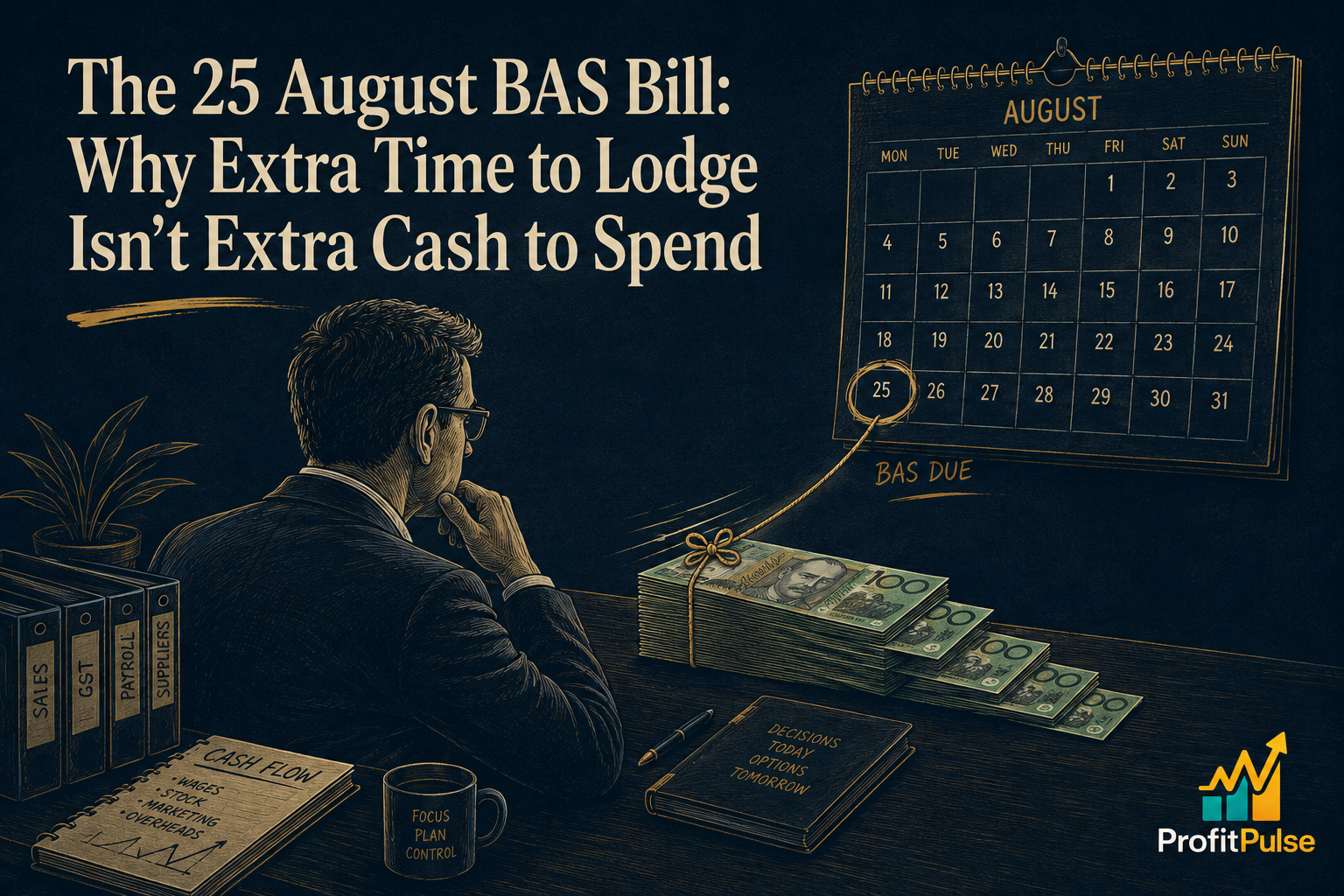
By the middle of August, most Australian businesses have already closed the books on their April to June BAS. Self-lodgers had it due on 28 July. But a large share of owner-led businesses lodge through a registered tax agent, and for them the same quarter’s BAS doesn’t fall due until 25 August. That extra window can feel like a bit of breathing room after a demanding EOFY. It isn’t extra cash. It’s a deferred bill with the due date parked a few weeks further down the calendar.
The GST sitting in the account right now was collected from customers across April, May and June, some of it during a genuinely strong run of trading. By the time the BAS bill actually lands in late August, that quarter feels finished, the next one is well underway, and the money has usually already been absorbed into ordinary trading, wages, stock, a supplier payment that couldn’t wait.
None of this happens because a business has done anything wrong. It’s what tends to occur whenever a liability’s due date sits two months behind the trading that created it, and nobody has drawn a hard line around the money sitting in between.
What the Agent Extension Actually Buys You
The concessional due date that comes with lodging through a registered tax agent exists for a straightforward reason. Agents are managing BAS lodgments for dozens or hundreds of clients at once, and the extra weeks give them room to work through that volume properly. It’s an administrative allowance, not a signal that the underlying liability has changed shape. The GST owed was fixed the moment it was collected from a customer, quarter by quarter, invoice by invoice. Only the payment date has moved. Treating the gap between collection and payment as if it were working capital the business is free to use is where the trap usually starts, and it is an easy trap to fall into, because nothing about the bank balance signals that part of it already belongs to someone else.
The Trap Is in the Timing, Not the Number
The pattern we typically see across owner-led businesses on the East Coast is not that the BAS number itself comes as a surprise. Most owners can estimate roughly what they will owe, often within a reasonable margin. The surprise is how the number feels relative to what’s sitting in the account by the time it’s actually due. Trading through July and into August has continued, new revenue and its own GST component have mixed into the same account, and the balance by late August reflects current trading momentum far more than it reflects a liability that was actually locked in back in June. The bill lands at the exact moment the business feels furthest away from the quarter that generated it, which is precisely why it lands as a shock rather than as an expected, budgeted payment.
A business that self-lodges and pays by 28 July rarely runs into this, because the gap between collection and payment stays inside a single quarter’s trading rhythm. The concession that helps a tax agent manage their workload quietly removes that alignment for everyone lodging through them, unless the business builds its own discipline back in.
Ring-Fencing the Liability Instead of Guessing at It
The more reliable habit is treating GST collected as money that was never the business’s to begin with, from the moment it lands rather than the week before it’s due. A regular transfer of the GST component out of the operating account and into a separate holding account, timed to actual trading rather than to the BAS calendar, removes the guesswork entirely. Weekly or fortnightly is usually a better cadence than monthly, because it keeps the transfer size small and unremarkable rather than one large, painful movement right before a deadline. This is one of the things a 13-Week Cash Flow Build is built to catch, showing GST and other tax liabilities as their own line in the forecast rather than letting them blend invisibly into the operating cash balance, so the number due in August is never a surprise sitting inside a healthy-looking bank balance.
Building the Habit Before the Next Quarter Closes
Businesses that stop getting caught out by this rarely do anything complicated. They simply fold the BAS provision into the same rhythm as their broader cash flow discipline, reviewed monthly rather than remembered quarterly under deadline pressure. ProfitPulse works with owner-led businesses across Queensland, NSW and Victoria on exactly this kind of forecasting, and it’s a straightforward thing to put in place before the next BAS quarter even closes. If the August bill landed heavier than expected this year, that’s usually the clearest sign it’s worth booking a discovery call with ProfitPulse before the next one does the same thing.
Frequently asked questions
When is BAS due for the April to June quarter using a tax agent?
Self-lodgers face a 28 July due date, but businesses lodging through a registered tax agent generally receive a concessional due date of 25 August for the same quarter. The extra weeks are an administrative allowance for the agent’s workload, not a change to when the GST was actually owed, so it pays to plan around the earlier date regardless.
Why doesn’t GST collected during the quarter count as available cash?
GST is collected from customers on behalf of the ATO, not earned by the business, so it was never really part of the business’s own working capital even while it sits in the account. Folding it into everyday cash flow discipline from the moment it’s collected, rather than the week before it’s due, is what keeps this distinction clear.
How can a business avoid a cash flow surprise when its BAS bill is due?
The most reliable approach is transferring the GST component of takings into a separate holding account on a weekly or fortnightly basis, rather than leaving it blended into the operating balance. A 13-Week Cash Flow Build shows this liability as its own line in the forecast, so the bill due in August is already accounted for well before the date arrives.
Does lodging through a registered tax agent change how much BAS is owed?
No. The concessional lodgment program changes when the payment falls due, not the amount owed. The GST liability is fixed at the point it’s collected from customers during the quarter, so the extra weeks should be treated purely as scheduling flexibility rather than as additional funds available to the business.
Why does the BAS bill often feel bigger in August than expected?
By late August, a business has usually traded through most of the following quarter as well, so the account balance reflects current momentum far more than it reflects the specific liability locked in back in June. The bill lands at the point the business feels furthest from the trading that actually generated it, which is what makes the number feel larger than it is.
Is this BAS timing gap a bigger issue for seasonal or growing businesses?
Generally yes. A business trading strongly through winter, or scaling quickly, collects a larger GST amount during the quarter and has more new revenue mixing into the account by the time the concessional due date arrives. Businesses across Melbourne, Queensland and NSW with lumpy or seasonal trading tend to feel this gap most sharply.
Leave a Reply