
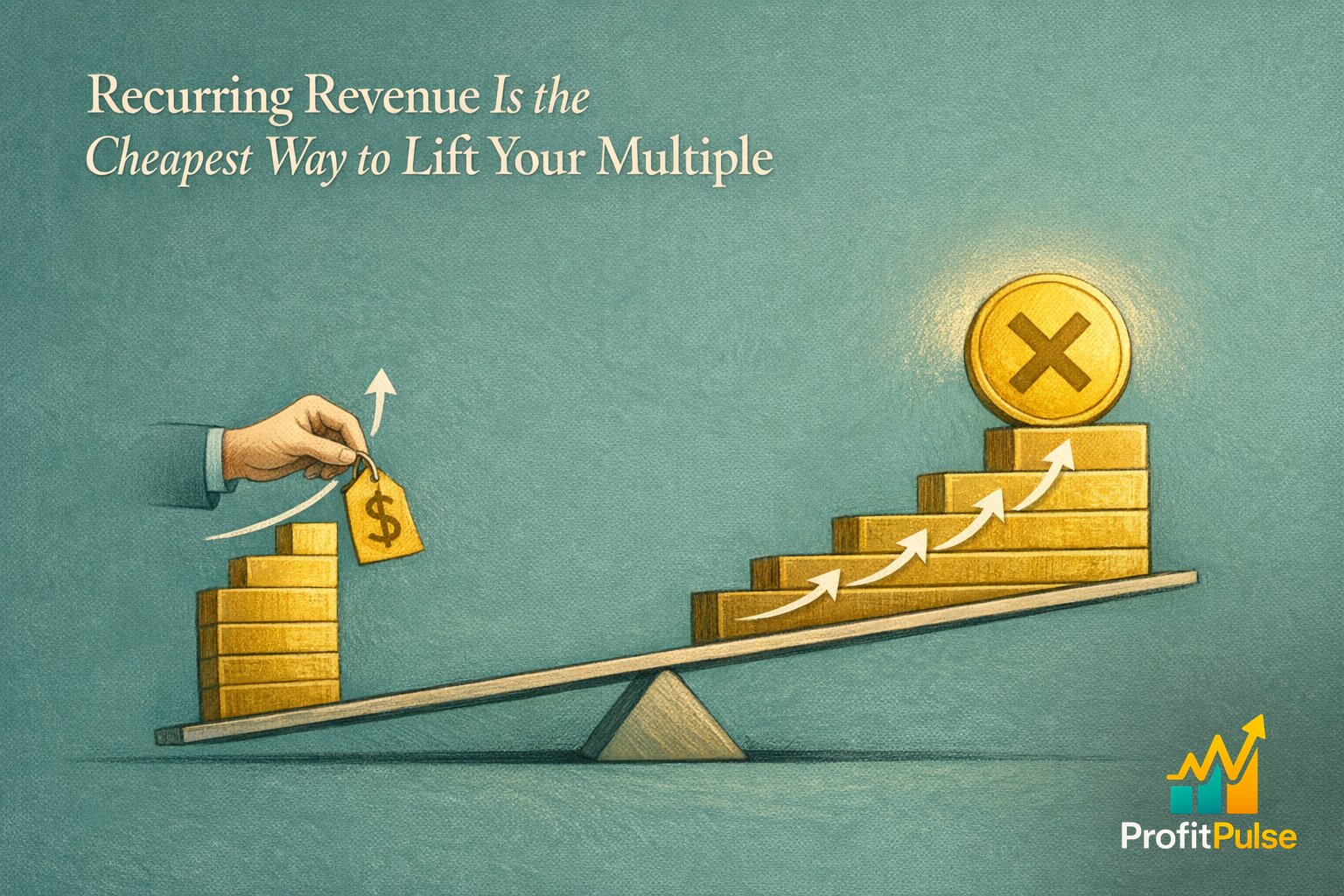
There are two ways to grow what your business is worth. You can grow the profit, or you can grow the multiple applied to that profit. Most owners spend almost all of their energy on the first and almost none on the second, and that is understandable. Profit is what you live in day to day. The multiple feels abstract until the moment someone makes an offer.
The catch is that a good year of profit lifts your sale price once, in proportion to the extra profit. A higher multiple lifts the price on every dollar of profit, this year and every year. And the single most reliable lever on the multiple, the one a buyer rewards almost without argument, is recurring revenue.
Why a Buyer Pays More for Recurring Revenue
A buyer is purchasing future cash flow, and the question that sits underneath every valuation is how confident they can be that the cash flow will still be there after you leave. One-off sales answer that question with a shrug. Each one has to be won again. Recurring revenue answers it with a contract, a renewal pattern, a base of customers who keep paying. That certainty is what the multiple is really pricing.
This is why two businesses with identical profit can be worth materially different amounts. The one earning three or four times annual profit on lumpy project work and the one earning a clearly higher multiple on contracted, repeating income are being judged on the same profit but very different risk. The recurring base lowers the buyer’s perceived risk, and lower risk is exactly what a higher multiple expresses. There is a second effect that owners often miss. A recurring base also reduces the buyer’s reliance on the owner personally, because revenue that renews on its own does not depend on the relationships and the selling effort that walk out the door when the founder leaves. That independence is one of the quietest but most powerful things a buyer pays for. Our guide to how businesses are valued walks through the methodologies behind this in more detail.
Where Recurring Revenue Can Realistically Be Built
The objection most owners raise is that their business does not lend itself to subscriptions. That is usually too quick. Recurring revenue is not only software subscriptions. It is maintenance agreements on equipment you have already sold, service plans that replace the ad-hoc call-out, retainers that turn project clients into ongoing relationships, monitoring or compliance arrangements that a customer renews without thinking, and supply agreements that lock in repeat orders.
Almost every business has a slice of revenue that customers would happily commit to in advance if it were offered as a plan rather than a one-off. The work is identifying which slice, pricing it so it is attractive to the customer and durable for you, and building the habit of selling the relationship rather than the transaction. The pricing matters as much as the offer. A plan priced too low locks in a thin margin you then carry for years, while one priced for the convenience and certainty it gives the customer can carry a better margin than the ad-hoc work it replaces. A business valuation often surfaces exactly where that latent recurring revenue is sitting, because the same analysis that values the business reveals which income streams a buyer would treat as reliable.
Building It Before You Need It
The owners who benefit most start years before any sale. Recurring revenue takes time to establish and time to prove, and a buyer wants to see a renewal pattern with history behind it, not a plan launched last quarter. A buyer will look closely at the renewal rate and the churn behind the headline figure, because a recurring base that loses a fifth of its customers every year tells a very different story from one that holds them. A Value Uplift Roadmap maps the specific levers that lift enterprise value and ranks them by expected dollar impact, and recurring revenue conversion is usually near the top of that list because it costs comparatively little to build and pays back on the multiple rather than just the profit.
None of this is about dressing up the numbers for a sale. A business with a strong recurring base is simply a better business to own, more predictable to run and less dependent on chasing the next deal. The owner of a business with a solid recurring base sleeps better, plans further ahead and feels the start of each month differently, because a known share of the year’s revenue is already committed rather than still to be won. That is the daily reward, quite apart from the exit. The valuation reward is a consequence of it, not a trick. The two reinforce each other, which is why this is rarely a hard sell internally once an owner sees the numbers. If you want to understand where recurring revenue could realistically sit in your business and what it would do to your value, that is the conversation worth having well before you think about preparing for an exit. The earlier you start, the more the multiple has time to move.
Frequently asked questions
Why does recurring revenue increase a business valuation multiple?
Because a buyer is purchasing future cash flow, and recurring revenue makes that cash flow far more certain. One-off sales have to be won again each time, while contracted or renewing income answers the buyer’s central question about whether revenue survives the owner’s exit. Lower perceived risk is what a higher multiple expresses. Our valuation guide explains how the methodologies translate that certainty into price.
Is growing profit or growing the multiple better for business value?
Both matter, but they work differently. A good year of profit lifts your sale price once, in proportion to that extra profit. A higher multiple lifts the price on every dollar of profit, every year. The multiple is the more leveraged lever, and recurring revenue is the most reliable way to move it. Most owners spend all their energy on profit and almost none on the multiple, which is the larger opportunity.
How can a traditional business build recurring revenue?
Recurring revenue is broader than subscriptions. It includes maintenance agreements, service plans replacing ad-hoc call-outs, retainers, monitoring or compliance arrangements, and supply agreements that lock in repeat orders. Almost every business has a slice of revenue customers would commit to in advance if it were offered as a plan. The work is identifying that slice, pricing it well, and selling the relationship rather than the one-off transaction.
How long before a sale should I start building recurring revenue?
Years, ideally. A buyer wants to see a renewal pattern with history behind it, not a plan launched last quarter. Recurring revenue takes time to establish and prove, so the owners who benefit most start well before any sale is on the table. Starting early also means the multiple has time to move. Our exit readiness guide covers the value drivers worth building ahead of a transaction.
Can two businesses with the same profit have different valuations?
Yes, and often by a wide margin. A business earning its profit on lumpy project work and one earning the same profit on contracted, repeating income are judged on identical profit but very different risk. The recurring base lowers the buyer’s perceived risk, and that shows up directly in the multiple. It is one of the clearest examples of why revenue quality, not just revenue size, drives what a business is worth.
How do I find out where recurring revenue could sit in my business?
A valuation or value uplift analysis usually surfaces it, because the same work that values the business reveals which income streams a buyer would treat as reliable. From there you can map the specific levers, rank them by expected dollar impact and build the recurring base deliberately. It is rarely as hard as owners assume. Most businesses have latent recurring revenue waiting to be offered as a plan rather than a one-off.
Leave a Reply