
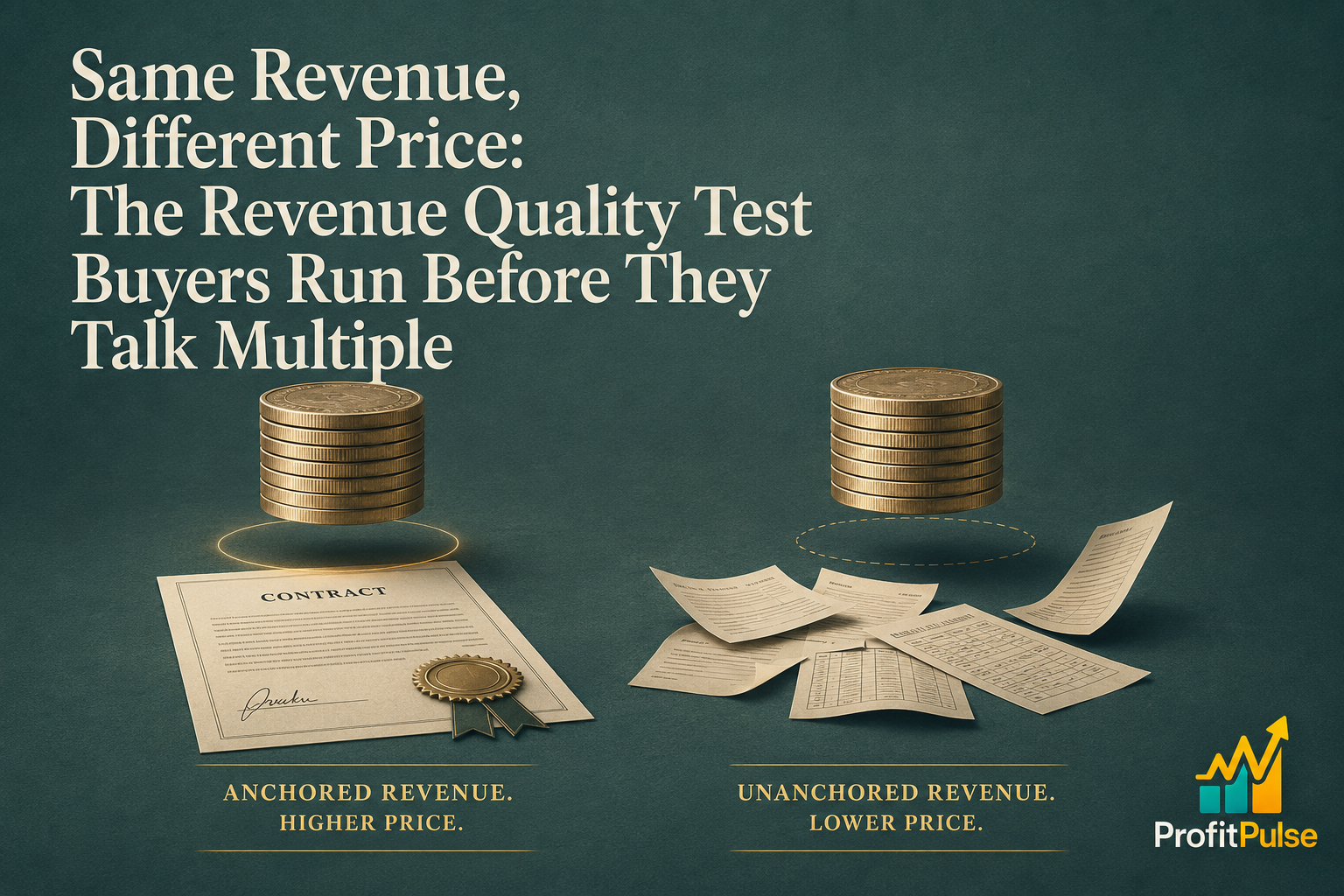
Two businesses turn over the same revenue. Both post a similar profit margin. Both have been trading for close to a decade. When they go to market, one attracts an offer at four times earnings and the other struggles to get past two and a half. The gap is not sitting in the P&L. It is sitting in where that revenue actually came from.
This is the part of a sale process most owners have never been asked to think about, because it never shows up on a monthly management report. Revenue is revenue on a profit and loss statement. It is not revenue on a buyer’s model, where every dollar gets sorted by how confidently it can be expected to repeat next year without the seller standing in the room.
The pattern across owner-led businesses preparing for sale is that revenue quality gets discovered during due diligence, at the point where it can no longer be improved before the numbers are locked in. Understood twelve months earlier, it is one of the more straightforward levers available to lift a multiple.
What “Revenue Quality” Actually Means to a Buyer
Revenue quality is a simple sort. On one side sits income that is contracted, subscribed, or built on a customer relationship with genuine switching cost. On the other sits income that has to be re-won: tenders, one-off projects, spot orders, and relationships that live entirely with the owner or a single senior salesperson. Both count as revenue. Only one of them counts as an asset in a buyer’s eyes.
A buyer is not really paying for last year’s number. They are paying for their own confidence that a similar number repeats next year under their ownership. Contracted or recurring income lets them underwrite that confidence with a document. Re-won income asks them to underwrite it with a guess about relationships and market conditions they do not control.
Why the Same Revenue Line Prices Differently
This is where the multiple gap actually comes from. A business built on three-year service agreements with staggered renewal dates gets priced closer to the top of its industry range, the kind of range explored in our guide to business valuation. A business built on the same revenue, won project by project through competitive tender, gets priced closer to the bottom, even with an identical EBITDA line and an identical growth trend over the past three years.
Buyers are not being unfair when they price it this way. They are pricing the actual risk of the asset they are acquiring. A book of contracted revenue is closer to a bond. A book of re-won revenue is closer to an option, valuable, but only if the next round of tenders or referrals lands the way the last few did. Most owners have never separated their own revenue into these two buckets, because both buckets feel the same from inside the business. They only feel different from outside it, where the buyer is standing.
The Contracts a Buyer’s Due Diligence Team Actually Reads
During due diligence, the request is rarely for a revenue summary. It is for the underlying agreements: term length, renewal mechanics, exclusivity clauses, price escalation terms, and how concentrated that contracted revenue is across customers. A handshake arrangement with a long-standing client, however genuinely reliable, reads very differently to a buyer than a signed three-year agreement with the same client, even where the commercial relationship is identical in practice.
This is one of the eight readiness dimensions our Exit Readiness Diagnostic scores before a business goes anywhere near a buyer conversation, precisely because contract quality is one of the easier gaps to close if there is genuine runway before sale. Moving a client from an annual purchase order to a documented multi-year agreement rarely changes the commercial relationship. It changes what a buyer is allowed to assume about it.
A Simple Test to Run on Your Own Revenue
The test does not require a data room. Take last year’s revenue and sort it into two columns: income that is contracted, subscribed, or governed by a formal agreement with defined terms, and income that had to be actively re-won through a quote, tender, or repeat sale process. Most owner-led businesses across Queensland, New South Wales and Victoria have never run this split, and the result is often more lopsided toward the re-won column than the owner expected.
The number itself is less important than the direction it points. A business sitting at twenty per cent contracted revenue has a clear, specific improvement project ahead of it, the same kind of project we help owner-led businesses across Melbourne and the wider East Coast work through inside an Indicative Business Valuation, where revenue quality is one of the named value drivers rather than a footnote.
None of this changes what the business actually does day to day. It changes what a buyer is willing to believe about next year, and that belief is what the multiple is actually pricing. Businesses rarely fix this gap in the final six months before sale, because contracts take time to renegotiate and renewal cycles do not compress on request. The owners who move earliest are the ones who get to negotiate from strength rather than explain the gap after a buyer has already found it. If revenue quality has never been mapped for your business, a discovery call is a straightforward way to see where the split currently sits.
Frequently asked questions
What does revenue quality mean when valuing an Australian business?
Revenue quality describes how confidently income can be expected to repeat next year without active re-selling. Contracted or subscription-based income scores highly because it is documented and time-bound. Income that has to be re-won through tenders, quotes or one-off projects scores lower, even where the relationship is genuinely stable, because a buyer cannot verify it the same way.
Why do buyers pay more for contracted revenue than for repeat customers?
A repeat customer relationship, however loyal, depends on the customer choosing to return again with no formal obligation to do so. A contracted relationship is documented, with defined terms and renewal mechanics a buyer can independently verify. Buyers are pricing certainty, and a signed agreement is easier to underwrite than a pattern of past behaviour, however consistent that pattern has been.
How much of my revenue should be under contract before I sell my business?
There is no universal figure, since the right mix depends on the industry and how the sector typically transacts. What matters more is direction. A business that has never measured its contracted share, and can lift it meaningfully in the twelve to twenty four months before sale, tends to see a more material shift in buyer confidence than the exact percentage it lands on.
What do buyers look for in customer contracts during due diligence?
Term length, renewal terms, price escalation clauses, exclusivity, and how concentrated the contracted revenue is across customers. A single dominant contract can raise its own concentration risk even while lifting overall contract coverage. Our Exit Readiness Diagnostic reviews contract quality alongside the other seven dimensions buyers assess before making an offer.
Can I improve my revenue mix before selling an Australian SME?
Yes, and this is one of the more practical value levers available with genuine lead time. Moving key clients from informal or annual arrangements to documented multi-year agreements, or building a subscription or retainer option where the market allows it, rarely changes the underlying relationship. It does change what a buyer is entitled to assume about it once the sale process starts.
How does an Indicative Business Valuation account for revenue quality?
An Indicative Business Valuation names revenue quality as one of the specific value drivers or detractors behind the headline multiple, rather than folding it silently into a single EBITDA figure. That makes it visible as something the business can act on, well before a buyer’s own due diligence team raises it as a finding.
Is project-based or tender-won revenue always a problem for a business sale?
Not always. Many strong businesses, particularly in construction and professional services, run substantially on project or tender-won revenue and still transact well, provided the pipeline and win rate are documented and demonstrably repeatable. The issue is not the revenue model itself. It is whether that repeatability can be evidenced rather than simply asserted.
Leave a Reply