
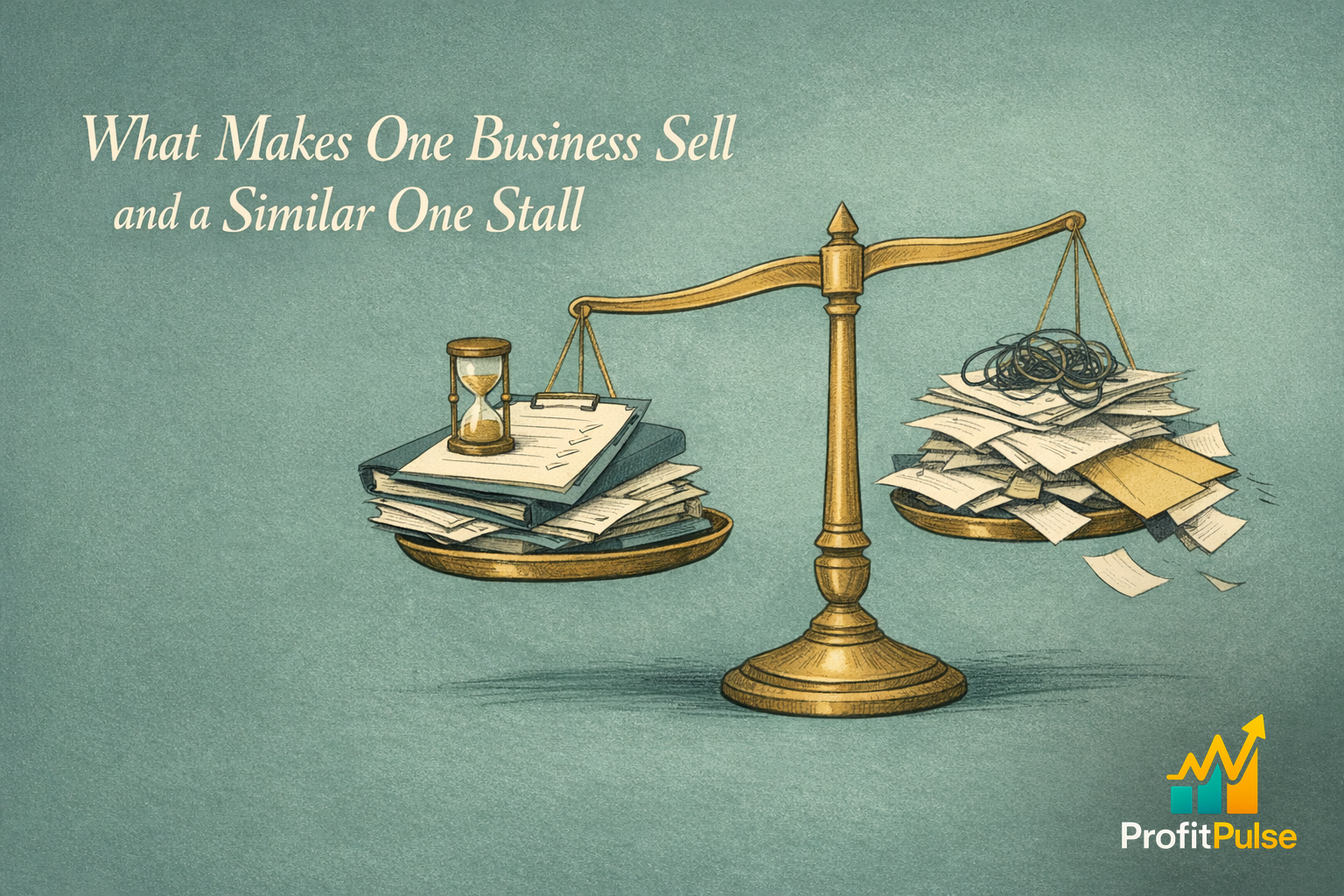
Put two businesses side by side that look the same on paper. Similar revenue, similar profit, similar industry, similar region. One sells cleanly at a strong price. The other sits on the market, attracts low offers, and eventually the owner takes it off and tells people the timing was wrong. The timing was not the problem. The two businesses were never as alike as the headline numbers suggested.
What separates them rarely shows up in the profit figure. It shows up in everything a buyer has to satisfy themselves about before they are willing to pay. The business that sells is the one where those questions already have clear answers. The business that stalls is the one where every answer requires digging, and every dig surfaces another question.
The encouraging part is that the gap is built, not born. It is the result of choices made over years, which means it is available to any owner willing to start early enough.
A buyer pays for certainty, not just profit
Profit tells a buyer what the business earned. It does not tell them whether that profit will survive the owner walking out the door. That is the question underneath every other one. When the numbers are clean and reconciled, when the add-backs are obvious rather than argued, when the management accounts agree with the tax return, a buyer can trust what they are seeing and move quickly.
When the financials need interpreting, the opposite happens. Every inconsistency is a reason to discount the price or slow the deal, not because the business is weaker but because the buyer cannot tell. Uncertainty is priced as risk, and risk is priced low. Clean financials are not an accounting nicety here, they are the thing that lets a good business be seen for what it is. This is the core of genuine exit readiness.
Systems and key-person risk decide the multiple
The single factor that most often separates the two businesses is how much of the operation lives in the owner’s head. A business that runs on documented systems, with a team that holds the relationships and knows the process, is buying its own future without the seller. A business where the owner is the system is asking a buyer to purchase a job that only the current owner knows how to do.
Buyers see this immediately, and they price it. Reduced key-person risk lifts the multiple because it lifts the certainty that the earnings continue. Documented systems do the same. None of this can be assembled in the final month before a sale, which is precisely why the businesses that sell well started building it long before they intended to go to market. Our valuation work consistently points to these same drivers.
A useful test an owner can run on themselves is to look at where the important relationships actually sit. If the best customers deal with the business because they trust a manager and a process, the relationships transfer. If they deal with the business because they like and rely on the owner personally, a buyer has to wonder how many of them stay once that owner is gone. The same applies to the key suppliers, the lender, and the senior team. Moving those relationships off the owner and onto the business, deliberately and over time, is some of the most valuable work an owner can do, and almost none of it shows up in this year’s profit. It shows up entirely in the price a buyer is willing to pay later.
Customer concentration and contract quality move the price too
Two further things sit quietly inside the same question of certainty, and they often explain a gap the profit figure cannot. The first is customer concentration. A business where one client represents a large share of revenue carries an obvious risk the buyer can see, because the relationship may not survive the handover and its loss would reshape the earnings overnight. The same profit spread across a broad base of customers is worth more, because no single departure threatens it. Owners rarely think of their customer mix as a valuation driver, yet it is one of the clearest.
The second is the quality of the contracts and revenue underneath the profit. Recurring revenue under contract is worth more than the same dollar of revenue won fresh each month, because it is more certain to continue. Documented supplier terms, transferable leases, and agreements that survive a change of ownership all reduce what a buyer has to take on trust. The business that has tidied these up is not simply better organised, it is genuinely worth more, because every contract that holds after the sale is one less reason for the buyer to discount.
Readiness is a programme, not an event
The reason one business sells and a similar one stalls is almost never luck. It is the difference between readiness built over time and readiness attempted in a hurry. An Exit Readiness Diagnostic scores a business across the dimensions a buyer actually examines, from financials and systems to customer concentration and owner dependence, so the gaps are visible while there is still time to close them. You can see how that fits the broader approach on the exit readiness service page.
The owner who sells cleanly is rarely the one who simply got a better offer. They are the one who, years earlier, started making the business easy to buy.
If you want to know how a buyer would see your business today, ProfitPulse helps owners find the gaps between a business that sells and one that stalls while there is still time to close them.
Frequently asked questions
Why do two similar businesses sell for very different prices?
Because the headline numbers hide what a buyer actually pays for, which is certainty that the profit survives the owner leaving. The business that sells well has clean financials, documented systems and low key-person risk, so questions have ready answers. The one that stalls makes a buyer dig, and every dig raises a new doubt that gets priced as risk. The gap is readiness, explored in our exit readiness guide.
What is key-person risk and how does it affect a sale?
Key-person risk is how much of the business depends on one individual, usually the owner. If the owner holds the relationships, the knowledge and the process, a buyer is effectively purchasing a job rather than a business. That uncertainty lowers the price. A business that runs on documented systems and a capable team continues without the seller, which lifts the multiple because it lifts the certainty that earnings continue.
How early should I prepare a business for sale?
Earlier than most owners expect, often years before going to market. The things that drive a strong sale, clean financials, documented systems and reduced owner dependence, cannot be assembled in the final month. They are built over time. Starting early means the gaps are visible while there is room to close them. An exit readiness diagnostic shows where you stand today.
Why do clean financials matter so much to a buyer?
Because a buyer prices uncertainty as risk, and risk as a discount. When the numbers are reconciled, the add-backs are obvious and the management accounts agree with the tax return, the buyer can trust what they see and move quickly. When the financials need interpreting, every inconsistency becomes a reason to lower the offer or slow the deal, regardless of how strong the business actually is.
Does higher profit always mean a higher sale price?
Not on its own. Profit tells a buyer what the business earned, not whether that profit continues once the owner walks away. Two businesses with the same profit can sell for very different prices depending on systems, customer concentration and owner dependence. The multiple applied to profit reflects certainty, so a slightly less profitable business that is easy to buy can outsell a more profitable one that is not.
How does customer concentration affect what a business is worth?
A business leaning heavily on one or two clients carries visible risk, because losing that relationship in a handover would reshape the earnings overnight, so a buyer discounts for it. The same profit spread across a broad customer base is worth more, since no single departure threatens it. Owners rarely treat their customer mix as a valuation driver, yet broadening it is one of the clearest ways to lift the price a buyer will pay.
What is an exit readiness diagnostic and what does it cover?
It scores a business across the dimensions a buyer actually examines, including financials, contracts, customer concentration, owner dependence, systems, team, growth story and risk. The point is to make the gaps visible while there is still time to close them, rather than discovering them mid-deal. It is the difference between going to market ready and going to market hopeful. You can read more on the service page.
Leave a Reply