
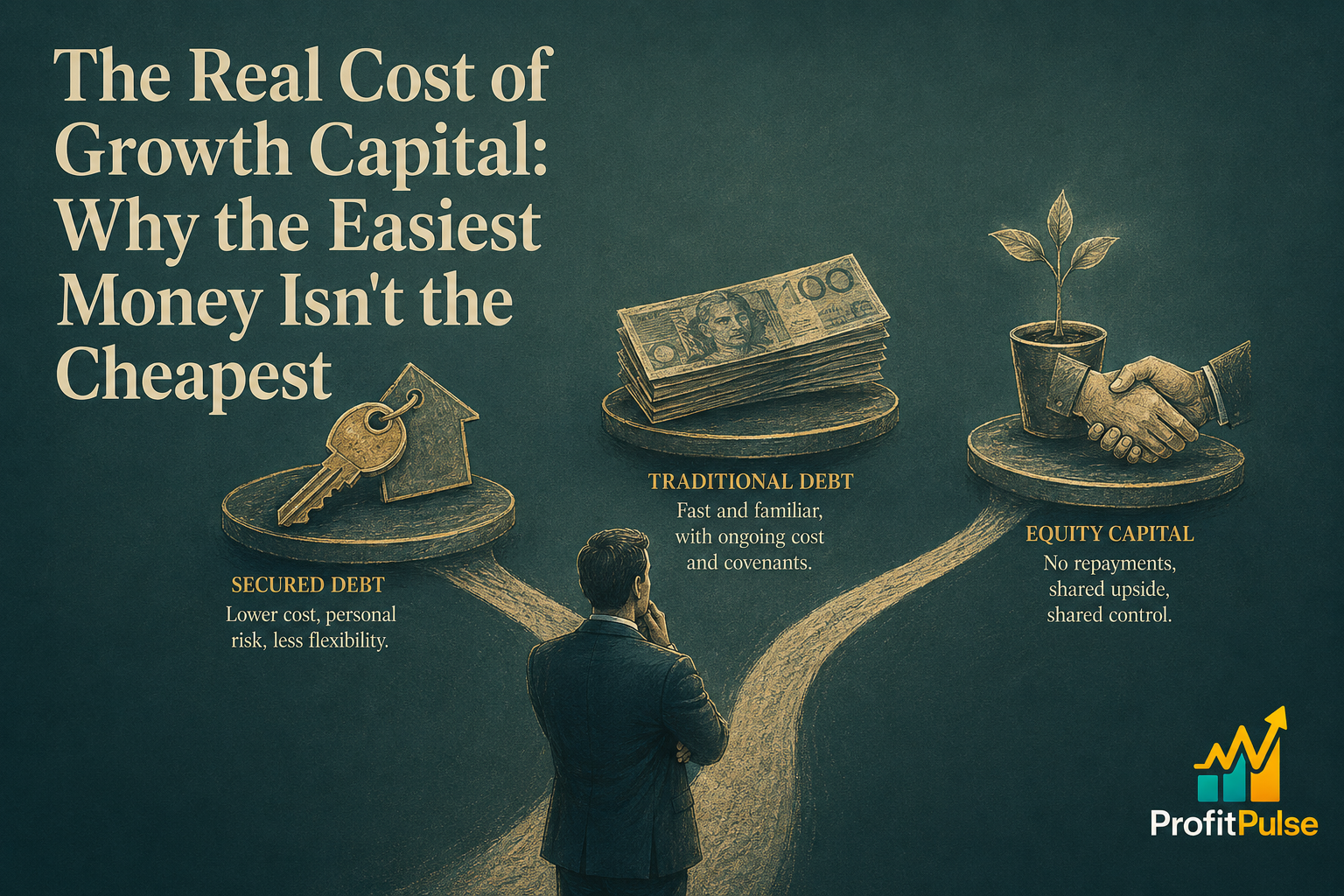
Most Australian SME owners can tell you, to the dollar, what their business loan repayment is each month. Fewer could tell you what it actually costs to draw down the redraw facility on the family home, roll an overdraft for another quarter, or hand over a slice of equity to bring in a co-investor. The financing decision that funded the new equipment, the early hire, or the bigger stock order rarely gets weighed the way a formal loan application would be. It just gets made, usually with whatever capital sits closest to hand.
That is the trap. Convenience and cost are not the same thing, and the gap between them compounds quietly across a growth phase. The capital source an owner reaches for first is rarely the one they would choose with a clear head and a proper comparison in front of them.
The Convenience Trap
Redraw on the mortgage, the business credit card, an overdraft that has quietly become permanent rather than seasonal, a loan from a director’s personal account. None of these feel like a financing decision at the time, because no one sits across a desk and assesses an application. The money is already accessible, so it gets used, and the actual cost gets counted later, if it gets counted at all.
The cost hides in a different place for each source. Redraw ties a business outcome to the family home, a risk most owners would not choose consciously if it were put to them plainly and separately from the mortgage paperwork. An overdraft that rolls month to month rather than clearing typically carries one of the higher effective rates a business will pay for capital, precisely because it was never structured as long-term funding in the first place. A director’s loan account feels free because no interest changes hands, but it still carries an opportunity cost, the return that money could have earned doing something else.
What the Alternatives Actually Cost
A properly structured facility looks less convenient and is often cheaper once the full picture is counted. A term facility sized to the purpose and matched to the useful life of what it funds, an equipment loan against machinery with a genuine working life, a working capital facility priced against the business’s actual trading pattern rather than inherited from a set-up years ago. None of that happens on the spot, which is exactly why it gets skipped in favour of whatever is already sitting there.
Equity sits at the far end of the comparison and is the easiest to misjudge. It carries no interest and no repayment schedule, which makes it feel like the cheapest option in the room. It is rarely that. Every dollar of equity capital costs a permanent share of profit and, usually, a say in decisions, for as long as the business exists. The businesses that get burned are rarely the ones who raised equity. They are the ones who raised it without pricing what that share would actually be worth five years later.
Matching the Price to the Purpose
The useful question is not which capital is fastest to access, it is what the specific use of funds actually justifies paying for. A short, self-funding purchase, stock that turns within a couple of months, a piece of equipment that pays for itself within a season, can usually carry a higher rate without straining the business, because the return shows up quickly enough to service it. A multi-year growth bet, a new site, a platform rebuild, a market entry, is a different case entirely. Debt sized to a slower, less certain return can strangle cash before the upside ever shows up, and that is often where sharing equity, structured properly, turns out to be the cheaper long-term choice even though it looks more expensive on day one.
This comparison is exactly the work behind a capital raise feasibility assessment, matching the shape of the funding need to the instrument that actually fits, debt, mezzanine or equity, before the search for a lender or investor even starts. It is also the kind of decision that benefits from sitting inside an ongoing fractional CFO partnership rather than being made once and forgotten, because the right answer changes as the business and its growth needs change.
Most owners have never laid the real options side by side, not because the comparison is difficult, but because nobody asked them to slow down long enough to run it before drawing on the nearest source of cash. Getting it right once, ahead of the next round of growth capital, tends to save more than any single rate negotiation ever could. If that comparison has never been run properly against your own numbers, a capital raise conversation is a useful place to start, or you can book a discovery call directly.
Frequently asked questions
How do you compare the real cost of different sources of business capital?
Line up the interest rate or equivalent cost, the security or risk attached, and the term against the purpose of the funds. Redraw and overdraft carry hidden risk and rollover cost, term debt carries a fixed and visible price, and equity carries no interest but a permanent share of profit. A proper capital raise feasibility comparison puts all three side by side before a decision is made.
Is it a bad idea to use redraw on the family home to fund a business?
Not automatically, but it is a decision that deserves the same scrutiny as a formal loan application, which it rarely gets. Redraw ties a personal asset to a business outcome, and that risk is easy to underweight because no lender assessment forces the comparison. Weighing it against a properly structured business facility is worth doing before the redraw becomes the default.
Why does an overdraft cost more than it looks like on the statement?
An overdraft priced and used as short-term, seasonal cover is a reasonable tool. The cost climbs when it quietly becomes permanent working capital rather than clearing between peaks, because it was never structured or priced for that use. At that point a term facility matched to the actual funding need is usually the cheaper option.
When does raising equity work out cheaper than taking on more debt?
Generally when the growth bet is large, slow to return and would strain cash flow under a debt repayment schedule before the upside arrives. Equity has no interest cost, so it can carry a business through a longer runway that debt service would not survive. The trade-off is a permanent share of future profit, which needs to be priced properly rather than accepted by default.
Should a growing Australian SME use one lender or spread across facilities?
There is no universal answer, but the more useful question is whether each facility is matched to what it is actually funding, rather than how many lenders are involved. A fractional CFO partnership typically reviews the full facility mix against the business’s funding needs rather than judging it by lender count alone.
What is a capital raise feasibility assessment and when is it useful?
It is a structured review of whether a business is ready to raise debt, mezzanine or equity capital, which instrument actually fits the need, and roughly what lenders or investors would be prepared to pay or lend. It is most useful before the search for capital starts, not after an approach has already been made, so the business is negotiating from a position of clarity.
How often should an SME revisit its mix of debt, equity and internal funding?
At least once a year, and again whenever a major growth decision is on the table, because the right mix shifts as the business, its cash generation and its risk appetite change. A facility that made sense at five million dollars in revenue is not automatically still the cheapest option at fifteen million.
Leave a Reply