
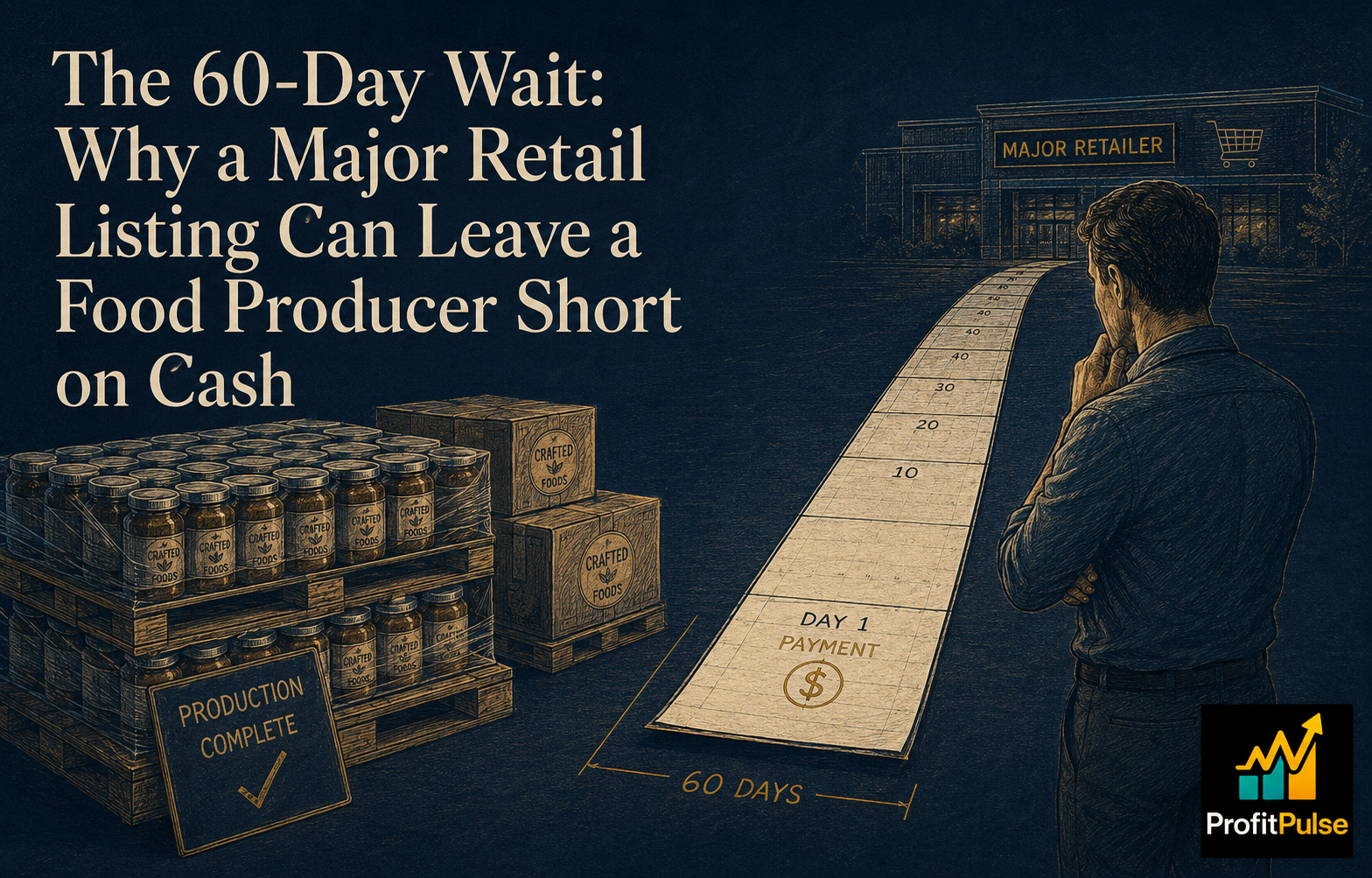
A major retailer listing is the moment many small food and beverage producers have been chasing since the day they started. National shelf space, a purchase order with real volume behind it, the kind of validation a growing brand rarely gets anywhere else. It should be the moment the business stops feeling fragile.
For a lot of producers, it is also the moment cash gets tightest rather than looser. The purchase order confirms the revenue is coming. It does not confirm when, and the gap between those two things is where otherwise profitable food and beverage businesses run into real trouble.
Major retailers typically pay on terms of forty five, sixty or sometimes ninety days from invoice, and the invoice usually cannot be raised until the goods have cleared the retailer’s own distribution centre and quality checks. A producer’s own costs, ingredients, packaging, contract labour, freight, run on a far shorter clock, most of them due before the product has even left the factory floor.
The Gap Between Making the Product and Getting Paid for It
Picture the sequence on one production run. Raw ingredients and packaging are ordered and typically paid within seven to thirty days of supply. Casual or contract labour brought on to meet the volume is paid weekly or fortnightly. Freight to the distribution centre is paid on delivery or within days. All of that cash goes out before the retailer’s own intake and quality assurance process even confirms the stock has been accepted.
Only once that confirmation happens can the producer raise an invoice, and only then does the sixty or ninety day clock actually start. By the time payment lands, ninety to a hundred and twenty days can have passed since the ingredients were first ordered. For a business running on modest margins, that is a long stretch to fund a single production run out of its own cash, and it is a gap that a profitable looking P&L does not explain on its own.
Why a Bigger Order Can Make the Squeeze Worse, Not Better
The instinct is to assume growth solves this. It rarely does, at least not on its own. A reorder from the same retailer, or a second listing with another chain, tends to land while the first invoice is still sixty days from being paid. Meeting it means funding another full production cycle before the first one has returned any cash at all.
This is the pattern behind a food producer that looks strong on paper, healthy revenue growth, gross margin holding up, and still finds itself unable to make payroll or pay a key supplier on time. It is not a profitability problem. It is a timing problem that compounds every time the order book grows, and it is one of the more common reasons a growing producer ends up needing short term finance at exactly the moment it should be celebrating a win.
Building the Cash Model Before You Sign the Next Listing
The producers who manage this well do not wait until the squeeze shows up in the bank balance. They model the cash conversion cycle for each retail relationship before accepting the volume, working out precisely how many days of production cost need to be funded between the ingredients going out the door and the retailer’s payment landing.
That number then drives three decisions: how much of the next listing to accept in the first order, whether a facility or invoice finance arrangement is needed to bridge the gap, and where supplier terms can realistically be extended without straining the relationships that keep production running. A working capital unlock that maps exactly where cash is trapped between ordering ingredients and being paid by the retailer is usually the fastest way to see the true size of the gap, rather than discovering it mid production run.
None of this means saying no to major retail listings. It means going into them with the cash model built first, not assembled after the second reorder has already landed. For food and beverage producers across Queensland and the East Coast supplying major chains, folding that view into ongoing cash flow discipline is what turns a growth story into a business that can actually fund its own growth. If that gap between production cost and retailer payment sounds familiar, it is worth booking a discovery call before the next listing is signed.
Frequently asked questions
Why do major retailers take sixty to ninety days to pay food producers
Retailer payment terms are calculated from invoice date, and the invoice usually cannot be raised until the goods have cleared the retailer’s distribution centre and passed quality assurance checks. Once that happens the standard forty five to ninety day clock begins, meaning actual cash receipt can land three to four months after the ingredients for that run were first ordered.
How can a food producer manage cash flow while waiting on retailer payment
The starting point is modelling the cash conversion cycle for each retail relationship, working out exactly how many days of production cost need to be funded before payment lands. From there, options include supplier term negotiation, invoice or trade finance, and sizing the first order to match what the business can genuinely fund, folded into ongoing cash flow discipline.
Is winning a major supermarket listing always good for a small producer’s cash
Not automatically. A listing confirms revenue is coming, not when it arrives, and the payment terms attached to it can strain cash more than a smaller, faster paying customer base would. The listing itself is usually still worth pursuing, but it needs a funded cash plan behind it rather than an assumption that growth alone will cover the gap.
What is a working capital unlock and how does it help a food producer
A working capital unlock maps where cash is trapped across debtors, inventory, supplier terms and production timing, then produces a prioritised plan to release it. For a food producer, that usually means seeing precisely how many days of cash are tied up between ordering ingredients and being paid by a retailer, and where that gap can be closed.
Should a producer negotiate payment terms before or after signing a retail listing
Before, wherever possible. Payment terms are far easier to influence during the listing negotiation than once the relationship is established and the retailer has no commercial reason to revisit them. Even a modest improvement, or an agreed early order size, can materially reduce how much production cost needs to be funded out of the business’s own cash.
How many days of cash does a growing food producer typically need to fund
It varies by supplier terms, production lead time and the specific retailer’s payment cycle, but ninety to a hundred and twenty days between ordering ingredients and receiving payment is common once distribution centre intake and quality assurance timing are included. Modelling the actual number for each retail relationship matters more than relying on an industry rule of thumb.
When should a food and beverage business bring in a fractional CFO
Usually once the business is scaling into major retail relationships and the cash timing gap between production and payment starts to outpace what a spreadsheet built for a smaller, simpler business can track. A fractional CFO engagement typically brings the cash model and the growth strategy into the same view before the gap becomes a crisis.
Leave a Reply