
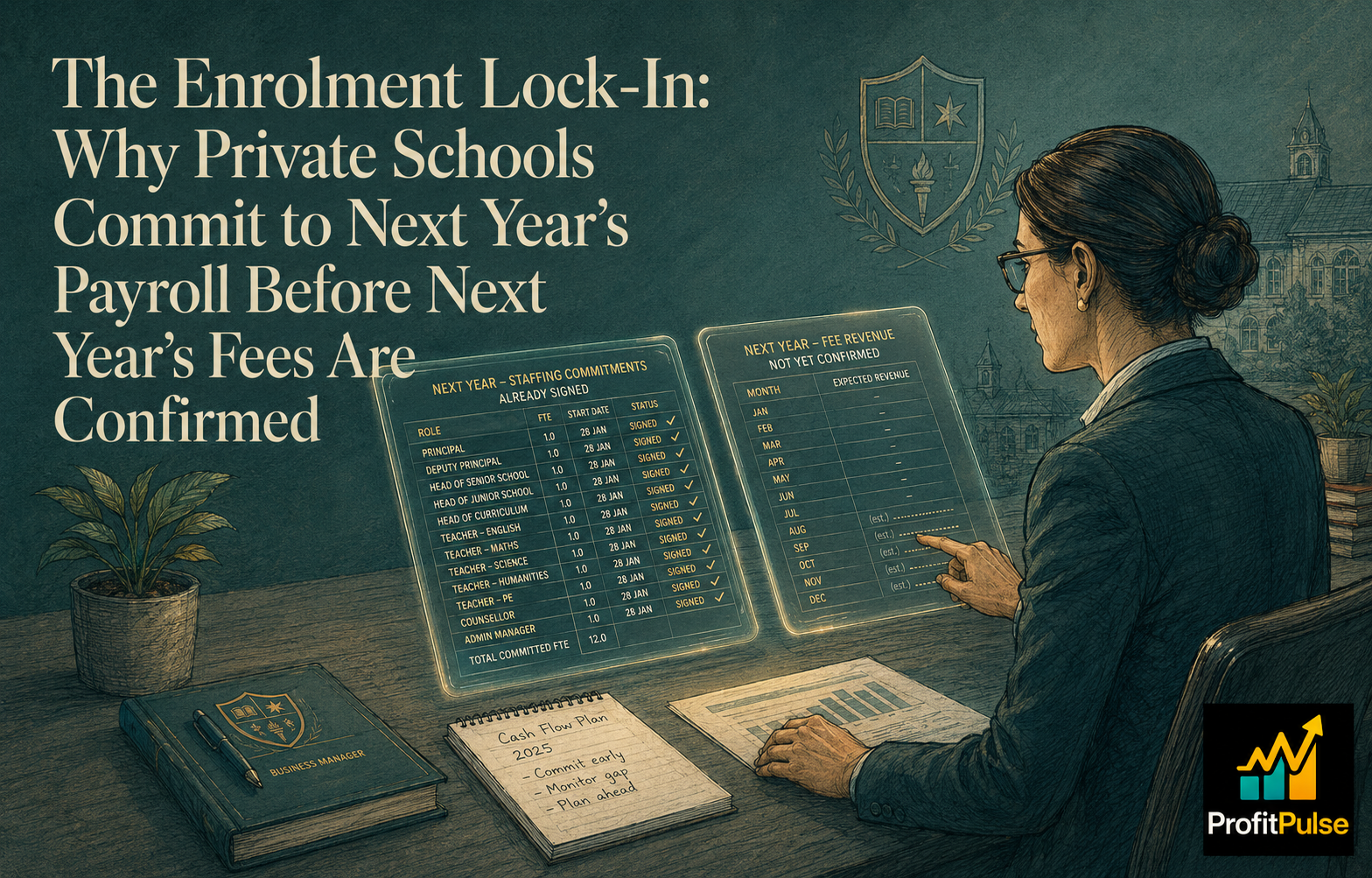
Across Queensland, NSW and Victoria, spring is when a private school makes its biggest financial commitment of the year, and it is not enrolment day or the fee due date. It is the moment staffing plans for next year are locked in. Teaching positions are confirmed or advertised, class structures are set, and the bulk of next year’s payroll is effectively decided, all built against a projected enrolment number rather than a confirmed one.
The fee revenue that funds those positions will not be fully known for months. Some families confirm early. Some wait until Term 4. Some are quietly weighing a move interstate, or back to the local state school, without saying so until the last possible moment. By the time the enrolment number settles, the staffing cost it is meant to fund has already been committed and contracted.
This is not a planning failure. It is the structure of the school calendar working against the structure of the cash cycle. Treating an enrolment forecast as though it carries the same certainty as a signed contract is usually where the pressure starts, and it tends to surface six to nine months later, well after anyone thought to look for it.
Payroll Set Against a Forecast, Not a Roster
Staffing costs in a school do not move smoothly with enrolment. They move in steps. A class needs a teacher whether it holds twenty two students or twenty six, and a subject needs a specialist whether elective numbers land slightly above or below plan. Once a staffing establishment is set for the following year, which for most schools happens through August and September, the cost is largely fixed regardless of how enrolment actually lands within a reasonable range either side of forecast.
That timing is not optional. Teaching talent in most Australian markets is scarce enough that waiting for a confirmed roll before extending or advertising a position means losing the candidate to a school that moved earlier. So the establishment gets set against next year’s projected enrolment, built from historical retention patterns, sibling pipeline and current Term 4 enquiry levels, well before the number it depends on is final.
Why the Enrolment Number and the Fee Number Rarely Match
A steady headcount does not guarantee steady fee revenue, and this is the gap that catches most bursars and business managers off guard. Sibling discounts, means-tested bursaries, staff fee concessions and early-payment discounts all sit between the published fee schedule and what actually lands in the account. A school can hold its enrolment number flat year on year and still watch its average net fee per student quietly decline, simply because the mix of who is enrolled has shifted.
Cash timing compounds the gap. Fees are typically invoiced by term, sometimes with an annual early-payment discount that pulls a portion of the year’s revenue forward while pushing the rest out to three later dates. Payroll and fixed costs, by contrast, run on a steady fortnightly or monthly rhythm from day one of the school year. The result is a business with genuinely healthy annual numbers that can still run short of cash in specific weeks, particularly early in a term before fee payments have cleared.
Forecasting From the Cost Side, Not Just the Enrolment Side
The schools that handle this well do not try to forecast enrolment more precisely. They build the year backward from what is already committed. Staffing and fixed costs are known dollar figures once the establishment is set, so those become the fixed side of the model. Fee revenue is then modelled against realistic collection timing, not the optimistic case where every family pays on the due date, and the two are laid side by side term by term rather than compared only at the annual level.
Done properly, this turns a vague sense of “enrolment looks fine” into a specific answer about which weeks of the year are tight and by how much, well before the school is inside them. A budgeting and forecasting setup that models staffing commitments against realistic fee timing, rather than against the enrolment number alone, is usually what closes this gap, and it tends to matter most for schools carrying a capital-heavy fit-out or expansion alongside the normal staffing cycle.
None of this changes when a school’s financial year actually starts. It changes how early the gap between commitment and confirmation becomes visible, and how much room there is to act on it. For principals and business managers across Queensland, NSW and Victoria heading into another enrolment cycle, building that view alongside a fractional CFO ahead of the next staffing round tends to be far more useful than reconciling it after the fact, and folding it into ongoing cash flow discipline keeps the gap from resetting to a surprise every spring. If that timing mismatch sounds familiar, it is worth booking a discovery call before the next staffing round is locked in.
Frequently asked questions
How do private schools forecast staffing costs before enrolment is confirmed
Most schools set next year’s staffing establishment through August and September, based on projected enrolment built from retention history, sibling pipeline and current enquiry levels rather than a confirmed roll. A budgeting and forecasting setup that treats staffing as the fixed side of the model and fee timing as the variable side gives a clearer, earlier read than waiting for enrolment to settle.
Why does average fee per student fall even when enrolment stays steady
Sibling discounts, means-tested bursaries, staff concessions and early-payment discounts all sit between the published fee schedule and what actually lands in the account. A school can hold headcount flat and still see net fee revenue per student decline as the mix of who is enrolled shifts, which is why enrolment numbers alone are a poor proxy for revenue health.
What is the difference between gross tuition fees and net fee revenue
Gross tuition fees are the published fee schedule multiplied by enrolment. Net fee revenue is what actually lands after sibling discounts, bursaries, fee assistance and early-payment concessions are applied. The gap between the two can be material, and it is the number that should drive cash flow planning rather than the headline enrolment figure.
How much cash buffer should a private school hold between school terms
Enough to cover payroll and fixed costs through the weeks between a term starting and the bulk of that term’s fees actually clearing, which is longer than most budgets assume. Modelling this properly as part of ongoing cash flow discipline usually reveals a buffer requirement larger than the figure most schools have historically carried.
When should a private school start planning next year’s budget
Before the staffing establishment is set, not after. Since most of next year’s payroll cost is effectively locked in through the enrolment and staffing decisions made in August and September, the budget and cash flow model needs to be built against that commitment at the same time, rather than assembled once enrolment numbers are confirmed later in the year.
How do sibling discounts and bursaries affect a school’s profitability
Each one individually is a small, sensible commercial or mission-driven decision. Together, without visibility into the cumulative effect, they can meaningfully erode average net fee per student over several years without ever showing up as a single decision anyone made. Tracking the net figure alongside the gross figure each year is the only way to see the trend before it compounds.
Can a fractional CFO help a private school manage enrolment and budget risk
Yes. The value usually sits in connecting the staffing commitment made each spring to the realistic fee revenue timeline that funds it, something that is easy to lose between an enrolment team focused on numbers and a business office focused on compliance. A fractional CFO engagement typically brings both sides into one forecast well ahead of the next staffing round.
Leave a Reply