
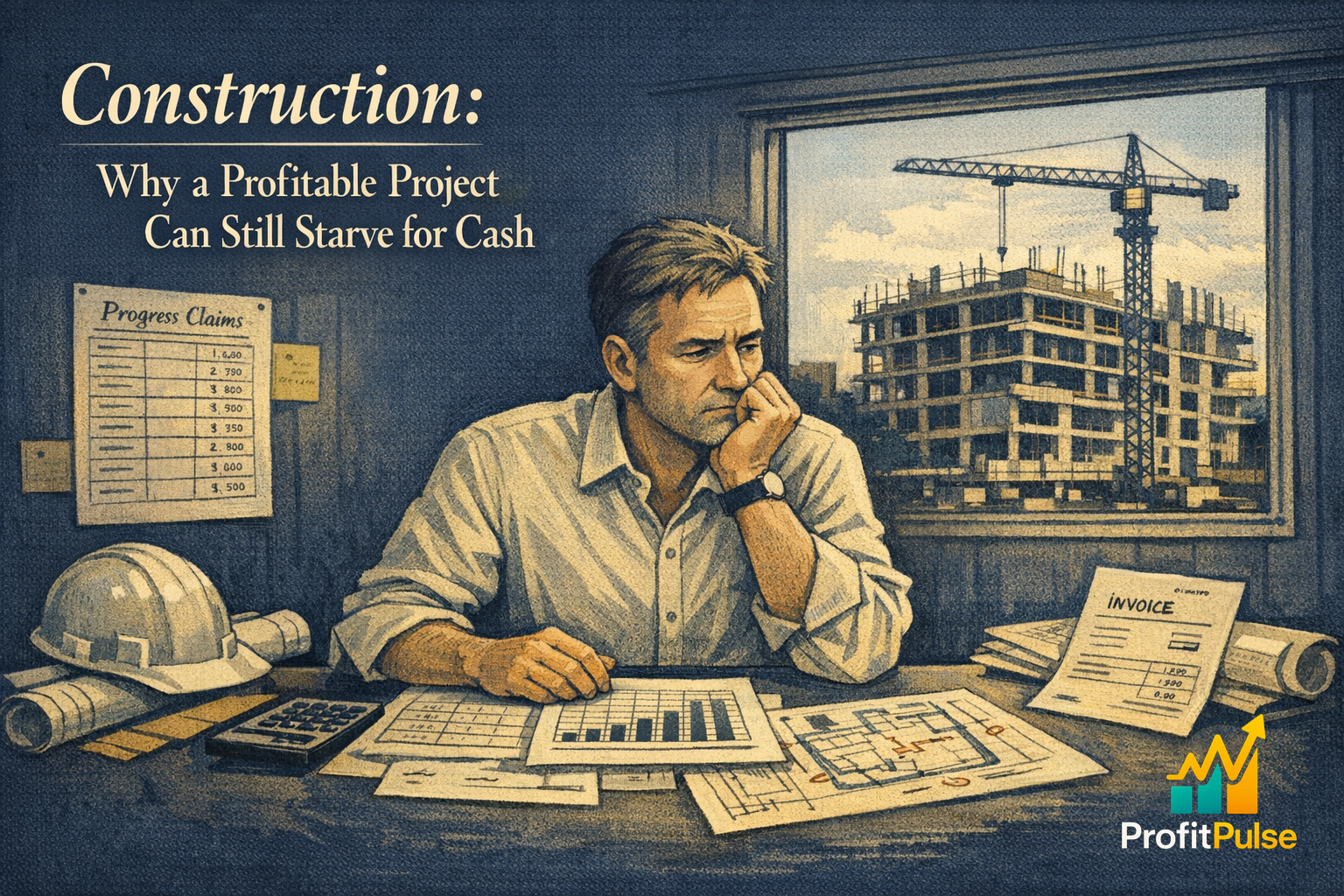
Ask a builder how a job is going and you will usually hear about the margin. The job was priced at a healthy markup, variations have been captured, and the project profit looks fine. Then payroll falls due, three subcontractors want paying, and the bank account says something very different from the project ledger. The job is profitable and the business is short of cash at the same time.
This is one of the most common and most dangerous patterns in construction, and it has nothing to do with poor pricing. It is the gap between when a project earns profit and when it actually generates cash. As Brisbane and the wider Queensland market move into the final quarter of the financial year with full pipelines, the businesses that understand that gap are the ones that will not get caught by it.
Profit is earned on paper, cash arrives on a delay
The mechanics are specific to the industry. You fund materials and labour as the work happens, but you only bill through progress claims, which are assessed, certified and paid weeks later. Retentions hold back a slice of every claim until practical completion and beyond, so a portion of your earned margin is locked away for months. Work in progress sits as value you have created but not yet invoiced. Meanwhile subcontractor payments often fall due before the client has paid you for that same work.
Stack those timing differences together and you get a structural cash gap on every active project. The job is genuinely profitable, the profit is just sitting in retentions, uncertified WIP and unpaid progress claims rather than in the bank. The faster you grow and the larger the jobs, the wider that gap becomes, which is why a strong year can feel tighter than a quiet one.
Variations deserve their own mention, because they are where the cash gap quietly widens on otherwise well-run jobs. Extra work gets carried out on the client’s instruction, the cost lands immediately in labour and materials, but the variation is not always documented, priced and claimed with the same speed. Months of accumulated variations can sit as work done and money spent but not yet billed, which is margin you have genuinely earned funding the client’s project for free until the paperwork catches up. The builders who stay liquid treat variation claims with the same urgency as the original contract sum.
Model project cash flow next to project profit
The fix is not to chase margin harder. It is to model project cash flow alongside project profit so the timing is visible before it bites. For every active job you want a view of when claims will be lodged, when they will realistically be paid, when retentions release, and when subcontractor and supplier payments fall. Laid against payroll and overhead, that shows you the weeks where cash tightens and gives you time to act rather than scramble.
This is exactly what a 13-Week Cash Flow Build does for a construction business. A rolling thirteen-week forecast, built from the accounting data and the job schedule, turns the structural cash gap from a recurring surprise into a planned position. You can see the squeeze coming, sequence claims and payments deliberately, and have the conversation with the bank or the client before the pressure hits rather than during it.
The forecast also changes how you decide on the next job. When you can see the combined cash position across every active project, a tender that looks attractive on margin can be read for what it does to cash as well. A large job with slow payment terms and heavy retentions might be profitable and still be the wrong job to start in a month when three other projects are already drawing on the same working capital. Holding that view turns the order book from a queue you simply work through into a sequence you can shape around the cash the business can carry.
The discipline that separates steady builders from caught ones
The builders who never seem to lurch from one tight week to the next are rarely the ones with the fattest margins. They are the ones who treat cash timing as a managed number. They lodge progress claims the day they are due, not the week after. They negotiate retention and payment terms with the same attention they give to pricing. They know which subcontractors can flex on timing and which cannot. None of this is glamorous, and all of it is the difference between a profitable quarter and a profitable quarter that nearly broke them.
Construction rewards operators who hold both numbers in view at once, the profit on the job and the cash through the door. There is more on building that discipline in our guide to cash flow discipline, and for builders across Brisbane heading into a busy autumn pipeline, getting the cash model right now is what keeps a full order book from quietly becoming a liability.
Frequently asked questions
Why does my construction business run short of cash on profitable jobs?
Because profit and cash arrive on different timelines. You fund materials and labour as work happens, but bill through progress claims that are paid weeks later, while retentions lock away a slice of margin for months and subcontractor payments often fall due before the client pays you. The job is genuinely profitable; the profit is just sitting in retentions and unpaid claims. A 13-Week Cash Flow Build makes that timing visible.
What are retentions and how do they affect construction cash flow?
Retentions are a portion of each progress claim the client holds back, usually until practical completion and sometimes for a defects period after. That means a slice of your earned margin on every job is locked away for months, even though you have already paid for the labour and materials that created it. Across several active projects, retentions tie up a meaningful amount of cash you have genuinely earned but cannot yet use.
How can builders in Brisbane forecast project cash flow?
Model cash flow job by job, not just at the business level. For each active project, map when claims will be lodged, when they will realistically be paid, when retentions release, and when subcontractor and supplier payments fall, then lay it against payroll and overhead. A rolling thirteen-week forecast does this well. Builders across Brisbane use this view to see tight weeks coming rather than discovering them at payroll.
Does fast growth make construction cash flow worse?
Often, yes. Each active job carries a structural gap between earning profit and receiving cash, so the more and larger the jobs you run, the wider that combined gap becomes. A strong year with a full pipeline can feel tighter than a quiet one because you are funding more work in progress, more subcontractors and more retentions at once. Growth needs to be funded deliberately, which our cash flow discipline guide covers further.
How do I avoid a cash crunch when subcontractor payments fall due?
Sequence cash deliberately rather than reactively. Lodge progress claims the day they are due, understand when each claim will realistically be paid, and know which subcontractors can flex on timing and which cannot. Negotiate retention and payment terms with the same care you give to pricing. The goal is to see the tight weeks in advance so you can act early, rather than discovering the gap when several payments land together.
What is the difference between project profit and project cash flow?
Project profit is the margin earned on the job, recognised as work is completed. Project cash flow is when money actually moves, which lags profit because of progress claim timing, retentions, uncertified work in progress and subcontractor payments. A job can show healthy profit while the cash sits in retentions and unpaid claims. Holding both numbers in view at once is what separates steady builders from those who lurch between tight weeks.
Leave a Reply