
July is usually the quiet month on a manufacturing floor. School holidays thin out the roster, customers who spent the last week of June closing off their own financial year are in no hurry to place a fresh order, and the freight backlog from the EOFY rush is only just clearing. None of this looks like a problem on paper. The management accounts still show the same gross margin percentage they showed in May.
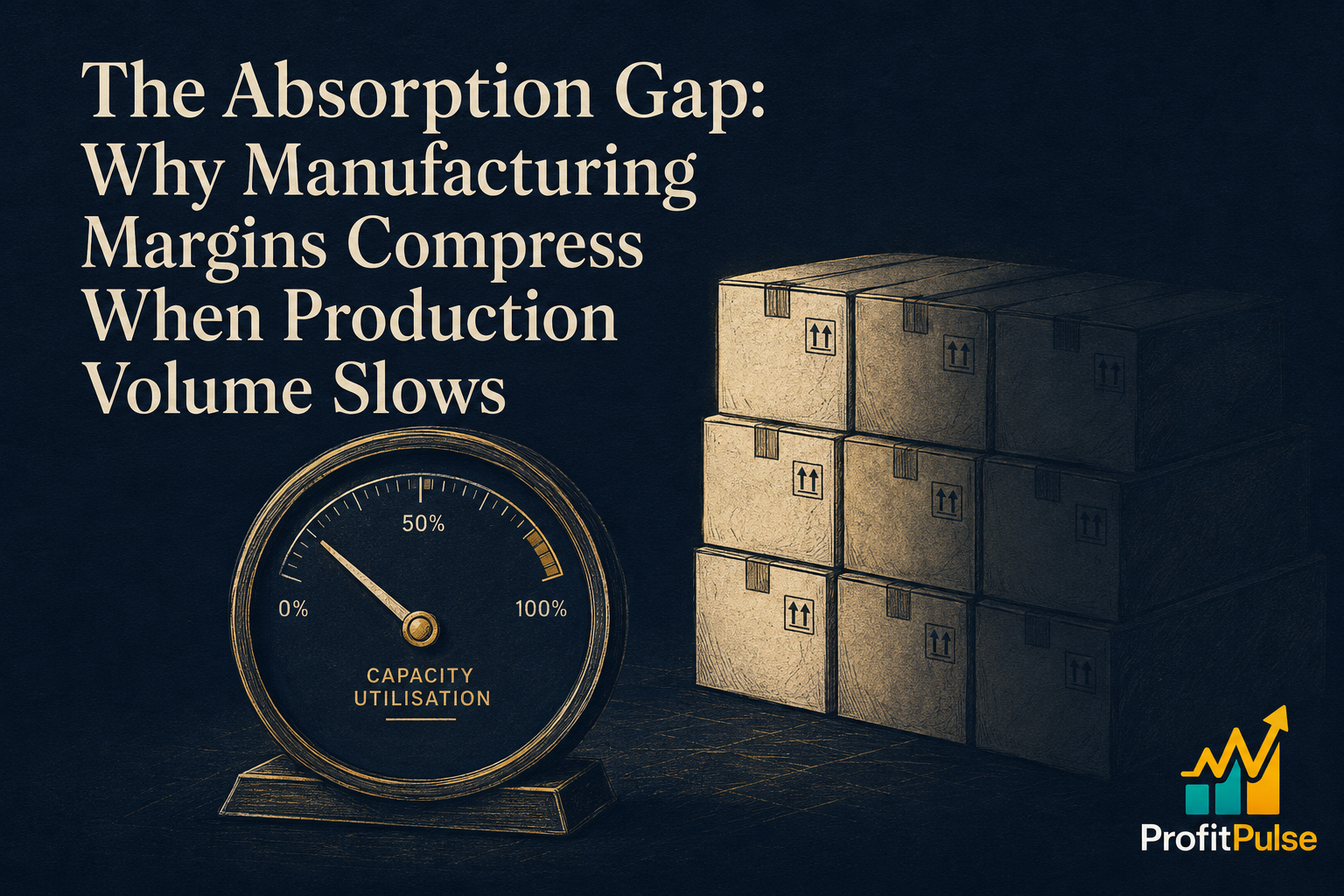
That is exactly the point at which the number stops telling the truth. Most manufacturers cost their products using a standard overhead rate, set once a year against an assumed level of production volume. The rate does not move when the actual volume does. A factory running at seventy per cent of the throughput it was costed on is still absorbing the same fixed overhead, spread across fewer units, and every one of those units is quietly more expensive to make than the cost sheet says it is.
What Overhead Absorption Actually Measures
The absorption rate is simple in theory: budgeted fixed overhead, the factory lease, equipment finance, supervisory wages, insurance, plant depreciation, divided by budgeted units of production, gives a rate per unit that gets loaded onto the standard cost of everything the business makes. It is usually set once, at the start of the financial year, and then left alone.
When actual output falls short of the volume that rate assumed, the shortfall in absorbed overhead has to land somewhere. It usually lands in a volume variance account, a line most owners have never opened, sitting well below the gross margin figure that gets discussed at the monthly review. The standard cost keeps reporting the same number it always has. The variance account quietly carries the difference between what the business assumed it would make and what the floor actually produced.
Why July Is the Month This Usually Shows Up
Most manufacturers set their standard cost using an average monthly volume, budgeted at the start of the financial year across twelve reasonably even months. July’s actual throughput rarely matches that average. Leave thins the roster, and customers in construction, retail and hospitality, the very businesses many manufacturers supply, are easing back in after their own EOFY close and in no hurry to commit to a fresh production run.
It is the same seasonal softness other industries feel in their bank balance, applied to a different lever. A manufacturer’s version of it hides inside the cost sheet rather than the cash position, which is exactly why it tends to go unnoticed for longer. Watching throughput against budget with the same discipline most businesses reserve for cash flow discipline catches the gap while it is still a monthly variance, not a full quarter of quietly eroded margin.
The Margin Report That Keeps Saying Everything Is Fine
A P&L built on standard cost applies the same rate regardless of whether the volume behind it was actually achieved, so a run of quiet months compounds without ever showing up as a headline number. Work in progress and finished goods inventory sit on the balance sheet carrying overhead that was never actually recovered in the period it was incurred, and the gap usually only becomes visible when a stocktake or a year-end reconciliation forces the standard back to what actually happened.
This is the pattern a Workforce Capacity and Utilisation Review is built to catch early, because it measures actual throughput and shift utilisation against what the business assumed it would produce, rather than waiting for the annual cost review to reveal the gap after the fact.
Making the Rate Move With the Floor
None of this requires treating every quiet month as a crisis. It requires the standard cost to be revisited more often than once a year, particularly in a business with a seasonal pattern as predictable as the one most East Coast manufacturers see every July. Tracking actual units produced against budgeted volume weekly, rather than discovering the gap at stocktake, turns a hidden margin leak into an early, manageable signal.
For a business without a finance function watching this line week to week, it is exactly the sort of pattern a fractional CFO partnership is built to catch before a quiet July becomes a quiet quarter, and before a standard cost sheet that was accurate in January stops being true without anyone noticing it happened.
Frequently asked questions
What is overhead absorption and why does it matter for manufacturers?
Overhead absorption is the process of spreading fixed factory costs, such as lease, equipment finance and supervisory wages, across the units produced, using a rate set against a budgeted volume. When actual production falls below that budgeted volume, the same fixed cost spreads across fewer units, quietly lifting the true cost of each one beyond what the standard cost sheet shows. It is the kind of pattern the ongoing oversight described in our guide to what a fractional CFO actually does is built to catch early.
How can I tell if my manufacturing overhead is under absorbed?
Check the volume variance account most accounting systems generate automatically but few owners open. A consistently unfavourable variance means actual production has been running below the level your standard cost assumed. Comparing actual units produced each month against your original budget, rather than relying on the standard gross margin percentage, is the more reliable early signal.
Why does gross margin look stable when production volume actually drops?
Standard costing applies the same overhead rate to every unit regardless of whether the volume behind that rate was achieved, so the reported margin percentage does not move even when the floor is running quieter than budgeted. The shortfall is captured separately in a variance account rather than in the headline margin figure most owners review each month.
What is a reasonable capacity utilisation rate for a small Australian manufacturer?
There is no single benchmark that applies across every product and process, since it depends on shift structure, equipment mix and order pattern. What matters more is tracking your own throughput against your own budgeted volume consistently, so a seasonal dip like a quiet July is recognised as a variance to manage rather than absorbed silently into the cost base.
How often should a manufacturing business review its standard costs?
Annually is the minimum most businesses do, but a seasonal manufacturer is better served reviewing the rate quarterly, or whenever throughput moves meaningfully away from budget. A Workforce Capacity and Utilisation Review gives a structured way to check actual throughput and unit labour cost against assumption without waiting for the annual cycle.
Does a quiet July always reduce profitability for Australian manufacturers?
Not automatically, but it is a predictable seasonal pattern worth planning for rather than discovering at stocktake. Leave-thinned rosters and customers easing back in after their own EOFY close both tend to soften July throughput for manufacturers supplying construction, retail and hospitality clients, and that softness needs to be reflected in how the month is costed, not just how it is scheduled.
What is the difference between standard costing and actual costing?
Standard costing applies a predetermined overhead rate to every unit based on budgeted volume, giving consistent, comparable numbers through the year. Actual costing recalculates the true cost each period based on what was really produced and spent. Most manufacturers run standard costing for simplicity, then reconcile to actual periodically, which is exactly where a volume-driven gap like this hides until the reconciliation catches it.
Leave a Reply