
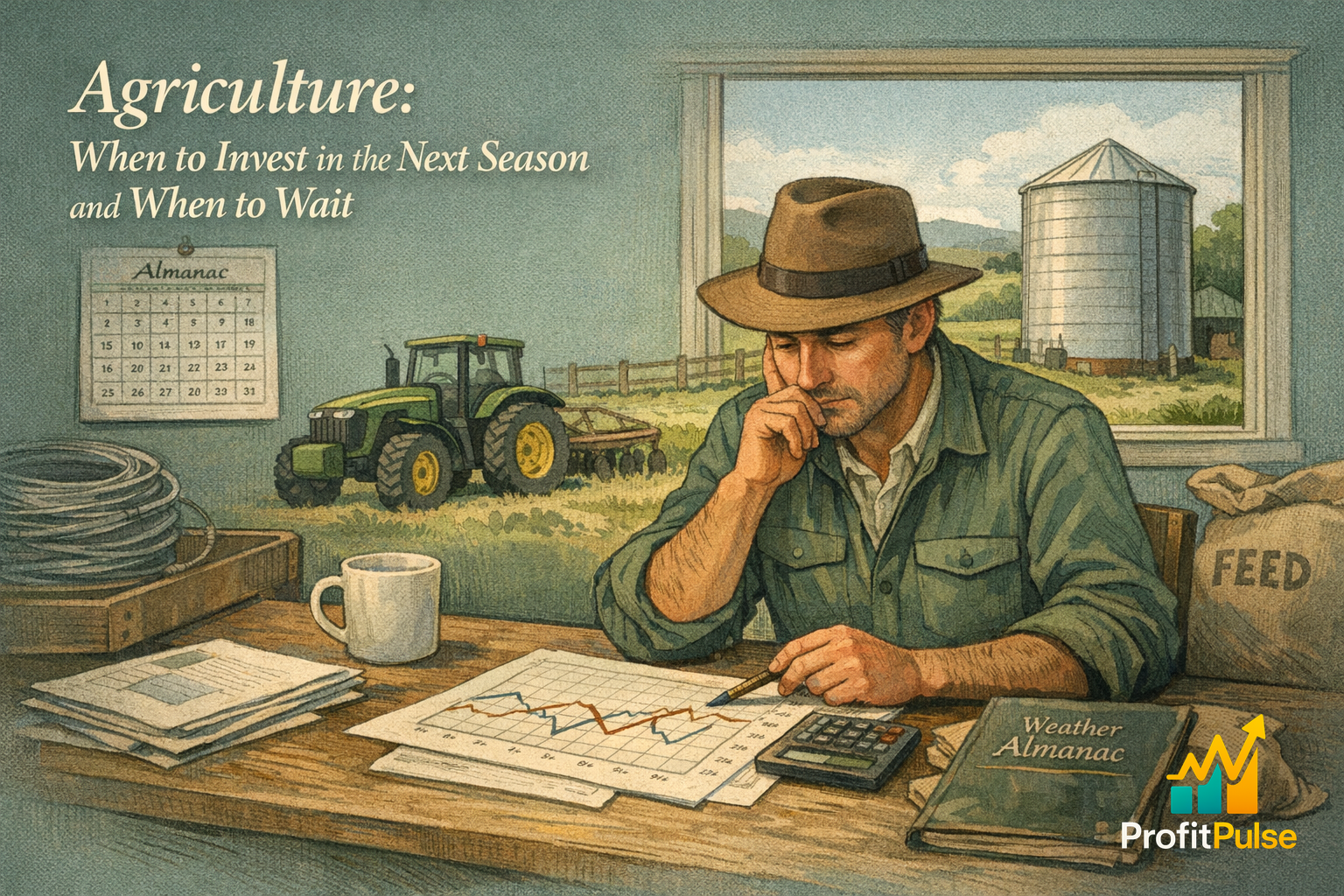
A good season leaves a particular kind of pressure behind it. The cash is there, the result was strong, and the case for investing in the next stage feels obvious: the newer machine, the extra country, the upgrade that would have paid for itself this year if only it had been in the shed. The confidence is earned. It is also the moment a capital decision most needs a colder eye than confidence alone provides.
For agriculture and primary production, capital decisions are unusually unforgiving. The amounts are large, the assets are held for years, and the return depends on seasons and prices no one controls. A piece of equipment or a parcel of land bought on the strength of one good year has to earn its keep across many years that may look nothing like that one. The question worth sitting with is not whether the business can afford the investment now. It is whether the investment will generate a return that justifies the capital across the seasons ahead.
Return per hectare, not a good year’s confidence
The discipline that separates a sound capital decision from a costly one is measuring it against expected return rather than present comfort. Return per hectare is the natural yardstick: what the additional capital is expected to generate per unit of productive land, tested across a realistic range of seasons rather than the best one just finished. A machine that lifts return per hectare meaningfully across average and poor years is a sound investment. One that only pays in a season like the last is a bet dressed as a purchase.
Capital intensity is the trap underneath this. Agriculture already ties up enormous capital in land, plant and stock relative to the income it produces, so every new commitment raises the stakes on the asset utilisation the business achieves. Capital that sits idle, the implement used a few weeks a year, the country that does not lift output enough to cover its cost, quietly drags on the return of the whole operation. The decision is not just whether the asset is useful. It is whether it will be used hard enough to justify what it cost.
This is where the alternatives deserve a fair hearing before the cash is committed. The same money that buys an implement used three weeks a year might instead clear a finance facility, fund a buffer that takes the pressure off the next lean season, or hire in the capacity at the few moments it is genuinely needed. Owning is not always the strongest use of capital, even when the cash is sitting there and the asset would be convenient to have. Contracting, hiring and sharing arrangements often deliver the same outcome without locking a large sum into something that earns its keep for a fraction of the year.
Weigh the capex against commodity and weather risk
Commodity price exposure has to sit inside the decision, not beside it. A capex case built on the prices of a strong year can look compelling and unravel the moment prices soften, because the return that justified the spend was leaning on a market that does not hold. Testing the investment against a conservative price, the kind that turns up in an ordinary or poor year, shows whether it still stands up when the market is unkind. If it only works at strong prices, it is a position on the market as much as an investment in the farm.
Weather risk works the same way. The return that pays back the capital assumes a season that produces, and seasons do not always cooperate. A sound capital decision can absorb a poor year without putting the business under strain, which means the timing matters as much as the merit. Sometimes the right move is to make the investment. Sometimes it is to hold the cash, strengthen the position, and wait for a point where the same purchase carries less risk.
A Capital Allocation Review works through exactly this, examining where capital is deployed across the operation against the return each use generates, and producing a clear recommendation on what to invest in, what to hold, and the expected return on each move. For a producer weighing a major purchase after a strong season, that independent read is the colder eye the decision deserves. Our insights on capital allocation set out how to weigh a capex decision against the risks that actually shape its return.
The best capital decision is often a patient one
Producers across Queensland know how quickly a confident season can give way to a hard one, which is precisely why the capital decisions made in the good years deserve the most scrutiny. The cash from a strong season is real, and so is the temptation to deploy it while it is there. The producers who compound their position over decades are usually the ones who invested deliberately, against expected return across the cycle, and were willing to wait when the numbers said wait.
Knowing when to invest in the next season and when to hold is among the most consequential calls a producer makes, and weighing it clearly against return and risk is the work we do alongside them. The quieter start of the year, with the last season’s result in clear view, is a sound time to make that call with a steady head.
Frequently asked questions
How should farmers decide whether to invest in new equipment?
Measure the investment against expected return rather than present comfort. Return per hectare is the natural yardstick: what the additional capital should generate per unit of productive land, tested across a realistic range of seasons rather than the best one just finished. A machine that lifts return across average and poor years is sound. One that only pays in a season like the last is a bet dressed as a purchase.
What is return per hectare and why does it guide capex decisions?
It is what a given investment is expected to generate per unit of productive land, which makes it the cleanest way to compare a capital decision against its cost. Tested across average and poor seasons, not just a strong one, it shows whether a purchase genuinely lifts the operation’s return or only pays in a good year. Using it keeps a capex case grounded in productivity rather than the confidence a single season leaves behind.
How does commodity price risk affect farm investment decisions?
A capex case built on the prices of a strong year can look compelling and unravel when prices soften, because the return justifying the spend was leaning on a market that does not hold. Testing the investment against a conservative price shows whether it still stands up when the market is unkind. If it only works at strong prices, it is a position on the market as much as an investment in the farm.
When should a Queensland producer wait rather than invest after a good season?
When the investment only pays at strong prices or in a producing season, the patient move is often to hold the cash and wait for a point where the same purchase carries less risk. Producers across Queensland know how fast a confident season can turn, which is why the capital decisions made in good years deserve the most scrutiny. A sound decision can absorb a poor year without straining the business.
What is a capital allocation review for a farm business?
It examines where capital is deployed across the operation, land, plant, stock and proposed purchases, against the return each use generates, and produces a clear recommendation on what to invest in, what to hold, and the expected return on each move. A Capital Allocation Review gives a producer weighing a major purchase after a strong season the independent, colder eye that a large and long-held decision deserves.
Why is capital intensity a risk for agricultural businesses?
Agriculture already ties up enormous capital in land, plant and stock relative to the income it produces, so every new commitment raises the stakes on the asset utilisation achieved. Capital that sits idle, the implement used a few weeks a year, the country that does not lift output enough to cover its cost, drags on the return of the whole operation. The question is not just whether an asset is useful, but whether it will be used hard enough to justify its cost.
Leave a Reply