
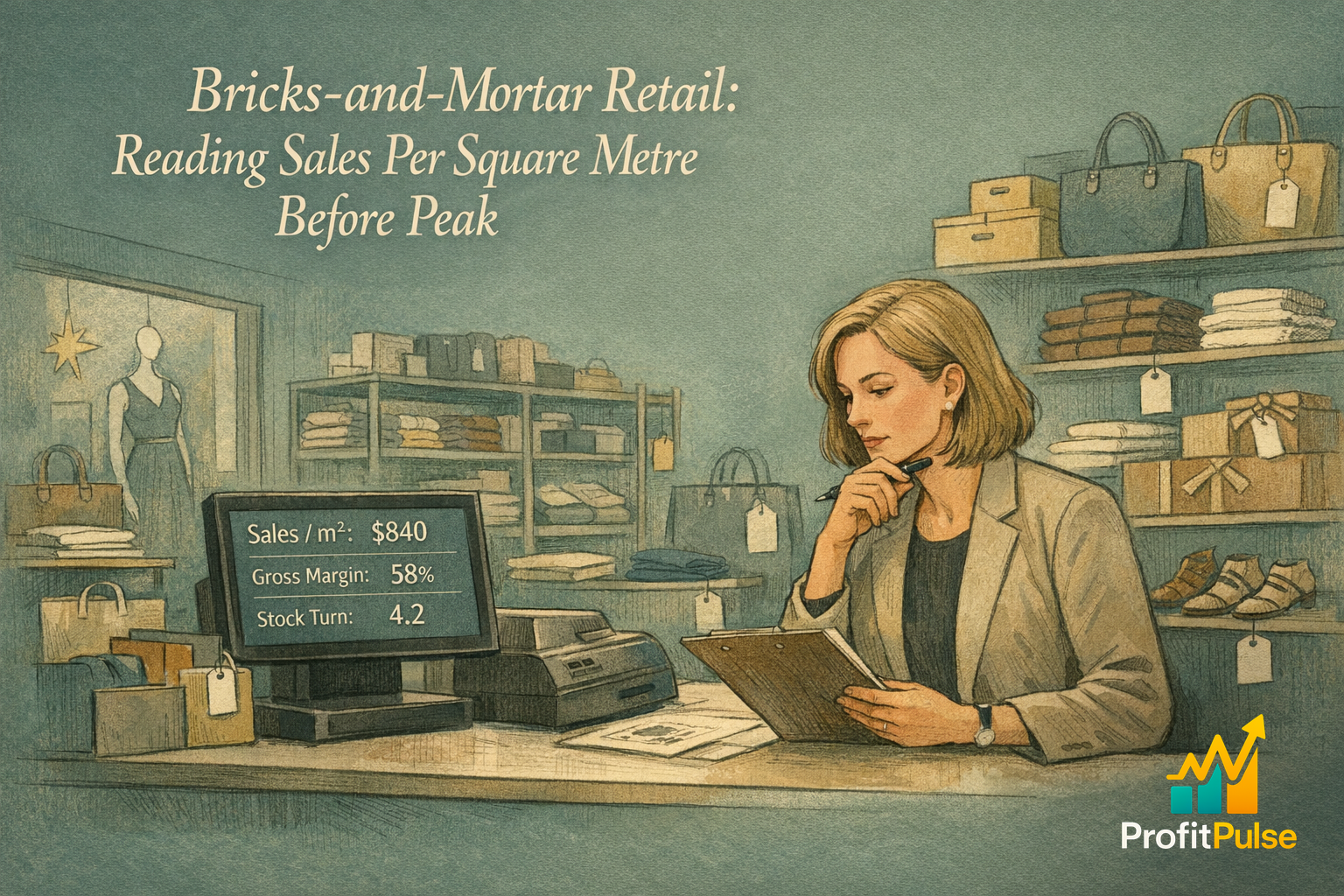
Spring is stocktake and planning season for bricks-and-mortar retail, the weeks where open-to-buy budgets for Christmas get set and the floor plan for peak trading takes shape. It is also the moment where a lot of retailers make their most expensive decisions on the loosest information, committing money to stock and space based on what sold last year rather than what actually paid.
The instinct is to judge the floor by sales. The category that turned over the most revenue feels like the one to back. But revenue and margin contribution are not the same thing, and a retailer planning peak on sales alone can pour open-to-buy budget into space that looks busy and earns little. Reading the floor by what it contributes, not just what it rings up, separates a profitable peak from a frantic one.
Sales per square metre tells you what the floor is really earning
Sales per square metre is the most honest measure of how hard a section of the shop is working, and margin per square metre is more honest still. A category can dominate the revenue line while occupying so much floor and carrying such a thin margin that it earns less per metre than a quieter corner. Until you measure it that way, the busy-looking section keeps its prime position by default rather than by merit.
The arithmetic is not complicated, which is part of why it gets skipped. Take the gross margin a category generated over a season and divide it by the space it occupied, then rank every category the same way. The exercise almost always surprises an owner, because the section that feels like the heart of the shop frequently sits in the middle of the ranking rather than the top. A bulky, discount-driven line can carry the headline sales figure while a compact, full-margin line three metres away quietly earns more per metre and asks for far less space to do it.
This matters most right before peak, because the floor plan you set for Christmas locks in for the highest-traffic weeks of the year. Giving prime space to a high-revenue, low-margin category is an expensive way to look busy. Reallocating space toward what actually contributes is one of the highest-return exercises a retailer can run before the rush. A Product & Service Line Profitability works through the floor this way, ranking each line by what it genuinely earns rather than what it turns over.
Stockturn decides whether open-to-buy pays
The second number is stockturn, how quickly inventory sells through and converts back to cash. A category with strong sales but slow stockturn ties up open-to-buy budget that could have funded faster-moving lines, and the gross margin return on inventory tells you which categories actually justify their share of the buy. A slow line with a healthy margin can still be a poor use of cash if it sits on the shelf for months.
Stockturn is also where the peak punishes a loose buy hardest. Cash committed to a slow-moving category in October cannot be reordered into a line selling out in early December, and the lines that sell out are usually the ones earning the strongest margin. Over-buy the slow line and under-buy the fast one, and the season ends with markdowns on one shelf and missed sales on another. Reading gross margin return on inventory before the buy, rather than reconciling it afterwards, keeps the open-to-buy flowing toward the lines that turn.
Before committing the Christmas open-to-buy, the question is not just which categories sell, but which return their cash quickly enough to keep funding the next order through the peak. Reading stockturn and gross margin return on inventory together is what stops a strong-looking buy from quietly starving the business of cash.
The basket and the adjacencies earn quietly too
Sales per square metre and stockturn read each line on its own, but a shop floor does not work in isolation, and average basket size is where the connections show up. Some lines barely justify their space on their own numbers yet consistently lift the basket, pulling a customer toward a higher-margin purchase nearby. A considered impulse range near the counter can earn its keep through what it sells around it rather than what it sells itself.
The practical move before peak is to read the floor as a set of adjacencies, not a list of categories. Placing a strong-margin, high-turn line in the path the Christmas crowd actually walks, and moving a slow, space-hungry one to a quieter corner, can lift the whole floor’s contribution without a single extra dollar of buy. The data shows where the traffic and the margin already sit; the floor plan decides whether they get used.
Plan the peak on contribution, not last year’s sales
The thread through all of this is a single shift: judge the floor and the buy by what they contribute, not by what they sold last year. Last year’s sales tell you what was popular. They do not tell you what paid, what tied up cash, or what earned its space. A peak planned on sales alone repeats last year’s hidden inefficiencies at scale.
The retailers who go into Christmas with a clear read on sales per square metre, stockturn and margin contribution trade the peak deliberately rather than hopefully. For retailers across Brisbane and the East Coast setting open-to-buy budgets now, that read is the difference between a busy Christmas and a profitable one. ProfitPulse helps owners see which lines and which metres actually earn, so the peak is planned on contribution rather than guesswork. You will find more on reading a business by its real numbers across our insights.
Frequently asked questions
What is sales per square metre and why does it matter for retail?
It measures how much revenue a section of the shop generates relative to the floor space it occupies, and margin per square metre is more honest still. It matters because a high-revenue category can occupy so much space at such a thin margin that it earns less per metre than a quieter corner. Reading the floor this way, rather than by total sales, shows which sections genuinely deserve their prime position before you lock in the Christmas floor plan.
How should a retailer set its open-to-buy budget before Christmas?
By judging categories on contribution and stockturn, not just last year’s sales. A line can sell well but turn slowly, tying up budget that faster-moving lines could have used. Gross margin return on inventory shows which categories justify their share of the buy. A Product & Service Line Profitability ranks each line by what it genuinely earns, so the open-to-buy funds the lines that pay rather than the ones that simply looked busy.
Why is stockturn important when planning peak trading?
Because stockturn decides how quickly inventory converts back to cash, and at peak that cash funds the next order. A category with strong sales but slow stockturn quietly starves the business of cash in the busiest weeks, even if it looks healthy on revenue. Reading stockturn alongside gross margin return on inventory tells you which lines return their cash fast enough to keep the buy moving through the rush.
Should retailers reallocate floor space before the Christmas peak?
It is one of the highest-return exercises before the rush. The floor plan you set locks in for the highest-traffic weeks of the year, so giving prime space to a high-revenue, low-margin category is an expensive way to look busy. Reading margin per square metre across the floor and shifting space toward what actually contributes can lift the result of the whole peak without a single extra sale.
What retail metrics best predict a profitable peak season?
Sales and margin per square metre, stockturn, gross margin return on inventory and average basket size together give the clearest read. Sales alone tells you what was popular, not what paid or what tied up cash. The lines that lift the basket earn their place differently from those that sell well alone. Reading these together lets you plan the peak on contribution rather than repeating last year’s hidden inefficiencies at a larger scale.
Why is planning peak on last year’s sales a mistake?
Because last year’s sales tell you what was popular, not what paid, what tied up cash, or what earned its space. A peak planned on sales alone repeats last year’s hidden inefficiencies at a larger scale, just when the stakes are highest. Judging the floor and the buy by contribution instead, using margin per square metre and stockturn, is what turns a busy Christmas into a profitable one. Our wider insights cover reading a business by its real numbers.
Leave a Reply