
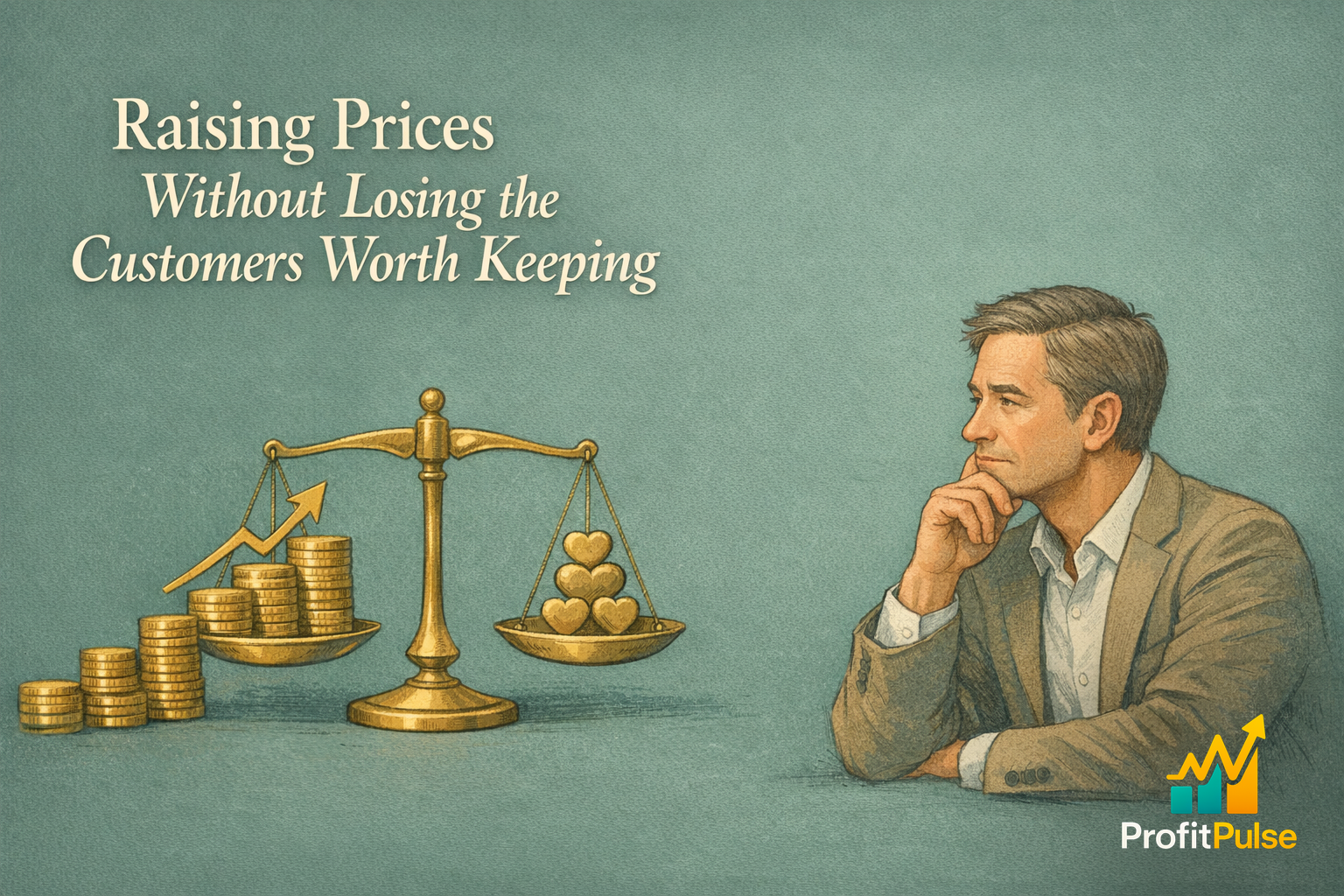
Of all the ways to lift profit, raising prices is the fastest and the one owners are most afraid of. A cost cut takes effort to find and effort to hold. A new customer takes marketing spend and time to land. A price increase, by contrast, flows almost entirely to the bottom line, because the cost of delivering the product or service barely changes. And yet most owners will do almost anything before touching their prices, because the fear of losing customers looms larger than the certainty of the extra margin.
That fear is real but it is usually overstated, and it is overstated for a specific reason. Owners imagine a price increase as a single flat percentage applied to everyone at once, which is indeed the riskiest way to do it. Done that way, the increase lands hardest on the customers least able to absorb it and softest on the ones who would happily pay more. A careful price increase is a different exercise entirely, and it carries far less risk than the blunt version owners are picturing.
Not every customer is the same, so not every price should move the same
The starting point is customer profitability. Some customers are highly profitable, easy to serve, loyal and not especially price-sensitive. Others are marginal, demanding, and already paying close to what the relationship is worth. A flat increase treats these two as identical, which is exactly why it feels dangerous. A considered increase reads the difference and moves prices where the value supports it, which is usually a long way from a single percentage across the board.
The customers worth keeping, the profitable, loyal ones, are also generally the most tolerant of a fair, well-communicated increase, because the relationship is about value rather than price. The customers a flat increase risks losing are often the marginal ones the business is barely earning from anyway. Seen clearly, a thoughtful price increase tends to protect the relationships that matter and gently filter the ones that do not, which is close to the opposite of the fear that holds owners back.
How you make the change matters as much as the size of it
The number is only half the exercise. How an increase is communicated decides how it lands, and the same percentage can read as either fair or arbitrary depending on the telling. An increase delivered with notice, with a brief and honest reason, and framed around the value the customer receives, tends to be accepted with barely a ripple. The same increase dropped without warning on the next invoice invites a phone call, because it feels like something done to the customer rather than agreed with them. Giving a long-standing customer a few weeks of notice costs nothing and changes the entire tenor of the conversation.
The arithmetic also tends to reassure owners once they see it. If a business runs on a thirty percent gross margin, it can lose a meaningful slice of volume after a price rise and still come out ahead, because the remaining sales each carry more margin. The exact figures depend on the business, but the shape of it holds. A well-placed increase almost always leaves the business better off even when a few of the most price-sensitive customers drift away, and those are usually the customers the increase was quietly meant to filter in the first place.
Price to value, not to cost alone
The other shift is from pricing off cost to pricing off value. Cost sets a floor, the level below which a sale loses money, but it does not set the ceiling. The ceiling is set by what the product or service is worth to the customer, and for genuinely valued work that figure is frequently well above where the price currently sits. Owners who have not revisited prices in a year or two are often charging against an old sense of their own value rather than the current one.
A Pricing Reset approaches the increase exactly this way. It reads customer profitability, tests where price tolerance genuinely sits, and recommends a defensible change grounded in value rather than a flat figure pulled from nerves. The result is usually a lift in gross margin that the business keeps, achieved without the customer exodus owners feared, because the increase was placed where it would hold rather than spread where it would hurt.
The lever owners reach for last
Pricing power is one of the strongest signals of a healthy business, and it is closely tied to value. A business that can raise prices and keep its best customers is a business that has built genuine worth, and that worth shows up not only in this year’s margin but in the eventual value of the business itself, because buyers pay more for businesses with demonstrated pricing power. The price list is one of the few documents that touches both today’s profit and tomorrow’s sale price.
If your prices have not moved while your costs and your value have, this quarter is a sensible time to look at them with intent, before the next round of quotes goes out. You can see how a structured approach works on the pricing page. ProfitPulse helps owners raise prices where they will stick and protect the relationships worth protecting, which is the version of a price increase that owners rarely fear once they have seen it done properly.
Frequently asked questions
Why is raising prices the fastest way to lift profit?
Because a price increase flows almost entirely to the bottom line. The cost of delivering the product or service barely changes, so the extra revenue is nearly all margin. A cost cut takes effort to find and hold, and a new customer takes marketing spend and time to land. Pricing, by contrast, is immediate and the gain is kept. It is the fastest lever owners have, which is also why leaving it untouched is so expensive over time.
Will raising my prices make me lose customers?
Less than most owners fear, when the increase is considered rather than flat. The customers worth keeping are generally the most tolerant of a fair, well-communicated increase, because the relationship is about value rather than price. The ones a flat increase risks losing are often the marginal customers you are barely earning from anyway. A thoughtful increase tends to protect the relationships that matter and gently filter the ones that do not, which is close to the opposite of the fear.
Why is a flat percentage price increase risky?
Because it treats every customer as identical when they are not. A flat increase lands hardest on the customers least able to absorb it and softest on the ones who would happily pay more. It ignores customer profitability and price tolerance entirely. That is exactly why owners find price increases frightening, they are picturing the blunt version. A considered increase reads the differences and moves prices where the value supports it, which carries far less risk.
What does pricing to value rather than cost mean?
Cost sets a floor, the level below which a sale loses money, but it does not set the ceiling. The ceiling is what the product or service is worth to the customer, and for genuinely valued work that figure is often well above the current price. Pricing to value means setting prices against that worth rather than just marking up cost. Owners who have not revisited prices in a year or two are usually charging against an old sense of their own value.
How does pricing power affect what my business is worth?
Pricing power is one of the strongest signals of a healthy business, and buyers pay more for it. A business that can raise prices and keep its best customers has built genuine worth, and that worth shows up in both this year’s margin and the eventual sale price. The price list touches today’s profit and tomorrow’s business value at the same time, which is why demonstrated pricing power is such a valuable thing to build deliberately.
How do I decide which customers to raise prices for?
Start with customer profitability. Identify which customers are highly profitable, loyal and not especially price-sensitive, and which are marginal and already paying close to what the relationship is worth. Move prices where the value supports it, which is usually a long way from a single percentage across the board. A structured pricing review tests where price tolerance genuinely sits and recommends a defensible change, so the increase is placed where it holds rather than spread where it hurts.
How often should an Australian SME review its prices?
At least once a year, and sooner if costs or the value you deliver have moved noticeably. Prices left untouched while costs rise quietly erode margin, and prices left flat while your value grows leave money on the table. Reviewing them with intent, rather than reaching for a nervous flat increase, keeps your pricing aligned with both your cost base and your worth. The close of a quarter is a sensible point to look before the next round of quotes goes out.
Leave a Reply