
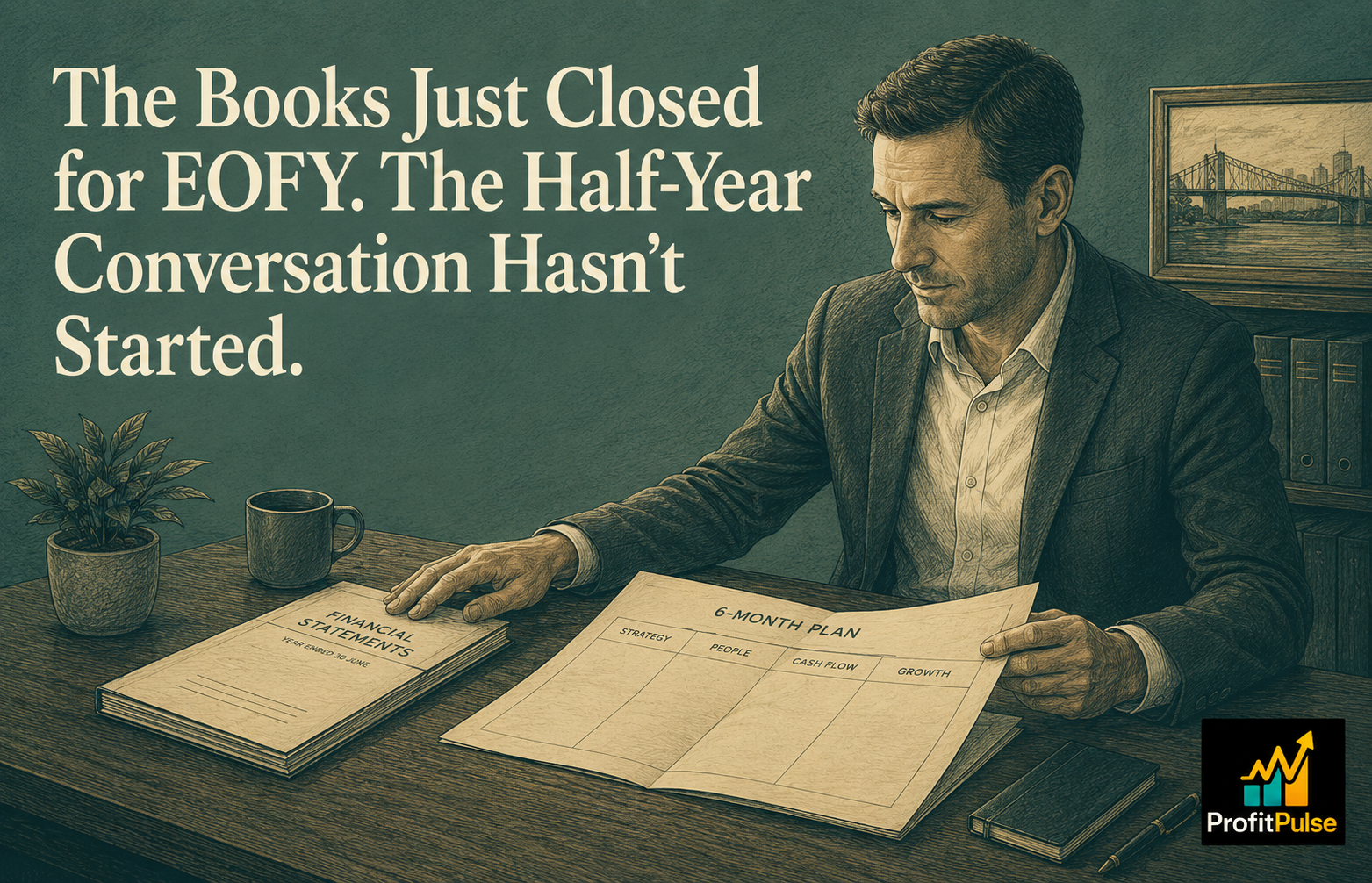
By the third week of July, most owner-led businesses across Queensland, New South Wales and Victoria have finally put FY26 to bed. The BAS is lodged, the final numbers are with the accountant, and the tax position is settled. There is a particular kind of relief that comes with finishing that job, the same relief as clearing a big compliance deadline off the desk.
But closing the books and using them are two different exercises, and most owner-led businesses only ever complete the first one. The FY26 numbers get filed, referenced again briefly when the tax return is finalised in a few months, and otherwise left alone until next June rolls around and the same cycle repeats. Six months of accurate trading data, sitting unused as the input to any actual decision.
That gap is easy to miss, because nothing about it feels urgent in the moment. There is no deadline attached to sitting down and asking what the first half of the year actually says about the second. So for most owner-led businesses, that conversation simply never gets a date on the calendar, and the closed books quietly become the least examined version of the numbers all year.
What the bookkeeper finishes, and what nobody picks up
This is not a gap in the compliance work. Your bookkeeper or BAS agent has done exactly what they are meant to do: reconcile the year, lodge on time, keep the business legitimate in front of the ATO. That is real and necessary work, and it is not the same work as asking what those closed numbers say about the next six months. Compliance accounting is built for the ATO’s calendar. Nobody is naturally positioned to turn it into the business’s own decisions unless someone owns that as a separate task.
The result, in most owner-led businesses, is a strange asymmetry. The most detailed, most accurate financial picture of the year arrives in July, precisely at the point when almost nobody is looking at it. By August, everyone has moved back to running the business day to day, and the half-year debrief that should have happened never does.
What a half-year debrief actually looks like
Done properly, it is a short, structured conversation rather than a lengthy exercise. It asks three things: where did H1 land against whatever plan or budget existed at the start of the year, what changed in the market or the business that the plan did not anticipate, and what needs to shift for H2 as a result. Pricing set in January deserves a second look once six months of real margin data exists. Hiring plans built on projected revenue deserve checking against the revenue that actually landed. Cash positions assumed at budget time deserve testing against the cash position actually sitting in the account.
None of that requires a lengthy report. Naming three specific risks the second half of the year is carrying, and three specific opportunities worth chasing while there is still time to act on them, does more for a business than another dense set of variance tables nobody reads past the first page. The value sits in the clarity of the three and three, not in the volume of analysis behind it.
This is close to what a Financial Health Check is built to do on a quarterly cadence: a structured review against the plan, with three forward risks and three opportunities named explicitly, so the business heads into the next quarter with a clear read rather than a vague sense that things are probably fine.
Why it rarely happens without someone owning it
The honest reason most owners skip this conversation is not a lack of discipline. It is that nobody inside the business is specifically responsible for stepping back from the day to day and running it. The owner is the one person with the full picture, and the owner is also the busiest person in the building. A structured half-year review competes for time against every operational fire that week, and the operational fire usually wins.
This is the actual value a fractional CFO adds that is easy to underestimate before you have one. It is less about any single insight and more about owning the cadence: making sure the half-year conversation happens on schedule, with the right numbers in front of the right people, whether or not the week has been calm enough to make space for it on its own. The pattern we see across owner-led businesses is that the conversation gets easier, not harder, once someone is responsible for simply making sure it occurs.
If FY26 is closed and nobody in the business has yet asked what it actually means for the six months ahead, that gap is worth naming before it becomes a pattern for another year. Understanding what a fractional CFO does day to day is a reasonable place to start, or book a discovery call and we can run through your H1 numbers together.
Frequently asked questions
How often should an Australian SME review its financial performance?
Most owner-led businesses check the numbers monthly out of habit, but a genuine review, one that asks what changed and what needs to shift, works best on a quarterly rhythm. Six months in, at EOFY and again at the calendar half-year, is the minimum. Building that cadence into a fractional CFO arrangement removes the risk of it slipping when the business gets busy.
What does a fractional CFO do that a bookkeeper does not?
A bookkeeper or BAS agent keeps the ledger accurate and the business compliant with the ATO, which is essential and entirely different work. A fractional CFO takes those same accurate numbers and turns them into decisions: pricing, hiring, cash timing and where to direct the next dollar of capital. Both roles matter, and they sit alongside each other rather than in competition.
Is EOFY the right time to do a full six month business review?
It is one of the best times, because the numbers are already reconciled and final rather than provisional. The mistake most businesses make is treating EOFY purely as a compliance deadline rather than also using the closed, accurate figures it produces as the input for a half-year strategic conversation before the data goes stale.
What is included in a quarterly financial health check for a business?
A structured quarterly financial health check compares actual performance against the business plan, names three forward-looking risks and three opportunities, and gives the owner a clear, current read on the business every ninety days rather than a vague sense that things are probably tracking fine.
When is a business ready to bring in a fractional CFO?
Readiness is less about revenue size and more about whether financial decisions are being made on stale or partial information. If EOFY numbers close and nobody translates them into a plan for the next six months, that is a clearer signal than any specific turnover threshold. This guide covers the common triggers in more detail.
Do I still need my accountant if I bring in a fractional CFO?
Yes. Your accountant or bookkeeper continues to own the compliance and lodgement work, which a fractional CFO does not replace or duplicate. The two roles work from the same numbers but toward different ends, one keeping the business compliant, the other turning those numbers into forward decisions.
How much does a quarterly financial health check cost for an SME?
Cost depends on the size and complexity of the business and how much of the review needs building from scratch versus refining an existing rhythm. The pricing page sets out current ranges, and most owners find the ninety-day cadence pays for itself in decisions made earlier rather than six months late.
Leave a Reply