
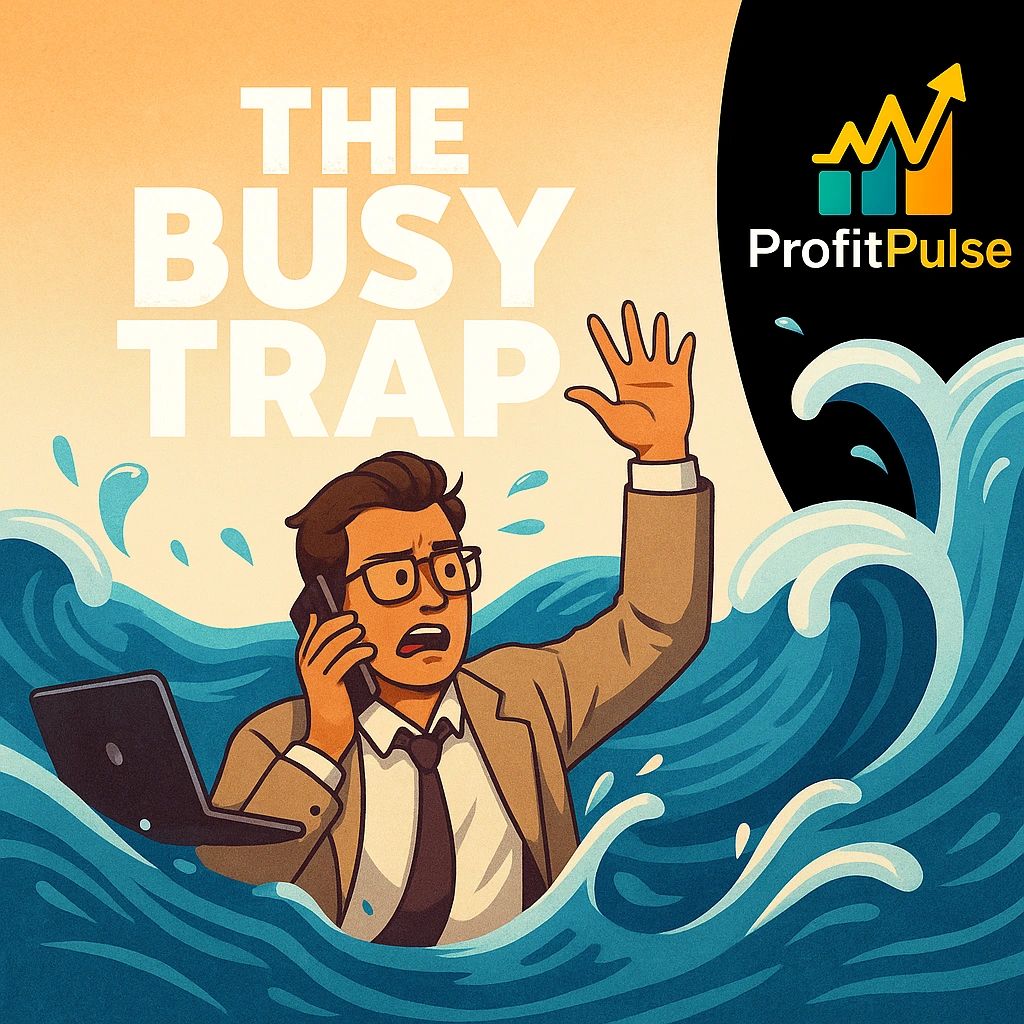
Walk into any cafe early in the morning and you’ll spot them: business owners already on their second coffee, checking emails before the day even begins.
By evening, they’re still at it. Answering customer questions, approving invoices, chasing staff rosters, and mentally calculating next week’s cash flow, all while their inbox keeps growing.
The rhythm is relentless, and familiar!
Many owners wear this kind of busyness as a badge of honour. Long hours mean commitment, right? It feels productive, purposeful, necessary. Yet, somewhere between sunrise and the next seven-day week, they start to notice something uncomfortable: despite all the effort, profit isn’t growing in proportion to the energy being spent.
This is what we refer to as The Busy Trap.
It’s when effort becomes a substitute for clarity. The to-do list grows, but insight doesn’t. The business looks active but forward momentum is lacking.
Effort and Profit Don’t Always Travel Together
Working hard has always been part of running a business, and that’s admirable. But effort on its own doesn’t guarantee progress.
You can be busy building quotes, managing teams, and solving problems, yet you could still be missing the few activities that actually increase the bank balance.
Profit doesn’t reward effort, it rewards focus.
There’s a subtle but important difference between being productive and being profitable. Productivity is about doing more. Profitability is about doing what matters most, better and continuously.
Where Most Businesses Lose Leverage
When I speak to business owners who are in The Busy Trap, three patterns are evident:
1. Pricing hasn’t kept pace with value
Many businesses set their pricing years ago and never revisit it. Inflation, cost of delivery, and customer expectations evolve, yet pricing often stays fixed. The result? More work for the same or even less return.
2. Processes rely too much on people, not systems
If you find yourself solving the same problem twice, that’s a process gap, not bad luck.
Automation, better delegation, and smarter workflows protect both your time and your margin.
3. Focus spreads too thin across low-value work
Owners often chase every lead or opportunity, believing more activity equals more income. But not all work is equal.
The highest-performing businesses spend time on the 20% of clients or products that generate 80% of their profit, without losing sight of the value that each client brings.
The takeaway is simple: when energy is scattered, returns are diluted.
The Power of Leverage
Leverage doesn’t mean doing less, it means getting more value from what you already do.
- A single pricing review can create more profit than months of cutting costs.
- An hour spent designing a process might save five hours of manual follow-up later.
- Choosing the right kind of customer to serve can double margins without adding workload.
These are the quiet wins that come from stepping off the treadmill long enough to look around.
When you understand your true drivers of profitability: pricing, process, and positioning, you realise that growth isn’t about running faster. It’s about running in the right direction.
A Simple Reflection
If hard work alone built profit, every exhausted business owner would already be a millionaire.
So, ask yourself this week:
Where is your effort earning less than it should?
Which parts of your day are creating motion but not progress?
Sometimes the best way to grow your business is to stop working harder and start working clearer.
At ProfitPulse, we help Australian business owners find that clarity, turning effort into insight, and motion into measurable profit.
Book Your ProfitPulse Consultation
If you’re ready to see how much hidden profit exists in your business, book a complimentary 45min Discovery Call with ProfitPulse today.
Frequently asked questions
Why does my business feel busy but not profitable?
Almost certainly because the busy work and the profitable work are not the same work. Most owner-led businesses make seventy percent of their profit from twenty percent of their activity, but the other eighty percent of activity feels equally urgent. Without measurement, the profitable work gets crowded out by the busy work.
How do I escape the busy trap as an SME owner?
Audit your time for two weeks. Tag each block as growth, maintenance, or distraction. Most owners discover that the growth bucket is much smaller than they thought, and the distraction bucket is much larger. Naming the buckets is usually enough to start reallocating. The harder discipline is doing this every quarter.
What is the difference between activity and revenue-generating work?
Activity keeps things moving. Revenue-generating work either acquires new customers, deepens existing customer value, or improves the price or margin of what you already do. Most operational work falls into neither category. Sorting honestly between the two reveals the leverage points that have been there all along.
How do I focus my time on what actually grows the business?
Build the operational rhythm that runs without you, then protect three to five hours a week for strategic work. Most owners try to do this in reverse, working strategically when there is time and operationally the rest of the time. The result is that strategic time never happens. Diary discipline beats good intentions.
Can a fractional CFO help me work less and earn more?
For most owners, yes, because the work that a fractional CFO takes off your desk is precisely the financial and analytical work that should not have been on your desk in the first place. Most owners recover six to ten hours a week within the first quarter of engagement, which is enough to reinvest in growth work that compounds.
Leave a Reply