
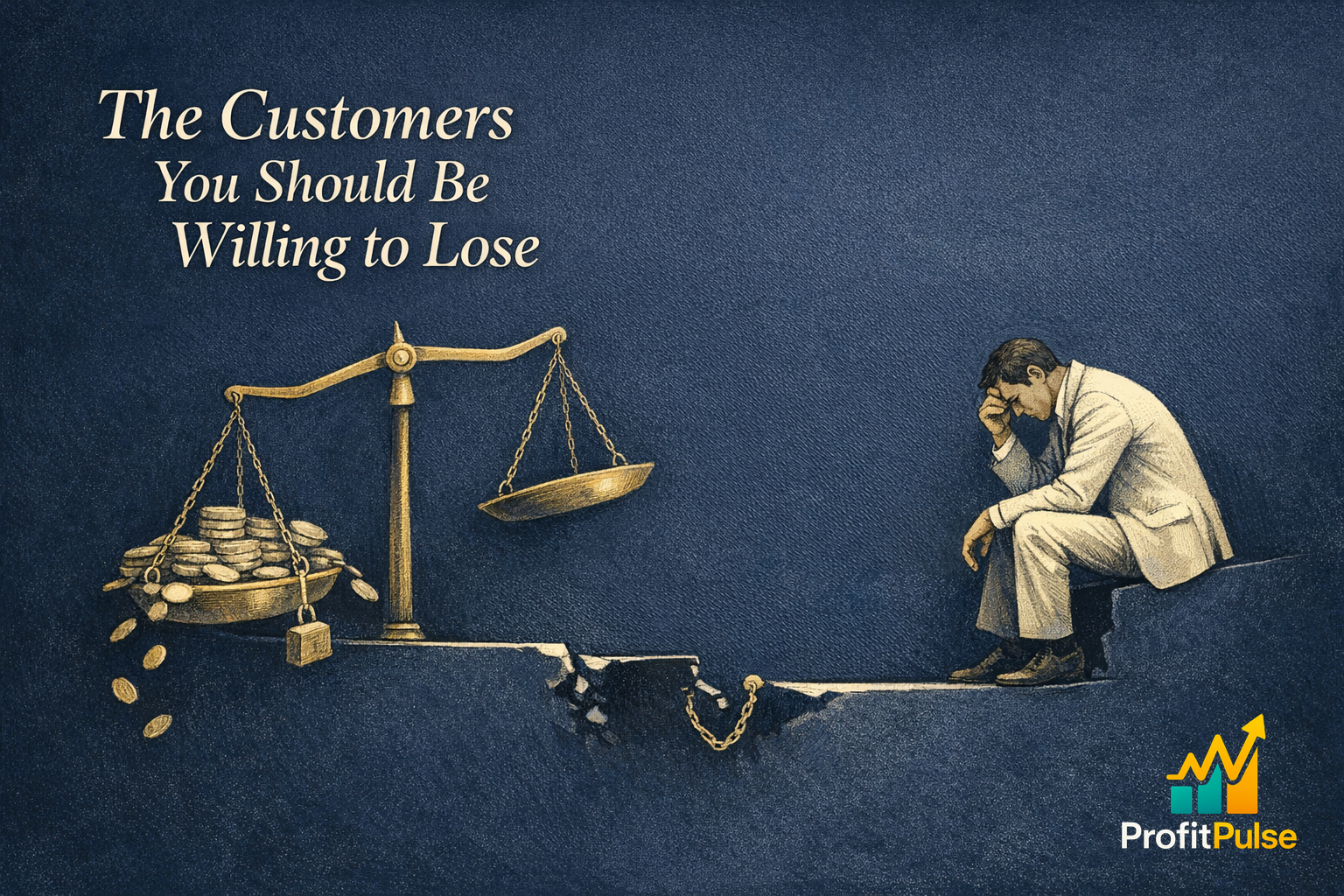
Every business has them, even if it has never named them: customers who generate revenue but consume more than they return. They pay slowly, demand disproportionate attention, push for discounts, change scope constantly, and absorb the time of your best people. On the revenue line they look like contributors. On the profit line, once you account for the true cost of serving them, they are quietly subtracting.
The uncomfortable truth is that letting some customers go can do more for profit than winning new work, because the new work has to be won, delivered and collected, while the cost of a loss-making customer disappears the moment they do. Most owners resist this idea instinctively, because revenue feels like progress. But not all revenue is created equal, and the discipline to tell the difference is one of the more reliable margin levers a business has.
The loss-makers hide inside healthy-looking revenue
The reason these customers persist is that standard reporting hides them. Your profit and loss tells you the total margin across all customers. It does not tell you that a handful of accounts are dragging the average down while the rest carry them. The revenue from a difficult customer looks identical on the page to revenue from an ideal one, which is exactly why the problem goes unaddressed for years.
Seeing it requires ranking customers not by revenue but by profit contribution after the real cost to serve. That cost includes the obvious, such as discounts and slow payment, and the less obvious, such as the hours your team spends managing them, the rework caused by constant scope changes, and the opportunities your best people miss because they are tied up. When you load all of that in, the picture often reorders dramatically. The top revenue customers are frequently not the top profit customers, and some sit below the line entirely. A Customer Concentration & Profitability Map is built precisely to surface this, ranking every customer by margin contribution and effort to serve.
The cost to serve that does the most damage is the one that never appears on an invoice: the attention of your most capable people. When a senior team member spends a day managing a demanding low-margin account, the cost is not only their time. It is the higher-value work they did not do, the better customer who waited, the improvement that was not made. That opportunity cost is invisible in any ledger, which is exactly why a draining account can persist for years while quietly capping what the rest of the business could have earned. Naming it is uncomfortable precisely because it makes the trade-off explicit.
Letting go is a decision, not a failure
Naming a loss-making customer does not always mean firing them. Often the better first move is to fix the relationship: reprice it to reflect the real cost, tighten the scope, or change the terms so the account pays its way. Many customers, presented fairly with the reality, will accept a sensible adjustment, and the account moves above the line. The point is to make the decision deliberately rather than carry the loss by default.
For the accounts that cannot be made to work, letting them go releases capacity, attention and cash that can be redirected toward customers who actually pay for the value they receive. The release is rarely a single dramatic moment. It is the senior person who suddenly has a day back, the team that stops bracing for the next difficult request, the capacity that was always there but was being consumed by an account that never paid for it. Owners who make this move are often surprised that the lost revenue is replaced faster than expected, because the freed capacity goes straight into work that returns more.
This is rarely about difficult people. It is usually about a relationship that was priced or scoped for a different time and never revisited. Framing it that way makes the conversation easier and keeps it fair to everyone involved.
Profit follows focus, not volume
The businesses that quietly outperform are often not the ones with the most customers. They are the ones that know exactly which customers drive their profit and protect their capacity for them. Profit does not reward serving everyone equally. It rewards focusing your best resources on the work that returns the most.
This is also why protecting the good customers is as much a part of the discipline as addressing the loss-makers. The accounts that pay fairly, decide quickly and value the work are easy to take for granted precisely because they cause no trouble, and the quiet danger is that the capacity they deserve gets consumed by the demanding accounts that shout louder. Once the profitability ranking is in front of you, the obvious next move is to make sure your strongest people and your best response times go to the customers who actually earn them, rather than to whoever happens to be the most insistent that week.
This discipline also shows up in value. A business with a clean, profitable customer base, free of accounts that drag the margin, is worth more than one carrying hidden loss-makers, because the quality of earnings is higher. There is more on how customer profitability feeds enterprise value in our guide to business valuation, and for owners ready to look honestly at who they serve, identifying the customers you should be willing to lose is often the fastest profit decision available, with more on this theme across our insights library.
Frequently asked questions
How do I know which customers are unprofitable?
Standard reporting hides them, because your profit and loss shows the total margin across all customers, not the spread. You find them by ranking customers by profit contribution after the real cost to serve, which includes discounts, slow payment, the hours spent managing them and the rework from constant scope changes. The picture usually reorders dramatically. A Customer Concentration & Profitability Map is built to surface exactly this.
Why can losing a customer actually increase your business profit?
Because the cost of a loss-making customer disappears the moment they do, while new work has to be won, delivered and collected before it pays. A customer who consumes more in time, rework and slow payment than they return is subtracting from profit even though they add to revenue. Releasing that capacity and attention, and redirecting it to customers who pay for the value they receive, often lifts profit more than chasing new accounts.
Should I fire unprofitable customers or fix the relationship?
Often fixing it is the better first move. Repricing the account to reflect the real cost, tightening the scope or changing the terms can move it above the line, and many customers, presented fairly with the reality, will accept a sensible adjustment. Firing is for the accounts that genuinely cannot be made to work. The point is to make the decision deliberately rather than carry the loss by default, year after year.
What is the true cost of serving a customer?
More than the discounts and slow payment that show up obviously. It includes the hours your team spends managing the account, the rework caused by constant scope changes, and the opportunities your best people miss because they are tied up. Loading all of that in often reveals that top revenue customers are not top profit customers, and some sit below the line entirely once the real effort to serve them is counted.
Does customer profitability affect what my business is worth?
Yes. A business with a clean, profitable customer base is worth more than one carrying hidden loss-makers, because the quality of earnings is higher and the profit is more durable. Buyers pay more for earnings they can trust to continue. Removing accounts that drag the margin both lifts current profit and improves how the business is valued. Our guide to business valuation covers how earnings quality feeds enterprise value.
How does focusing on fewer customers improve profitability?
Profit follows focus, not volume. The businesses that quietly outperform are rarely the ones with the most customers; they are the ones that know exactly which customers drive their profit and protect their best resources for them. Spreading your strongest people thinly across every account, including the ones that drag the margin, dilutes the return. Concentrating effort on the work that pays for its value is one of the more reliable margin levers available.
Leave a Reply