
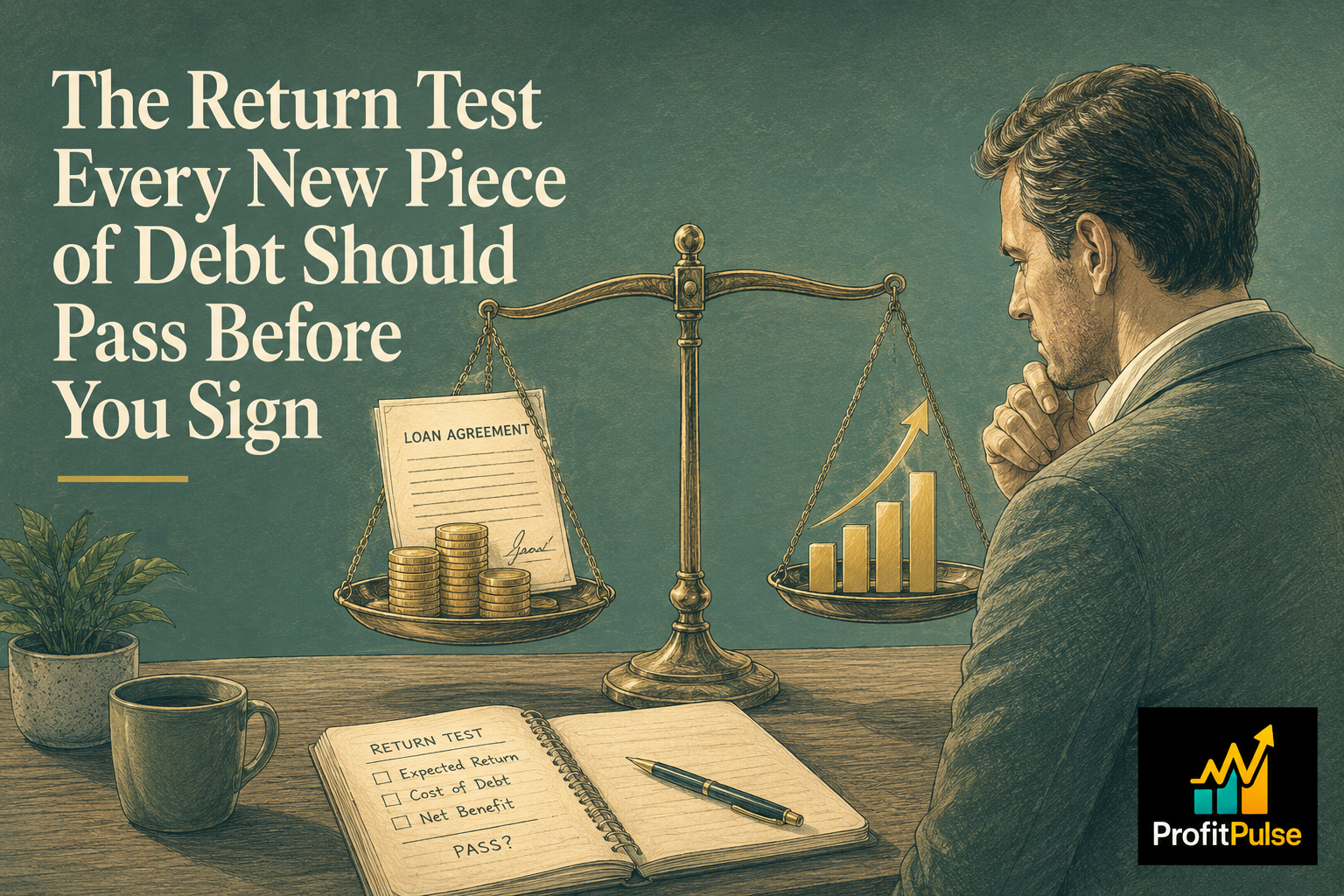
A bank says yes. The relief of that approval can feel like validation, as though the decision has already been made and made well. But approval only answers one question: can the business service the repayments from the cash it already generates? It says nothing about whether the thing the loan is funding, the new machine, the second site, the extra hire, will actually return more than it costs.
Serviceability and return are different tests, and owner-led businesses tend to run only the first one. The bank runs its own version of the second test on its own behalf, protecting its own capital, which is not the same as protecting yours. By the time the facility is drawn and the asset is delivered, the only test left is whether it worked, and by then the debt is on the balance sheet either way.
Late July is when this gap shows up most often. FY26 is closed, the new financial year has some momentum behind it, and the growth decisions that were parked over EOFY start moving again: a second location in Sydney or Melbourne, a fleet upgrade, a round of hiring ahead of a busy spring. Each one usually starts with a conversation about whether the repayments fit, not whether the return clears the bar.
What Approval Actually Measures
A lender’s serviceability test looks backward and sideways: historical cash flow, existing obligations, security available, industry risk profile. It is designed to answer one question, whether the business can meet repayments even through a softer trading period. It is a real and useful test. It is also entirely indifferent to whether the specific thing being funded is a good use of that capital.
This is where the pattern we see most often begins. An owner treats the bank’s approval as though it settles the underlying question, when the bank was never asking that question in the first place. The fractional CFO conversation with clients is rarely about whether they can borrow the money. It is almost always about whether they should, given what the borrowed capital needs to earn back.
The Number the Approval Letter Never Shows
Every piece of debt carries a hurdle: the minimum return the funded investment needs to generate before it is worth taking on. At a baseline, that hurdle is the all-in cost of the debt itself, the interest rate plus establishment fees, account fees and any security costs folded in. But the true hurdle sits a little higher than that number, because a loan that merely breaks even against its own interest rate still consumes management time, reduces flexibility, and adds a fixed repayment the business now carries regardless of how the investment performs. A sensible margin above the raw interest cost, to account for that risk and effort, is what turns a serviceability figure into a genuine decision rule.
Once that hurdle is set, the test becomes straightforward to apply, even without perfect precision. A second site needs to be judged against what it will plausibly add to profit, not revenue, once it is trading normally. A fleet upgrade needs to be judged against the cost saving or capacity gain it enables, not against how tired the old vehicles look. An extra hire needs to be judged against the margin they will generate once fully utilised, not against how stretched the team feels today.
Where the Test Usually Gets Skipped
The businesses that skip this step are not being careless. They are usually moving fast, trusting that growth decisions which felt right at the time will justify themselves later. The pattern shows up most clearly around expansion decisions with a long or vague payback: a second location chosen because the first one is full rather than because the numbers on the second one have been modelled, or a round of hiring brought forward because the team feels stretched rather than because the additional capacity has a clear revenue line attached to it.
None of this means the decision was wrong. Many of these investments do pay off. The issue is that the return was assumed rather than tested, which means the business finds out whether it worked at the same time everyone else does, well after the money is already spent.
Running the Test Before the Meeting, Not After
The more useful sequence reverses the usual order. Before approaching a lender, model what the specific use of funds needs to return to clear its hurdle, using the actual cost of the facility being considered rather than a rough guess. That number then becomes the standard the investment is measured against, both before the loan is signed and again a year later when it is possible to check whether the return actually showed up. This is precisely the discipline a Strategic Growth Diagnostic is built around, mapping revenue, capacity and margin headroom into a funding plan where each dollar of new capital carries an expected return before it is deployed, not after.
Approaching a lender with that number already worked out changes the conversation too. A business that can explain what a facility needs to earn back, and how that figure was reached, is a different proposition to one that can only explain what the repayments will be. The preparation that goes into a capital raise matters just as much for a straightforward equipment loan as it does for a larger raise.
The businesses we see borrow well are rarely the ones with the lowest interest rate on offer. They are the ones who ran the return test before they ran the serviceability test, so the two questions never got confused with each other in the first place. If that number has never been written down for the debt already sitting on your balance sheet, or the debt you are about to take on, a conversation before you sign is worth more than one after.
Frequently asked questions
How do I know if a business loan is a good investment and not just affordable?
Affordability only tells you the repayments fit current cash flow. Whether it is a good investment is a separate question: does the thing the loan funds return more than the loan costs, once interest, fees and the time it takes to manage the change are all counted. Run both tests, not just the one the bank already ran for its own purposes.
What is a hurdle rate and how should an Australian SME business set one?
A hurdle rate is the minimum return an investment needs to clear before it is worth funding. For most SMEs it starts at the all-in cost of the debt and adds a margin for risk and management effort, so a genuinely marginal investment does not sneak through just because the interest rate looked low. A fractional CFO can help set one that fits the business.
Does a bank approving a loan mean the investment behind it will pay off?
No. Approval means the lender believes the business can service the repayments from existing cash flow, which protects the lender’s capital. It says nothing about whether the specific asset, hire or site the loan is funding will generate a return above its own cost. Those are two different tests, and only one of them is the bank’s job to run.
What return should a new location or piece of equipment generate before it is worth financing?
At minimum, enough additional profit, not revenue, to clear the true cost of the debt funding it plus a margin for risk and the management attention it will absorb. Modelling that figure against a realistic trading scenario, rather than the best case, is core to a Strategic Growth Diagnostic.
How do I work out the true cost of a business loan in Australia?
Add the headline interest rate to establishment fees, ongoing account or line fees, and any cost attached to the security the lender requires, then express the total as a single effective rate over the life of the facility. Comparing that figure, not just the advertised rate, against the expected return is what makes the comparison meaningful.
When does equity make more sense than debt for funding SME growth?
Debt suits investments with a fairly predictable, near-term return, because the fixed repayment has to be met regardless of how the investment performs. Equity suits growth with a longer or less certain payback, since it shares the risk rather than fixing an obligation against cash flow. The preparation involved in a capital raise differs accordingly.
Is it better to fund a growth decision from retained profit or from new borrowing?
Neither is automatically better. The same hurdle rate test applies either way, since retained profit has an opportunity cost even without a lender attached to it. The more useful question is whether the investment clears that hurdle at all, before deciding which pool of capital should fund it.
Leave a Reply