
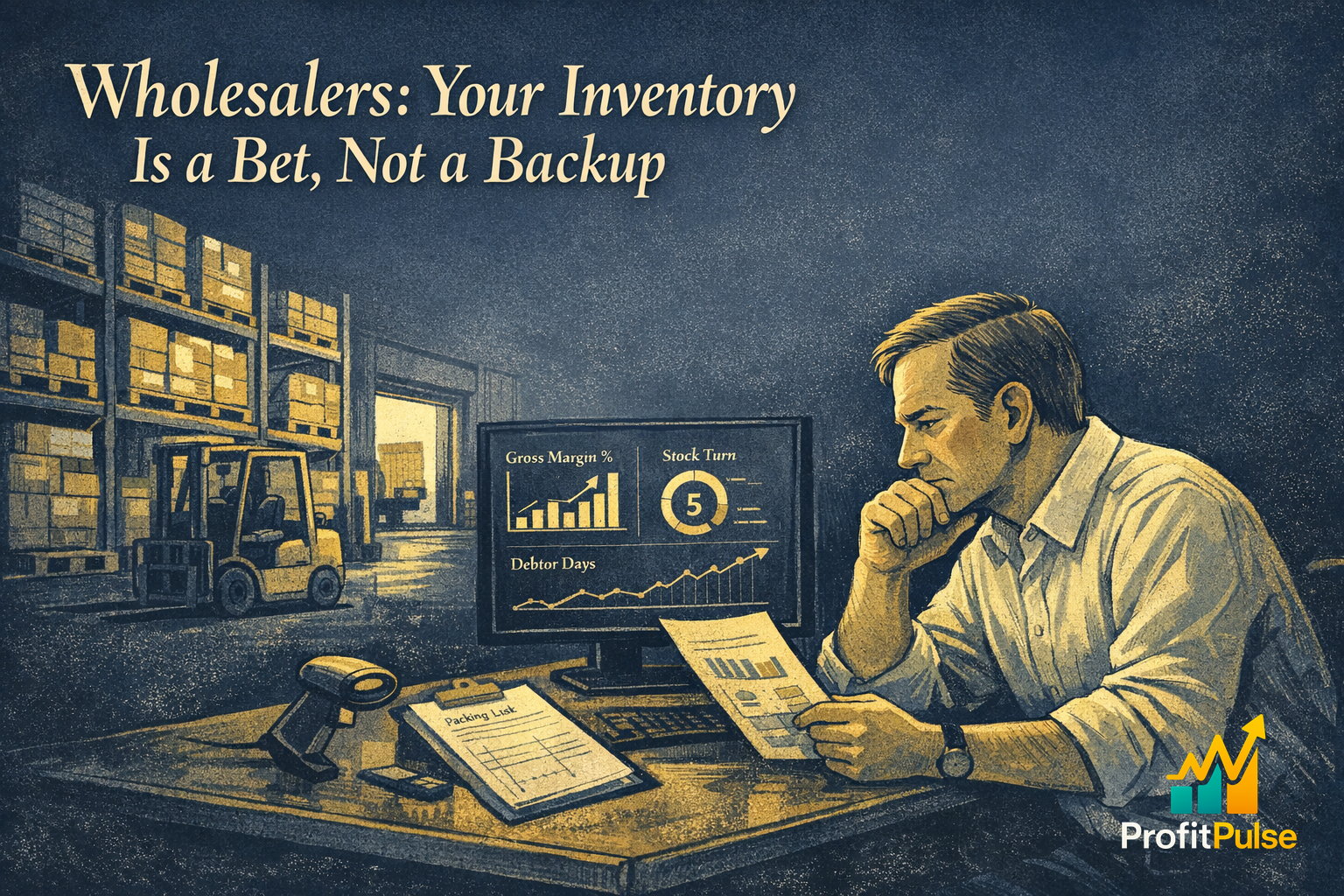
For a wholesaler, a full warehouse before Christmas feels like readiness. The shelves are stocked, the popular lines are deep, and there is comfort in knowing you can fill any order that lands. That comfort is real, and it is also expensive. Every unit on the shelf is cash that has already left the business and not yet come back, and not all of it is going to come back at the rate the warehouse implies.
Inventory gets treated as a backup, a safety net against running short. It behaves more like a bet. Each line is a wager that demand will arrive before the cash tied up in it is needed elsewhere. Some of those bets are excellent. Some have been sitting on the shelf for two seasons, quietly costing money to store while pretending to be an asset.
The pattern across distribution businesses is not too little stock or too much. It is stock that is not read closely enough to tell the difference.
Stockturn tells you what is actually moving
The single most useful number on a warehouse shelf is stockturn, how many times a line sells through and gets replaced in a period. A high stockturn line is cash working hard, cycling through repeatedly and earning each time. A low stockturn line is cash sitting still, and the days inventory outstanding on it tells you exactly how long it has been parked.
The reason this matters most before peak is that the busy season tempts every distributor to deepen stock across the board. Demand looks strong, suppliers offer volume deals, and the warehouse fills. But deepening a slow line because the season feels busy is doubling down on a bet that was already losing. The lines worth backing are the ones with the stockturn to justify the cash, and the fill rate to prove customers actually want them at the depth you are holding.
Gross margin return on inventory ranks the shelves
Stockturn on its own is only half the picture, because a fast-moving line on a thin margin can earn less than a slower line on a rich one. Gross margin return on inventory brings the two together, measuring how much gross margin each dollar of inventory generates. It is the number that ranks the shelves honestly, separating the lines that earn their cash from the ones that merely occupy it.
Run that ranking and the dead stock becomes obvious. These are the lines low on both turn and margin, the ones that survive in the warehouse because no one has looked at them squarely. Clearing them, even at a discount, releases cash that a better line can put to work through the peak. This is the heart of cash flow discipline for a distributor, where the warehouse is the largest single use of cash in the business.
The ranking is also where a distributor decides what to do with the cash it frees up. Releasing money from dead stock only helps if it is redeployed deliberately, into deepening the lines that earn, shortening the terms on a strong supplier, or simply holding it through the thin weeks after the peak. Clearing slow stock and then immediately tying the proceeds back up in another marginal line is motion without progress. The point of reading the shelves is to put each freed dollar somewhere it works harder than where it sat.
Supplier terms are part of the inventory equation
How a line is funded matters as much as how fast it turns, and it is easy to overlook when the focus is on what sells. A line bought on thirty-day terms but taking ninety days to sell ties up the distributor’s own cash for the sixty-day gap, while a line that sells inside the supplier’s payment terms is effectively funded by the supplier rather than the business. Two lines with identical stockturn can place completely different demands on cash depending on the terms behind them. Negotiating longer terms on the slower lines, or shortening the holding on the lines where the terms are tight, changes the cash position without changing a single sale. Reading inventory without reading the supplier terms beside it misses half of what the warehouse is actually doing to the bank balance.
This is why the strongest distributors treat purchasing terms as a lever, not a given. The volume deal that looks attractive on unit price can be a poor deal on cash if it deepens a slow line on short terms, and a modest order on generous terms can be the better outcome even at a higher unit cost. The right question before a peak buy is not only what it costs, but when the cash for it actually leaves.
Make the warehouse work for cash, not against it
The goal heading into peak is not a fuller warehouse, it is a sharper one. A Working Capital Unlock maps the cash trapped in inventory alongside debtors and supplier terms, then ranks the actions that release it, so the stock you hold is the stock that earns. You can see how that fits the wider work on the services overview.
Queensland distributors carry the added pressure of freight and lead times that make over-ordering tempting, which is why we watch the sector closely across Queensland. The warehouse will be full this Christmas. The question is whether it is full of cash that is working or cash that is waiting.
If you want to know which shelves are earning and which are simply storing cash, ProfitPulse helps distributors read the warehouse as the working capital decision it actually is.
Frequently asked questions
What is stockturn and why does it matter for wholesalers?
Stockturn measures how many times a line sells through and gets replaced in a period. A high stockturn line is cash working hard, cycling through and earning each time. A low stockturn line is cash sitting still, and the days inventory outstanding shows how long it has been parked. For a wholesaler, where inventory is the largest single use of cash, stockturn is the clearest signal of what is actually moving.
What is gross margin return on inventory and how do I use it?
It measures how much gross margin each dollar of inventory generates, combining stockturn and margin into one figure. A fast line on a thin margin can earn less than a slow line on a rich one, and this number reveals that. Ranking every line by it separates the stock that earns its cash from the stock that merely occupies space. It is the honest way to decide what to back before peak.
How do distributors end up holding dead stock?
Usually because no one has looked at the slow lines squarely. Stock that is low on both turn and margin survives quietly, costing money to store while appearing as an asset on the balance sheet. Volume deals and a busy-season instinct to deepen everything make it worse. Clearing dead stock, even at a discount, releases cash a better line can use. A working capital review brings it to the surface.
Should wholesalers deepen stock before the Christmas peak?
Selectively, not across the board. The busy season tempts distributors to deepen every line because demand looks strong and suppliers offer volume deals. But deepening a slow line because the season feels busy is doubling down on a bet that was already losing. The lines worth backing are the ones with the stockturn and fill rate to justify the cash. The rest just tie up money the peak could use elsewhere.
How do supplier payment terms change an inventory decision?
They decide who funds the stock. A line bought on thirty-day terms but taking ninety days to sell ties up your own cash for the gap, while a line that sells inside the supplier’s terms is effectively funded by the supplier. Two lines with the same stockturn can place very different demands on cash depending on the terms behind them. A working capital review reads terms and turn together so the buying decision reflects both.
Why is inventory a cash flow issue and not just an operations one?
Because every unit on the shelf is cash that has already left the business and not yet returned. For a distributor, the warehouse is typically the largest single use of cash, so how that stock turns directly governs how much working capital is available. Treating inventory purely as an operational backup misses that it is, in cash terms, a bet on demand arriving before the money is needed elsewhere.
What is fill rate and how does it relate to inventory decisions?
Fill rate is the proportion of customer orders you can satisfy from stock on hand. It matters because it proves whether customers actually want a line at the depth you are holding. A high fill rate on a fast line justifies the cash committed to it; a deep holding on a line nobody is ordering is just parked cash. Reading fill rate alongside stockturn keeps stocking decisions tied to real demand.
Leave a Reply