
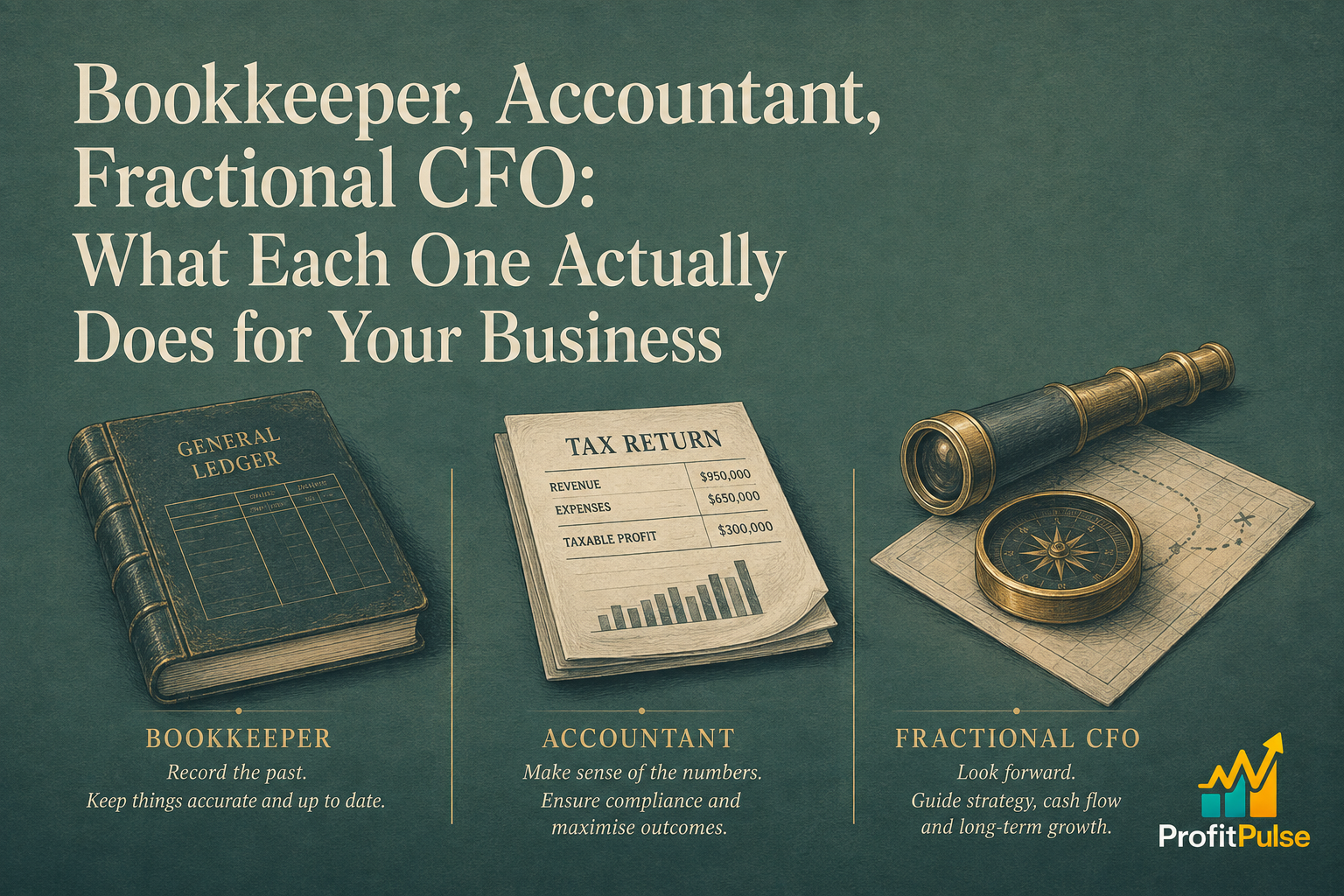
A business owner mentions to a colleague that they’re thinking about bringing in a fractional CFO, and the first response is usually some version of the same question: don’t you already have someone for that? You’ve got a bookkeeper who reconciles the accounts every week and an accountant who lodges the tax return and signs off the financial statements each year. Surely that’s the finance function covered.
It’s a fair question, and the confusion is genuinely understandable. Bookkeeper, accountant and CFO all get used loosely in everyday conversation, and in plenty of small operations one person does wear two of those hats at once. But the three functions aren’t competing for the same job. They’re answering three different questions, on three different timeframes, and a business can have excellent answers to two of them while the third has never really been asked.
The pattern we see most often in owner-led businesses past a few million dollars in revenue isn’t that the compliance work is being done poorly. It’s usually being done well. What’s missing is a fourth question that nobody on the existing team is actually set up to answer: given all of this accurate financial information, what should we do next?
What your bookkeeper and BAS agent are there for
Your bookkeeper’s job is to make sure what already happened in the business is recorded accurately and on time. Transactions get coded, bank accounts get reconciled, payroll gets run, superannuation gets calculated, and BAS and GST obligations get lodged by the deadline. It’s a rhythm, not a one-off task, and it needs to be right every single week because everything downstream depends on it. Your bookkeeper is doing exactly what they should be doing, which is producing a clean, accurate, backward-looking record of the business.
What your accountant adds on top
Your accountant typically works on a longer cycle, usually annual, and adds the layer that turns the bookkeeping record into compliant financial statements and a lodged tax return. Good accountants will also flag structural issues, such as whether a trust or company structure still suits the business, or whether an asset purchase should happen before or after 30 June. But the work is still fundamentally compliance-driven and calendar-driven. It answers what happened last year, and what the ATO requires this year. It was never designed to answer what the business should do about pricing next quarter, or whether it can safely take on a large new contract.
The different question a fractional CFO is actually answering
A fractional CFO Partnership sits above both of those functions and asks a different kind of question entirely, one that’s forward-looking rather than backward-looking. Should the price increase happen now or wait until the quieter quarter? Can the business genuinely afford to hire ahead of revenue, or does that decision blow a hole in the cash position in ten weeks? If the largest customer starts paying 30 days later than usual, what actually breaks? These are decisions with real dollar consequences, and they need someone who can build a forecast, stress test it, and sit in the room when the decision gets made. That’s a different skill set from lodging a BAS or finalising a tax return, and it’s why the two roles have never really overlapped, even though the titles sometimes get blurred. Our guide to what a fractional CFO actually does goes into more detail on where that line sits.
Why the three work best together, not apart
None of this makes the bookkeeper or accountant less important. If anything, the fractional CFO work depends entirely on the accuracy of what they produce. A forecast built on messy, delayed bookkeeping is just a guess with extra steps. The healthiest version of this setup is a business where the bookkeeper keeps the weekly record clean, the accountant keeps the compliance obligations met, and a fractional CFO uses that accurate foundation to help the owner make the decisions that actually move the business forward. Three different jobs, working together rather than in competition.
If you’ve got a good bookkeeper and a good accountant and you’re still the one lying awake doing the forward thinking on your own, that’s usually the moment this fourth function is worth a conversation. You can see how the engagement is structured on our pricing page, or book a discovery call to talk through where your business sits right now.
Frequently asked questions
What is the difference between a bookkeeper, an accountant and a fractional CFO?
A bookkeeper records what has already happened, reconciling accounts and lodging BAS on a weekly or monthly rhythm. An accountant compiles that record into compliant financial statements and a tax return, usually annually. A fractional CFO uses that accurate financial base to help decide what the business should do next, on pricing, cash flow, hiring and growth.
Do I still need an accountant if I hire a fractional CFO?
Yes. A fractional CFO doesn’t lodge tax returns or replace your compliance accountant, they work alongside them. Your accountant keeps the business compliant with the ATO, while a fractional CFO focuses on the commercial decisions that compliance reporting was never designed to answer.
How do I know if my business has outgrown its current finance support?
The clearest sign is when you have accurate, timely financial reports but you’re still the only person turning them into forward decisions, on pricing, staffing or cash. That’s usually the point where owner-led businesses in Queensland, NSW and Victoria start exploring a fractional CFO arrangement.
Can a fractional CFO work with my existing bookkeeper without conflict?
Yes, and it works best that way. A fractional CFO relies on the bookkeeper’s records being accurate and current, so the relationship is complementary rather than overlapping. The bookkeeper keeps the ledger clean, and the fractional CFO builds forecasts and decisions on top of it.
What does a fractional CFO actually do that my accountant doesn’t cover?
An accountant’s work is largely retrospective and compliance-focused, built around the tax year. A fractional CFO builds forward-looking forecasts, stress tests decisions before they’re made, and sits alongside the owner in conversations with banks, lenders or the leadership team. It’s a different rhythm and a different purpose.
How much does a fractional CFO cost for an Australian SME?
Cost depends on the level of involvement required, from a monthly management pack through to weekly leadership involvement. Our pricing page outlines the tiers, and our fractional CFO cost guide breaks down what typically drives the price up or down for a given business.
Is a fractional CFO the same as a part time CFO?
They’re closely related but not identical. Part time usually implies a fixed number of days on-site each week, while fractional typically means a flexible, outcome-driven engagement scaled to the business’s decision pace rather than a rigid day count. Both sit above bookkeeping and compliance accounting in the finance function.
Leave a Reply