
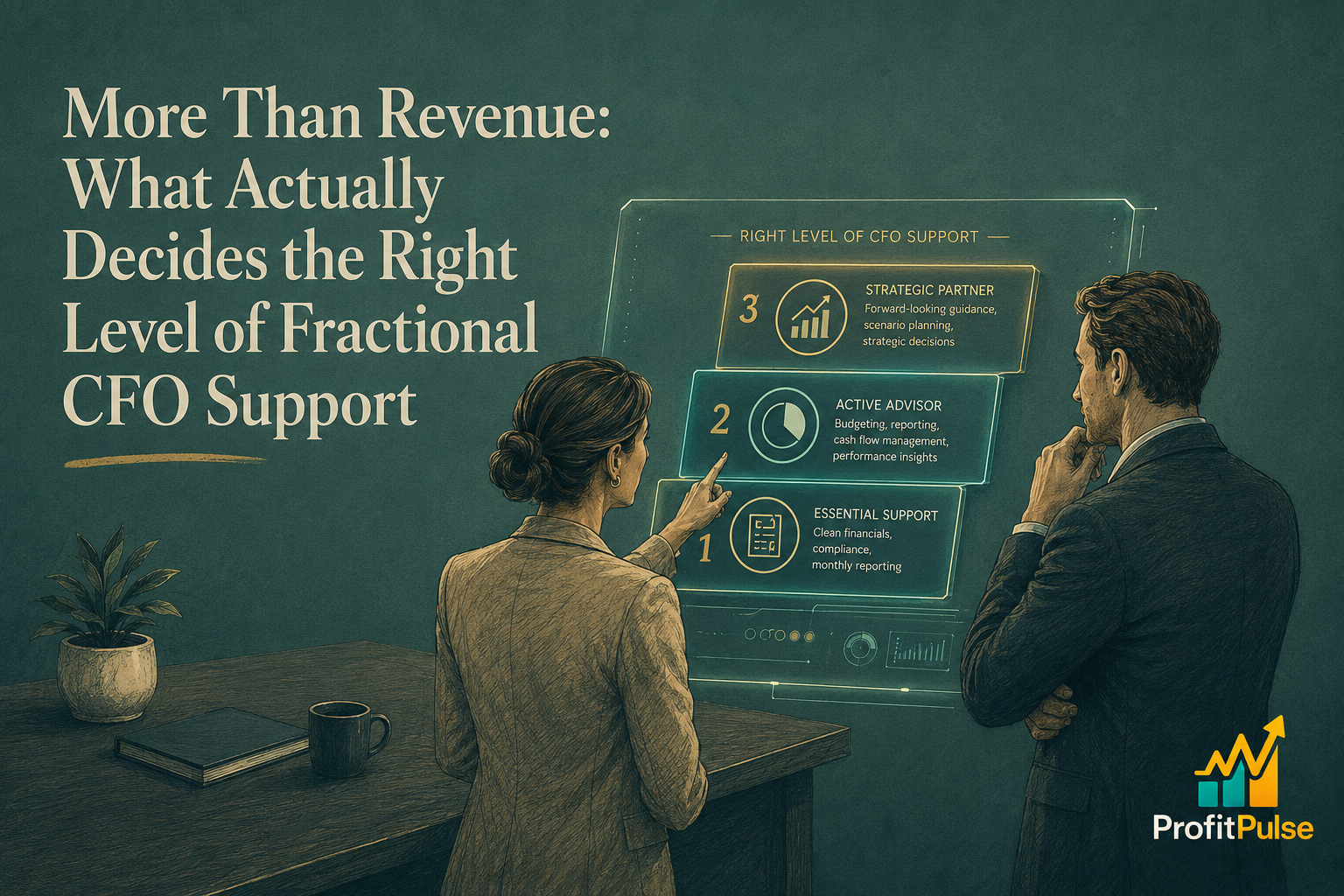
When an owner asks how much fractional CFO involvement their business needs, revenue is usually the first number they reach for. A three million dollar business assumes it needs less than a ten million dollar one, and a fifteen million dollar business assumes it has outgrown the lighter end of the scale. It is a reasonable instinct, but it is not the number that actually predicts whether the engagement earns its keep.
The pattern we see across owner-led businesses is that the right level of involvement tracks the pace of decisions being made, not the size of the business making them. A steady twelve million dollar manufacturer with a settled customer base, a stable team and predictable margins can run comfortably on a monthly rhythm. A four million dollar business that is hiring every quarter, testing a price change, opening a second site and weighing up a funding option all in the same six months needs someone at the table far more often, regardless of what the revenue line says.
Getting this sizing question right matters because a mismatch runs quietly in either direction. Too light a level of involvement and the business is still making its biggest decisions alone in the gaps between contact. Too heavy a level and the business is paying for a cadence of conversation that the pace of change in the business does not actually require.
Why Revenue Is the Wrong Sizing Question
Revenue is easy to compare and easy to bracket, which is why it becomes the default proxy. But revenue says nothing about how many live decisions are actually on the table in a given month. Two businesses turning over the same amount can be having entirely different years, one holding steady on the same customer base and cost structure it has run for years, the other adding capacity, renegotiating supplier terms and preparing a facility renewal with the bank all at once. The second business needs far more frequent involvement than the first, even though the accounts would put them side by side.
The more reliable question is how many commercial decisions are being made without a second, financially literate perspective in the room. A single owner weighing a pricing change, a hire, a lease renewal and a capital decision inside the same quarter is carrying a decision load that has little to do with the size of the top line.
What the Different Levels of Involvement Actually Solve For
A Fractional CFO Partnership is built around this distinction rather than a size bracket. At the lighter end, the engagement holds a monthly management pack and a steady rhythm of reporting, well suited to a business with a settled operating pattern and a handful of decisions to work through each quarter. At the more involved end, the same partnership extends to weekly participation in leadership conversations, lender discussions and board-level reporting, which suits a business where the number of live decisions is high enough that a monthly check-in would leave too much unattended in between. The current scope for each tier is set out on the pricing page.
Businesses in the middle of an active capital raise or a debt facility negotiation often need a further layer again. The Fractional CFO Capital Markets Add-on sits on top of any tier specifically for that period, covering lender and investor liaison and financial model ownership while the transaction is live, then steps back once it settles. It is a useful illustration of the underlying principle: the level of support should track what the business is actually doing, not stay fixed once it is set.
The Cost of Getting the Level Wrong
Under-buying tends to be the more common mismatch, and the least visible one. An owner on a lighter cadence keeps making the fast-moving decisions solo in the weeks between contact, and by the time the next report lands, three or four choices have already been made on gut feel rather than with a second perspective at the table. None of those decisions are necessarily wrong, but they were made without the benefit of the engagement the business is paying for.
Over-buying is quieter still. A business on a heavier cadence during a settled period is not being harmed by it, but the value of that frequency sits idle if there is nothing moving fast enough to need it. The fix in both directions is the same: matching the level of involvement to what is actually happening in the business, and revisiting that match as the business itself changes, rather than treating the original choice as permanent.
The honest way to answer this question is to look at the calendar of decisions the business expects to make over the next two or three quarters, not the number at the top of the P&L. For an owner who isn’t yet sure which end of that range their business sits closer to, understanding what the role actually covers is usually worth doing before the engagement is sized rather than after. You can book a discovery call to talk through where your business actually sits.
Frequently asked questions
How do I know which level of fractional CFO support my business needs?
The clearest signal isn’t revenue, it’s how many live decisions are on the table in a typical quarter: pricing changes, hires, funding, new sites. A business making several of these decisions every few months usually needs a more frequent level of fractional CFO involvement than a business with a settled, steady operating pattern.
Does a fractional CFO engagement scale with company revenue in Australia?
Not directly. Two businesses of the same size can have very different needs depending on how many commercial decisions are genuinely in motion. The pricing page sets out the tiers, but the right fit is decided by decision pace rather than the revenue line alone.
Can I change my fractional CFO engagement level as my business changes?
Yes, and it typically should. A business moving through a growth phase, a leadership change or a funding round often needs a heavier cadence for a period, then can step back to a lighter rhythm once things settle. The engagement is designed to move with the business, not stay fixed at the original setting.
What is the fractional CFO Capital Markets Add-on and when is it needed?
It is an additional layer added on top of any Fractional CFO Partnership tier while a debt, mezzanine or equity transaction is active, covering lender and investor liaison, financial model ownership and data room management. Once the transaction settles, the engagement typically steps back to its usual level.
Is a monthly fractional CFO cadence enough for a fast-growing business?
Often not for the duration of the growth phase itself. A business hiring, adding sites or renegotiating terms every few weeks tends to outrun what a single monthly check-in can catch, and decisions get made in the gaps without a second perspective. A heavier cadence for that period usually pays for itself in decisions made a month or two earlier.
How much does a fractional CFO cost for an Australian SME?
Cost depends on the tier and how much involvement the business needs in a given period, which is exactly why sizing the engagement to decision pace matters before looking at the number. Current pricing for each tier sits on the pricing page.
What does a fractional CFO actually do that a bookkeeper doesn’t?
A bookkeeper keeps the ledger accurate and the compliance reporting on time, which is essential and separate work. A fractional CFO uses those accurate numbers to shape pricing, hiring, funding and growth decisions, sitting alongside the bookkeeping relationship rather than replacing it.
Leave a Reply