
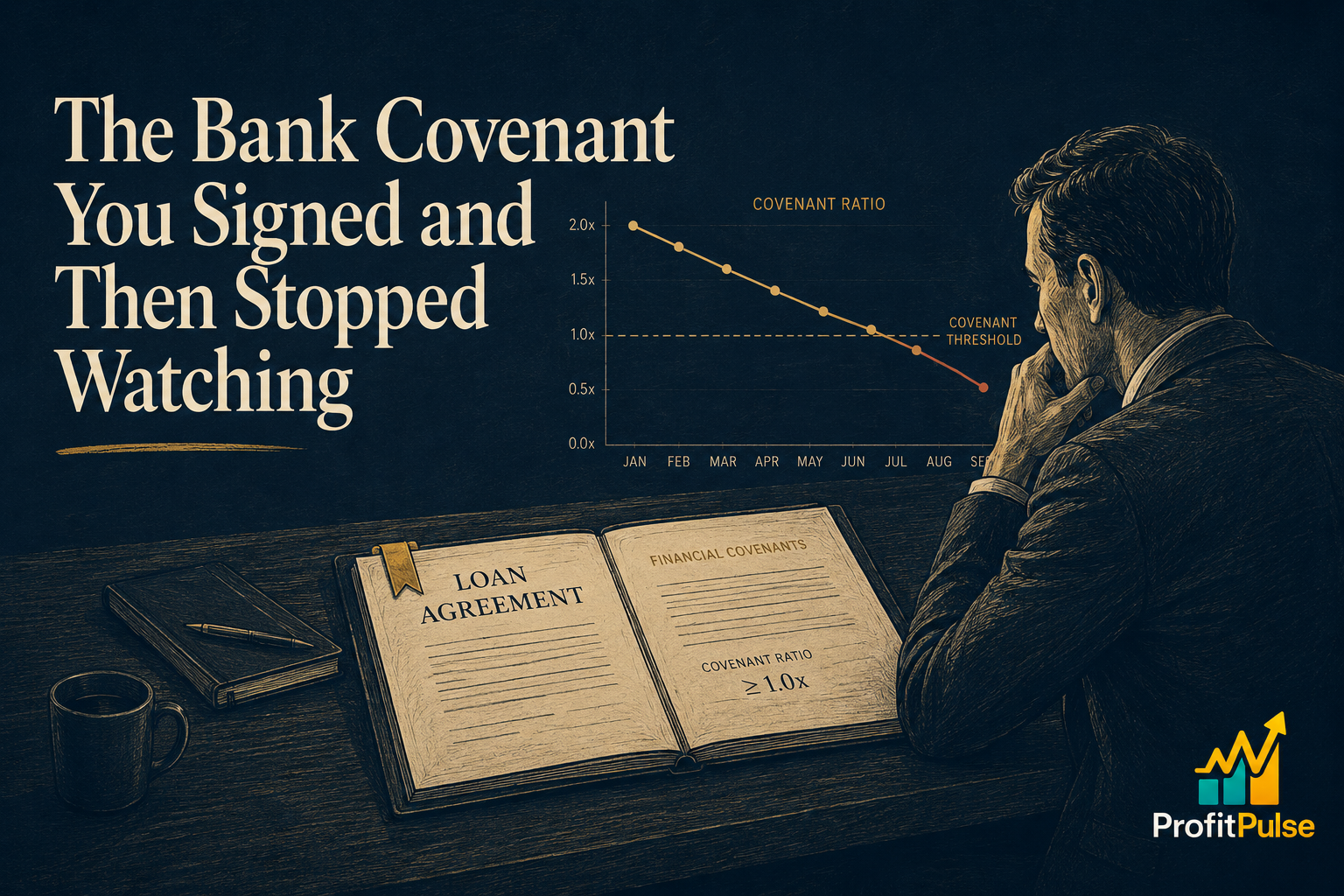
The facility gets approved, the documents get signed, and everyone gets back to running the business. Buried a few pages into that loan agreement sit the covenants the bank attached as a condition of lending: a minimum interest cover ratio, a ceiling on debt against EBITDA, a floor on the current ratio, sometimes a requirement to get consent before taking on further debt anywhere else. At settlement, most owners read them once, file the document away, and don’t open it again until something forces a look.
That’s a completely ordinary way to behave, not a sign of anything done wrong. Once the funds land and the actual work of the business takes over, a covenant stops feeling like something to track and starts feeling like paperwork that already did its job at drawdown. The pattern across owner-led businesses is that the covenant gets treated as a one-time hurdle rather than what it actually is, a condition that applies for the life of the facility and gets tested every reporting period, whether anyone is watching it or not.
A single quiet quarter, a customer who pays sixty days late instead of thirty, or a second piece of equipment finance taken on with a different lender without telling the first one, can be enough to trip a threshold nobody has looked at since the day it was signed. None of that requires a missed repayment. The business can be current on every instalment and still be sitting outside its covenant.
What a breach actually sets in motion
A covenant breach and a missed repayment are different events, and the first is far more common than owners expect. A technical breach doesn’t automatically mean the loan gets called in, but it does hand the bank a set of rights it didn’t have the day before: the ability to reprice the facility, request additional security, ask for an equity injection, reduce the limit, or in the more serious cases, demand repayment on a timeline that suits the lender rather than the business. Even the milder outcomes, a higher margin or more frequent reporting requirements, cost real money and management time that nobody budgeted for.
None of this is a reflection on how the business is being run. It’s usually a reflection of a number nobody has been watching, which is exactly the kind of gap a banking and facility review is built to catch before a lender does.
Why the numbers move even when nothing has gone wrong
The EBITDA sitting under a leverage covenant moves with ordinary trading softness, a slower month, a delayed contract, a margin dip on one large job, not with mismanagement. At the same time, most businesses keep adding debt after the original facility is in place: a vehicle lease here, a card facility there, a top-up on equipment finance, each one reasonable on its own and rarely checked against the cumulative effect on the original covenant. Two years on, the ratio that comfortably cleared the bank’s threshold at drawdown can be sitting much closer to the line, without a single decision along the way that felt like a risk at the time.
Watching it, not just signing it
The discipline that closes this gap is the same one that helps before a finance application goes in: running the calculation yourself on a set cadence rather than waiting for the bank’s annual review to do it for you. That means pulling the current interest cover and leverage position against the covenant thresholds at least quarterly, and doing it again immediately after any new debt is added anywhere in the business, not just through the original lender. It’s a short exercise once the numbers are laid out properly, usually no more than an hour against a set of management accounts that are already up to date. A rolling view of where the business sits against its own facility conditions is a far more useful number to carry into a growth decision than knowing the profit result alone, and it removes the guesswork from what a lender will see if a conversation ever needs to happen.
For businesses running an ongoing fractional CFO arrangement, this kind of monitoring usually sits inside the regular reporting rhythm rather than as a separate project, which is part of why it tends to catch a drifting ratio months before it becomes a conversation with the bank. We see this pattern often enough among Gold Coast and wider East Coast businesses carrying more than one facility that it’s worth treating as a standing item, not an annual one.
If it’s been a while since anyone checked the facility documents against where the business actually sits today, that’s a conversation worth having before the bank raises it first. You can book a discovery call to talk through what that review would look like for your facilities.
Frequently asked questions
What is a bank loan covenant and why do SME facilities include them?
A covenant is a condition attached to a loan, commonly a minimum interest cover ratio, a maximum debt-to-EBITDA level or a floor on the current ratio, that the business must keep meeting for the life of the facility. Banks use them to monitor risk after the money has been drawn down, not just at the point of approval.
What happens if a business breaches a loan covenant in Australia?
A breach doesn’t automatically mean the loan is called in, but it gives the bank the right to act, which can include repricing the facility, requesting more security, asking for an equity injection or reducing the limit. Even the milder outcomes, like extra reporting requirements, add cost and management time.
Can a bank call in a loan even if every repayment has been made on time?
Yes. A covenant breach is a separate event from a missed repayment. A business can be current on every instalment and still be in technical default if a ratio like leverage or interest cover has moved outside the threshold set at drawdown, which is why the covenant needs watching on its own, not inferred from the repayment history.
How often should an Australian SME review its bank covenants and facilities?
At least quarterly, and again immediately after any new debt is added anywhere in the business, even through a different lender. A banking and facility review is designed to test the current position against the original conditions rather than waiting for the bank’s own annual review to surface a problem.
What is a debt-to-EBITDA covenant and how does it get calculated?
It compares total debt against earnings before interest, tax, depreciation and amortisation, and is usually set as a maximum ratio the business must stay under. Because EBITDA moves with ordinary trading conditions, a quieter period can push the ratio closer to the threshold without any change in how the business is managed.
How can a fractional CFO help keep bank covenants and facilities on track?
Ongoing covenant monitoring typically sits inside the regular reporting rhythm of a fractional CFO partnership, rather than as a separate exercise added on top of the existing work. Interest cover and leverage get checked against the facility conditions alongside the normal monthly numbers, which means a drifting ratio tends to get caught and addressed months before it becomes a conversation the bank initiates.
Leave a Reply