
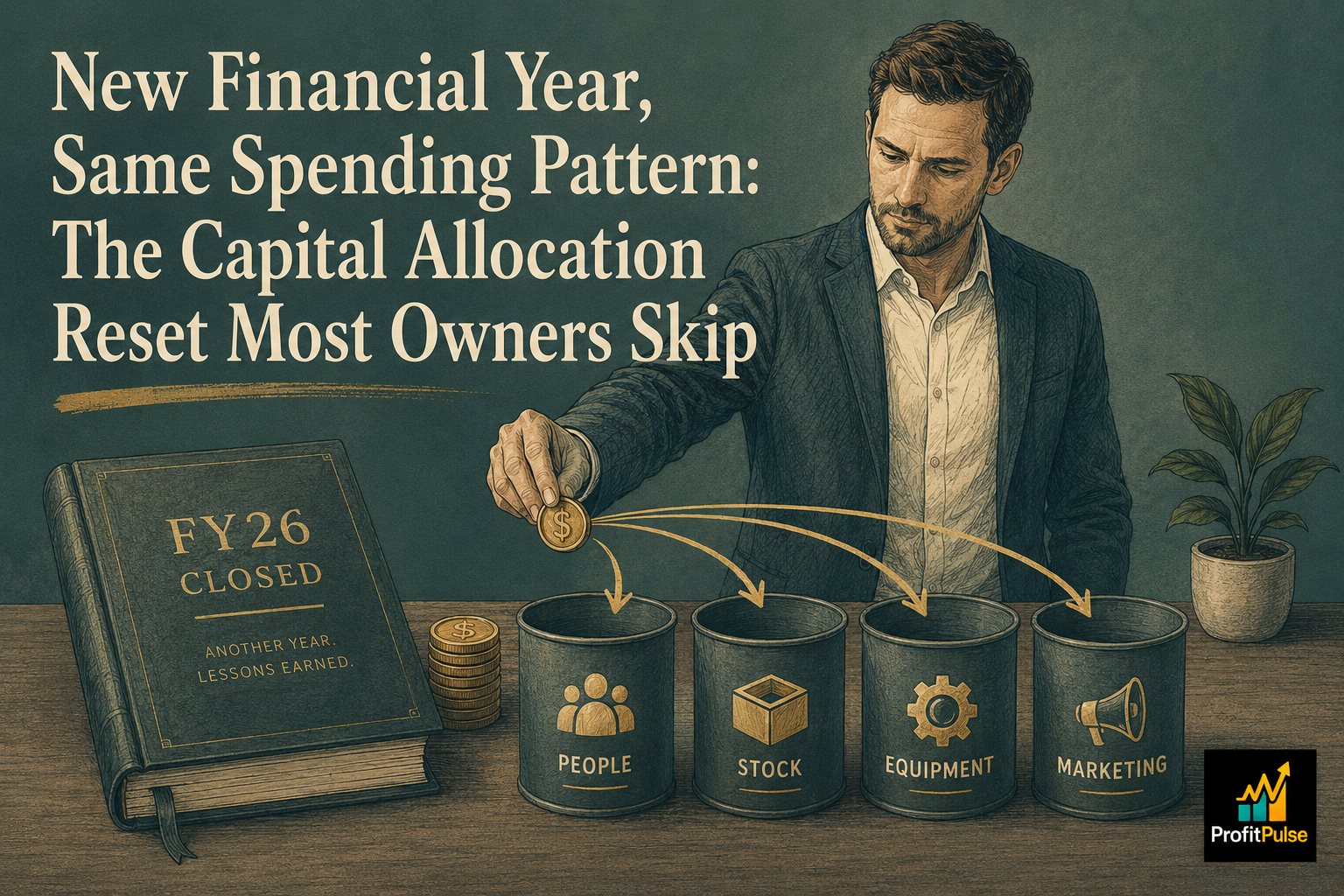
The new financial year is a week old. FY26 has closed, the profit and loss has settled into its final shape, and most owner-led businesses are already spending FY27’s money. The trouble is that the spending decision rarely gets made fresh. It gets carried over from last year, adjusted up a little for growth and down a little for whatever felt tight in June.
That pattern is easy to miss because it never looks like neglect. The marketing retainer renews at roughly the same figure. The team grows in the same shape it grew last year. Stock gets ordered on the same rhythm it always has. Nothing about it looks wrong, which is exactly why it survives another twelve months without anyone actually testing it against what it returned.
The first week of July is the one moment in the year when that test is cheap to run. FY26 is closed and will not move again. FY27 has not yet built its own momentum. For a few weeks, an owner can look plainly at where capital went last year against what it generated, before this year’s spending pattern locks itself back in by default.
The default budget is last year’s budget, plus a bit
Ask most owner-led businesses how they arrived at this year’s spending plan and the honest answer is some version of we took last year’s numbers and adjusted them. That is not a criticism. It is what happens when the people running the business are also the people run off their feet by the business. Building a plan from scratch every year takes time nobody has spare in the first week of a new financial year.
The cost of that shortcut is that it treats every category of spending as equally deserving of another year’s funding, regardless of what each one actually produced. A marketing channel that quietly stopped converting eighteen months ago keeps getting funded at the same level as one that is carrying the business. A role that made sense when the business was smaller keeps existing because removing it feels riskier than keeping it. None of this shows up as a problem on the P&L. It shows up as growth that costs more than it should.
The four places capital actually goes
In practice, almost every dollar an SME spends beyond the absolute basics lands in one of four buckets: people, stock or inventory, fit-out and equipment, and marketing or customer acquisition. Each of those buckets competes for the same pool of cash, and each one is usually reviewed on its own, by whoever owns that part of the business, rather than side by side against what it actually returned.
Reviewed separately, every bucket can look reasonable. Reviewed together, against the return each one generated over FY26, the picture usually shifts. Money that felt essential in isolation often turns out to be doing less work than a smaller amount spent somewhere else in the business. That comparison is the part most owners never get around to, not because they do not care, but because nobody is holding all four buckets in view at the same time.
What a genuine capital allocation review looks like
This is precisely the gap a Capital Allocation Review is built to close. It is an independent look at where capital has actually been deployed across people, stock, fit-out and marketing, set against the return each of those areas generated, with a re-deployment recommendation and an expected return attached to each move. It is not about cutting for the sake of cutting. It is about moving next year’s capital toward what FY26 proved actually works.
For businesses without someone at the table whose job is to hold that whole picture in view month to month, this is one of the quieter things a fractional CFO does as a matter of course, rather than as a one-off project. The comparison stops being an annual scramble and becomes a standing part of how the business decides where money goes.
Why the first fortnight of July is the cleanest window
Once FY27 trading gets underway in earnest, this comparison gets harder to make honestly. New spending starts overlapping with old spending, and it becomes tempting to judge this year’s decisions against this year’s early results rather than against what actually happened in the year just closed. The first fortnight of July, with FY26 numbers final and FY27 not yet in motion, is as clean a comparison as an owner-led business ever gets.
Businesses that use this window well are not the ones with the most complicated spreadsheets. They are the ones who simply stop and ask, for each of the four buckets, whether last year’s spend earned its place again this year, before the answer gets decided for them by habit. That single question, asked properly once a year, tends to matter more to FY27’s result than almost anything else on the to-do list this month.
Owners across Queensland and the rest of the East Coast tend to find this comparison is easiest to run with a second set of eyes on it, someone who is not attached to any one of the four buckets. If that would help before FY27 spending patterns set in, book a discovery call and bring last year’s numbers with you.
Frequently asked questions
How much profit should I reinvest in my business each year?
There is no fixed percentage that works across every business, because it depends on where capital already sits relative to what it is returning. The more useful question is whether last year’s spending, bucket by bucket, actually earned its place again this year. A Capital Allocation Review answers that with figures rather than instinct.
What does a capital allocation review actually involve?
It is an independent look at where capital is deployed across people, stock, fit-out and marketing, measured against the return each area generated, followed by a re-deployment recommendation with an expected return attached to each move. It replaces guesswork with a ranked, dollar-based view of where next year’s capital should actually go.
Is it better to pay down business debt or reinvest profit after EOFY?
This depends on what the debt costs against what reinvestment could plausibly return, and that comparison only holds up if the reinvestment case is tested rather than assumed. Businesses that compare both options against actual FY26 performance, rather than against gut feel, generally make the call with far more confidence.
How do I know if my marketing spend is still working?
The pattern we see most often is that a channel converted well when it launched and simply kept getting funded at the same level long after its performance changed. Reviewing marketing spend alongside the other three capital buckets, rather than on its own, is usually what surfaces this.
What does a fractional CFO cost for a small business in Australia?
Cost depends on the tier of involvement, from a monthly management pack through to weekly participation in leadership and lender conversations. The pricing page sets out current tiers, and most owners find the right level becomes obvious once they see what each one actually covers.
How often should a business formally review where its capital is going?
Once a year, at minimum, is the practical floor, and the first few weeks of a new financial year are the cleanest window because the prior year’s numbers are final and the new year has not yet built its own momentum. Some businesses run it quarterly once the habit is established.
What is the difference between a budget and a capital allocation review?
A budget usually extends last year’s categories forward with adjustments. A capital allocation review starts from what each category actually returned and asks whether it deserves the same funding again, which is a different and more useful question when the goal is growth rather than continuity.
Leave a Reply