
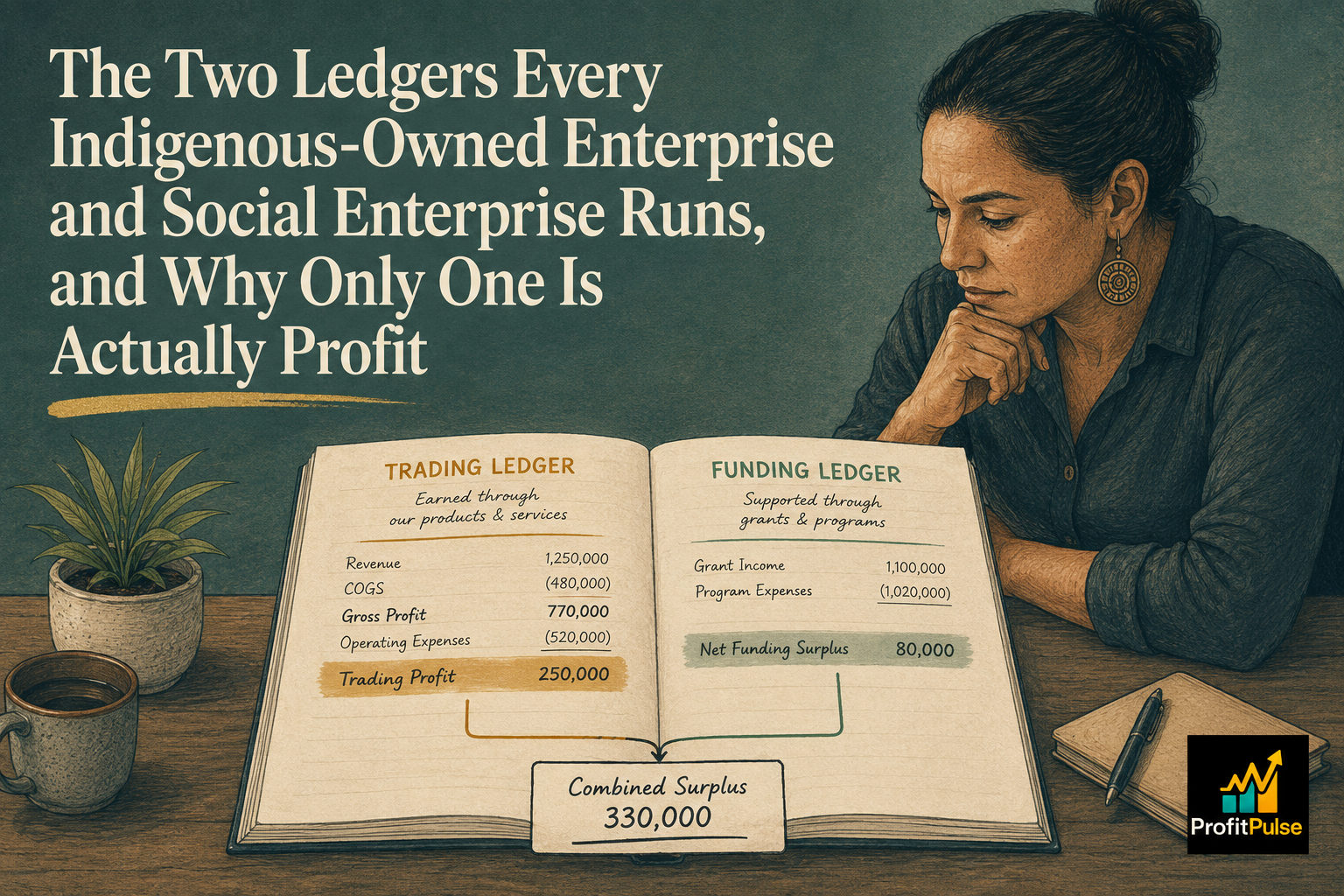
This is NAIDOC Week, and across Queensland, NSW and Victoria, Indigenous-owned enterprises and social enterprises are doing what they do every week of the year, carrying a cultural or community mission and a commercial operation inside the same organisation, often inside the same bank account.
That is where the financial picture usually blurs. Grant funding, sponsorship, government contracts and philanthropic support land in the same set of accounts as genuine trading revenue from the café, the consultancy, the cultural tourism arm, the retail line or whatever the commercial side of the business actually sells. Blended together, the combined result can show a comfortable surplus for the year, sometimes even a healthy one, while the trading arm underneath is being quietly carried by money that was never meant to subsidise it.
This is not a compliance problem or a governance failure. It is simply what happens when two genuinely different types of income sit inside one profit and loss statement without being separated. The pattern across mission-driven organisations we work with is that leadership can see the whole picture clearly enough to run the organisation day to day, but rarely has a clean view of which parts of it are commercially self-sustaining and which are propped up by funding that has its own cycle and its own end date.
When Blended Reporting Hides the Real Number
Grant and program funding is usually restricted income, tied to a specific purpose and reportable back to the funder against that purpose. Trading revenue and unrestricted donations are different in kind, available to be spent on whatever the organisation decides. When both sit in the same combined view without a clear split, overhead costs get absorbed across the whole entity rather than allocated to where they actually belong, and the trading arm ends up looking more efficient than it is, because a portion of its true cost base has effectively been carried by the grant.
The reverse can also be true. A commercial arm that is genuinely strong can look weaker than it is if program costs have been allocated against it to balance the overall result. Either way, the number leadership sees each month is not the number that tells them whether the trading side of the business could stand on its own if the funding cycle changed.
What This Does to Succession and Growth Decisions
Dual mission organisations face a succession question that most single-purpose businesses do not. A founder or a long-serving leader stepping back needs the next generation of leadership, or the board or council taking over governance, to understand exactly which revenue lines are self-funding and which depend on a grant round being renewed. Growth decisions carry the same risk. Taking on a new contract, opening a second trading location or expanding a service line based on a blended surplus figure can commit the organisation to costs that only made sense while a particular funding stream was active.
Boards and councils overseeing these organisations are usually asking the right question, whether the mission is being delivered sustainably, but they can only answer it properly if the financial reporting in front of them separates the two ledgers rather than presenting one blended number. A fractional CFO partnership built around this kind of dual reporting gives a board a monthly view of both sides on their own terms, rather than a single combined figure that quietly averages them together.
Separating the Two Ledgers
The practical fix is not complicated, though it does take deliberate effort in the first pass. Revenue and direct costs get tagged to either the program or the trading arm at the point of entry, rather than reconciled after the fact. Genuinely shared overhead, rent, core staff time, insurance, gets allocated using a sensible driver such as headcount, floor space or hours worked, rather than left sitting in a general pool. Once that split exists, the organisation can see a genuine contribution margin for its commercial activity, separate from the funded programs sitting alongside it.
A product and service line profitability review does exactly this work, ranking every revenue line, trading and funded, by its actual margin and effort to serve, so leadership can see which parts of the operation are carrying their own weight and which are dependent on external funding continuing on schedule. For organisations managing several grant cycles at once, pairing that with a rolling cash view through the guide on cash flow discipline makes the timing risk visible as well as the margin risk.
None of this changes the mission. It simply gives the people responsible for the organisation, its leaders, its board, its council, a true picture of which activities pay their own way and which are a function of funding that has its own cycle. That is a more useful position to plan succession, growth and governance from than a single blended number ever will be. Book a discovery call with ProfitPulse if separating these two ledgers is a conversation worth having this year.
Frequently asked questions
How do social enterprises separate grant income from commercial trading revenue?
The cleanest approach tags revenue and direct costs to either the funded program or the trading arm at the point of entry, then allocates shared overhead by a sensible driver such as headcount or floor space rather than leaving it in one pool. A product and service line profitability review applies this discipline across every revenue line so the two ledgers become visible separately rather than blended.
What is the difference between restricted and unrestricted income for a social enterprise?
Restricted income is grant or program funding tied to a specific purpose and reportable back to the funder against that purpose. Unrestricted income, generally trading revenue and undesignated donations, can be spent on whatever the organisation decides. Blending both into one reported figure without separating them makes it difficult to judge whether the commercial side of the business is genuinely self-sustaining.
Why can a mission-driven business look profitable while its trading arm loses money?
This happens through cross-subsidisation, where shared overhead is absorbed across the whole entity rather than allocated to where it actually belongs. A grant-funded program can effectively carry part of the trading arm’s true cost base, making the commercial side look more efficient than it would be if it had to stand entirely on its own revenue.
How should an Indigenous-owned enterprise report performance to its board or council?
Boards and councils overseeing dual mission organisations need to see the trading arm and the funded programs as separate lines, not one combined surplus figure. A fractional CFO partnership can build this dual reporting into the monthly pack, giving governance the clarity to judge sustainability rather than averaging the two together.
What happens to a social enterprise’s numbers when a grant funding cycle ends?
If overhead and program costs were never separated from trading activity, the end of a grant round exposes cost that the trading arm was never actually generating enough margin to cover on its own. Organisations that track the two ledgers separately throughout the funding cycle can see this shift coming well before the funding actually stops.
Can succession planning work without a clear commercial ledger in an organisation?
Succession becomes genuinely difficult without it, because incoming leadership or a new board cannot judge which revenue lines are self-funding and which depend on a grant round being renewed. Understanding the guide on what a fractional CFO does is a useful starting point for organisations weighing up ongoing financial oversight through a leadership transition.
Should a mission-driven organisation get an independent view of its trading profitability?
An independent, line by line view is usually the fastest way to see which activities pay their own way, since internal reporting built around a combined surplus figure rarely surfaces the gap on its own. It becomes especially useful heading into a new financial year, when funding rounds and trading conditions can shift the picture materially.
Leave a Reply