
By late August, most Australian e-commerce retailers have already locked in their Black Friday and Christmas trading plans. Stock has been ordered, the marketing calendar is set, and the revenue target for November and December looks strong on a spreadsheet. What is far less often modelled is the profit sitting underneath that revenue number.
The pattern we see across online retailers each peak season is not that volume fails to arrive. It almost always does. What frequently fails to arrive is the margin that volume was supposed to produce, because three costs quietly compound in the exact weeks when revenue looks its healthiest, and none of the three show up clearly until the season is already over.
The Discount Stack Nobody Adds Up
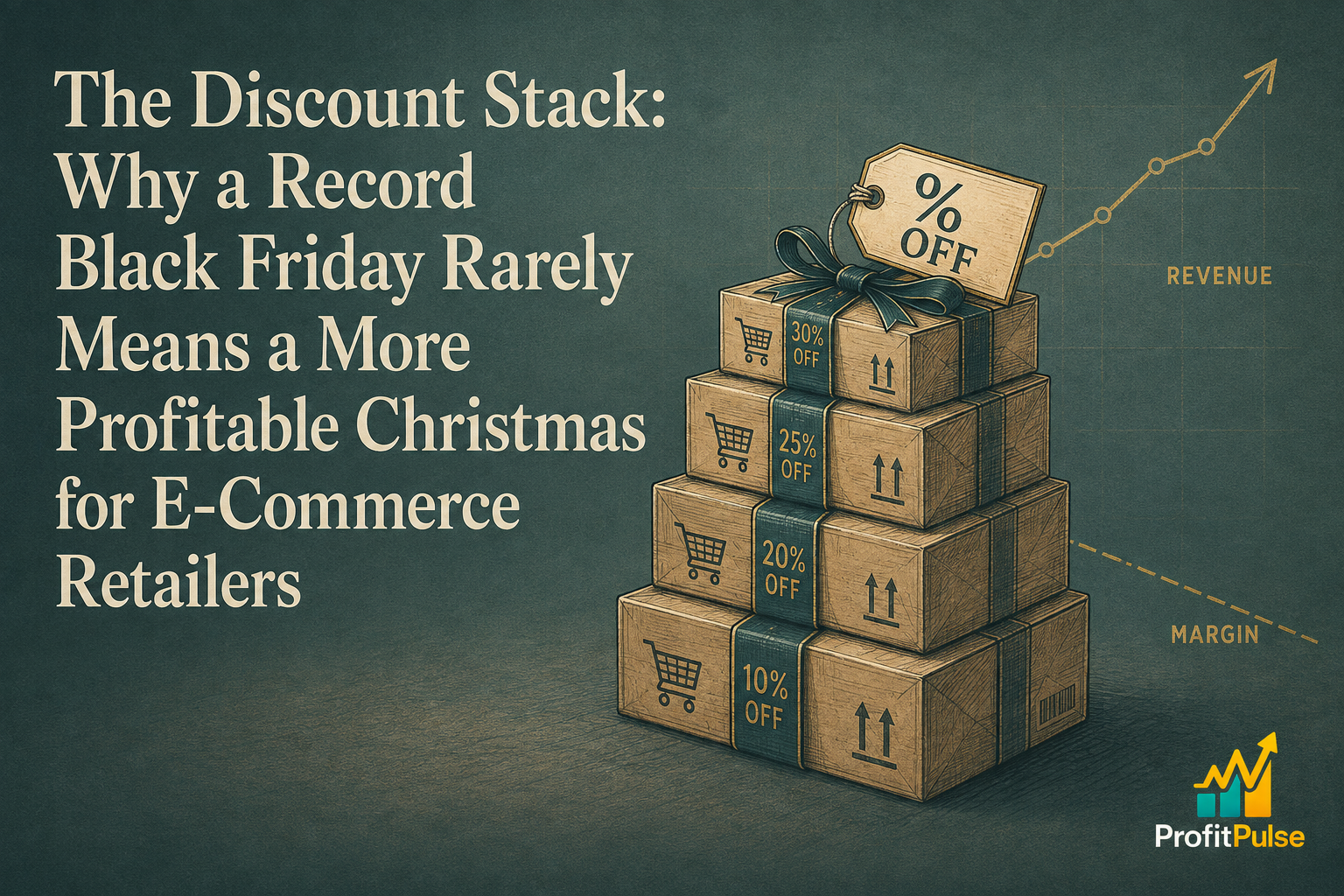
A Black Friday or Cyber Monday offer rarely stands alone anymore. The headline percentage off sits on top of a free shipping threshold, an affiliate or influencer commission, a loyalty points redemption, and payment gateway or buy-now-pay-later fees that rise in dollar terms as transaction volume climbs. Each layer shaves margin individually, and each one looks small in isolation when it is set. Stacked together across a single order, the real discount is often materially deeper than the number in the marketing brief, and few retailers price the campaign against that combined figure rather than the headline one.
The effect compounds again once bundling comes into play. A gift-with-purchase, a tiered spend threshold and a sitewide code layered on top of an already-discounted product can push the true margin given away well past what anyone signed off on. None of this is a case of poor planning. It is simply what happens when several teams, marketing, customer service and the platform itself, each add one more incentive without anyone holding the combined total against the product’s actual cost base.
This is the exact gap a structured pricing reset is built to close: working through customer profitability and margin data before the campaign launches, rather than reading the result off the bank balance in January.
Customer Acquisition Cost Doesn’t Take a Christmas Break
Every e-commerce retailer in Australia is bidding for the same shoppers in the same six weeks, and so is every retailer trying to reach an Australian audience from overseas. Cost per click on the main paid channels climbs through November and December as more advertisers compete for the same inventory, which means the customer acquired during peak season frequently costs more to acquire than the customer acquired in a quiet month. Revenue per order can look identical. Contribution margin per order, once acquisition cost is properly allocated, often is not.
The businesses that come through peak season with margin intact are usually the ones tracking acquisition cost by channel and by week throughout November and December, not just at the end of the quarter. That lets a retailer pull back spend on a channel the moment its cost per acquisition breaks the threshold the sale can actually absorb, rather than discovering the problem once the campaign has already run its course.
The Return Rate You Don’t See Until January
Gift purchases and impulse buys made during a sale carry a structurally higher return rate than normal-priced purchases, particularly in apparel, footwear and homewares. The revenue books in November and December. The refund frequently lands in January, once the return window closes and the wrong size or the change-of-mind item makes its way back. A December result that looks strong on the day can quietly soften once the return cycle finishes, which is one reason the true profitability of a peak season is often only visible six to eight weeks after it ends.
Modelling the Number Before the Sale, Not After It
None of this argues against running the sale. Black Friday and the Christmas peak remain the single biggest trading window most online retailers get all year, and stepping back from it is rarely the right call. The more useful discipline is stress-testing contribution margin per product line against a realistic discount depth, a realistic acquisition cost and a realistic return rate before the campaign is locked in, rather than after the results land. Retailers who do this tend to run a shallower, better-targeted discount that protects margin, instead of matching whatever depth feels competitive in the moment. It is worth pairing that work with a proper look at cash flow discipline across the peak trading calendar, since the stock and advertising spend behind a big November are almost always paid for well before the revenue they generate arrives.
For most owner-led e-commerce businesses, the fix is not avoiding peak season. It is knowing the real contribution margin behind the discounted price before the campaign goes live, so the November and December calendar is built around figures that still hold up once January’s returns are counted. That is a conversation worth having with a fractional CFO well before the first sale banner goes up.
Frequently asked questions
How can Australian e-commerce retailers protect margin during a Black Friday sale?
The pattern we see work best is modelling contribution margin per product line against the combined discount, including shipping thresholds and payment fees, before the campaign is set. A pricing reset run ahead of peak season shows exactly how deep a discount the business can afford without giving away the volume gain.
Why does customer acquisition cost rise for online retailers in November and December?
More advertisers compete for the same Australian shoppers in the same narrow window, which pushes up cost per click across the main paid channels. The customer acquired in peak season often costs more than the customer acquired in a quiet month, even when the average order value looks the same.
How should e-commerce businesses account for return rates when forecasting peak season profit?
Gift and impulse purchases made during a sale carry a higher return rate than normal-priced sales, especially in apparel and homewares. Building an expected return rate into the November and December forecast, rather than treating the sale price as final revenue, gives a more accurate read on the quarter.
What discount depth is too deep for a Black Friday or Cyber Monday campaign?
There is no universal number. The right ceiling is whatever discount still clears the combined cost of shipping thresholds, commissions, payment fees and acquisition cost while leaving a contribution margin the business is comfortable with, which is different for every product line and needs to be calculated rather than guessed.
How much cash should an online retailer hold before the Christmas trading peak?
Enough to fund the inventory and marketing spend that sits ahead of the revenue it generates, since stock and ad spend are both paid for well before peak season cash lands. A cash flow discipline approach built around the peak trading calendar avoids funding gaps in the run-up to November.
Does a high return rate always mean a product quality problem?
Not necessarily. Peak season return rates are structurally higher than the rest of the year because more purchases are gifts, impulse buys or size gambles rather than considered purchases. A rising return rate is worth tracking, but it needs to be read against the season it happened in, not treated as an isolated quality signal.
When should online retailers start planning pricing for the Christmas peak season?
Most of the businesses we see get the best outcome start the margin and cash conversation in August or September, well before stock commitments and ad budgets are locked in. That leaves time to adjust discount depth or product mix rather than discovering the true margin once the sale is already live.
Leave a Reply