
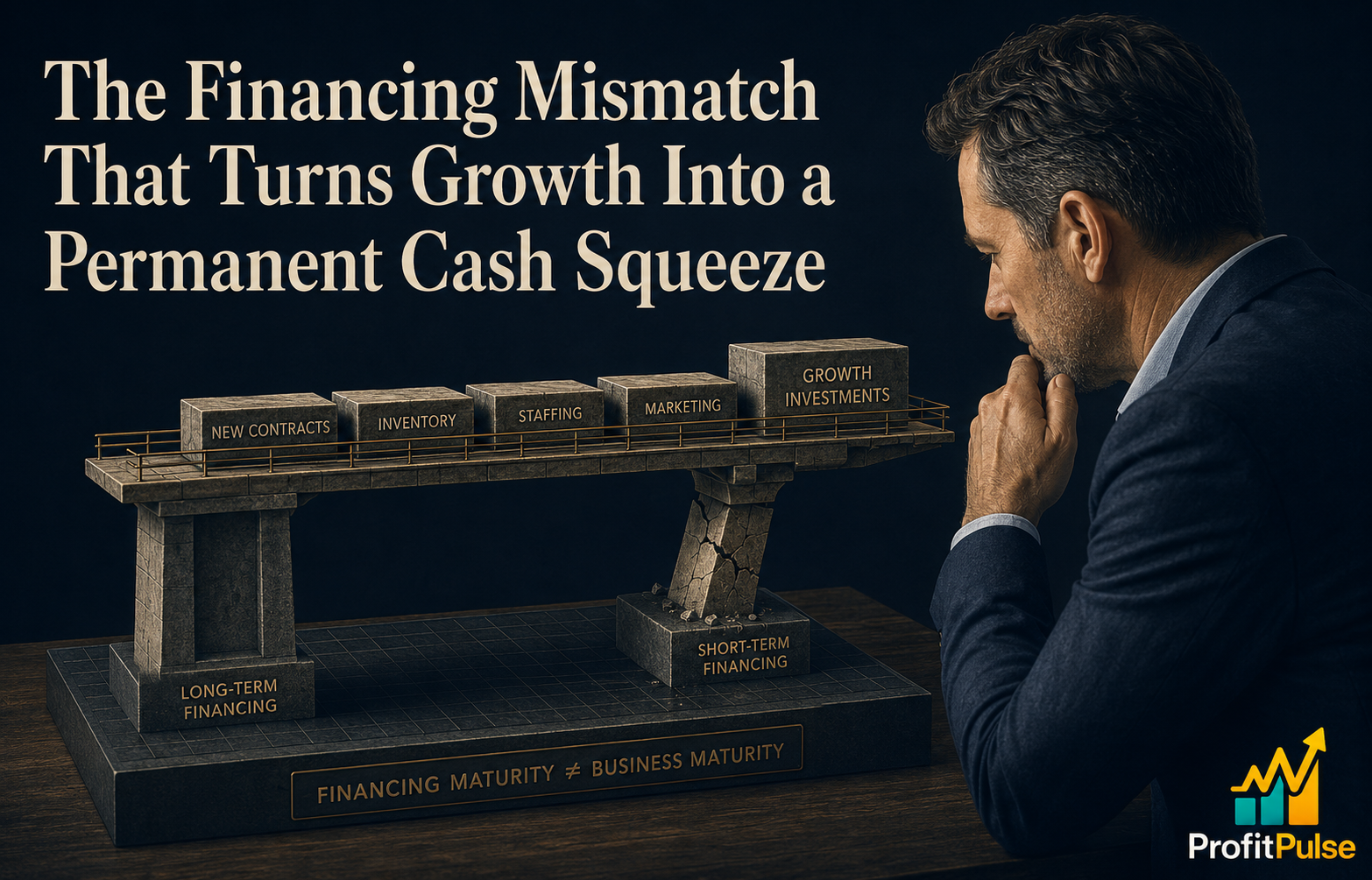
A business hires two extra people ahead of a busy quarter. A delivery van gets bought while the asset finance application is still sitting with the broker. A supplier wants a bigger deposit on the next stock order than usual. None of these decisions feels large on its own, and none of them looks like a financing decision at all. It looks like a business simply drawing on the facility it already has, because the facility is already there and a new application takes time nobody has spare.
Eighteen months later, the overdraft that used to move up and down with the trading cycle sits permanently near its limit. The business is profitable. Revenue has grown. And yet the bank account never seems to loosen up the way growth is supposed to feel. The instinct is to call this a cash flow problem. Most of the time it is something more specific: growth that was funded on short-term debt built for a different job entirely.
This is one of the quieter patterns we see across owner-led businesses on the East Coast, and it rarely gets named, because every individual purchase made sense at the time.
The quiet substitution
An overdraft or line of credit is designed to absorb a timing gap that reverses. Stock goes out the door before the customer pays, the facility covers the difference for a few weeks, the payment lands, the balance comes back down. That is the job it was built for, and it does that job well.
The substitution happens gradually. A van gets bought on the overdraft while waiting on finance approval, and the refinance never quite makes it back to the top of the list once the van is running and doing its job. A hire made during a quiet month gets carried on the facility through a slower patch, and by the time trade picks back up, that headcount has simply become permanent. None of these moments feel like a financing decision. Each one is just the easiest way to get something done that week. Stacked across a year or two, they quietly convert a facility meant for short-term timing gaps into permanent working capital for assets and people that will be part of the business for years.
Why it stays hidden until it doesn’t
The profit and loss statement gives no warning here. Interest on an overdraft is a modest line item, and the business is still reporting a healthy result, because the mismatch is a balance sheet and structural problem, not a profitability one. What actually happens is that the buffer the facility was meant to provide for a genuine short-term shock, a late-paying customer, an unexpectedly quiet month, a one-off cost, simply is not there any more. The headroom is already spoken for by last year’s van and last year’s hire.
The bank may not flag this early either, provided repayments are made and the account is not overdrawn past its limit. From the lender’s side, a facility sitting consistently near its ceiling looks like a business that has grown into needing more room, not necessarily one carrying the wrong type of debt. The signal that something structural is wrong tends to show up first inside the business, as a persistent, low-grade tightness that never quite matches how well trade is actually going.
Matching capital to the job it is actually doing
The useful discipline is treating capital as three distinct tools rather than one pool of available cash. A revolving facility is for timing gaps that reverse within weeks or months, the debtor cycle, a seasonal stock build, a short and genuinely temporary shortfall. Term debt or asset finance is for anything with a multi-year useful life, a vehicle, equipment, a fit-out, ideally structured so the repayment term roughly tracks how long the asset will actually be earning its keep. Growth or expansion capital, whether that is subordinated debt, equity, or a structured raise, is for the step-changes that do not have hard collateral behind them and will not pay back inside a single trading cycle, a new site, a new market, a material lift in team size ahead of the revenue that justifies it.
Most businesses never deliberately choose between these three. They use whatever facility is already open, because opening a new one takes a conversation and some paperwork, and the pressure of the week rarely allows for either. An independent Banking and Facility Review looks at exactly this question, whether the facilities a business currently holds are actually structured for what the business is using them for, and what should be refinanced onto a more appropriate term before it keeps sitting where it does not belong.
Before FY27 growth spending accelerates
Mid-July is a reasonable moment to run this check. FY26 has closed cleanly, this year’s growth spending has not yet built its own momentum, and it is still possible to look plainly at what is currently sitting on the overdraft and ask whether it belongs there. Vehicles and equipment bought on short-term facilities over the past year can usually be refinanced onto appropriately termed debt, which frees up the working capital headroom the facility was meant to hold in reserve. Where the growth ahead is bigger than refinancing can solve, a genuine step-change in team, site or capability, that is a different conversation, closer to capital raise preparation than to a facility tidy-up.
Businesses across Queensland and the broader East Coast that run this check tend to find the same thing: the business was never short of cash in the way it felt. It was carrying the right amount of debt in the wrong shape. If your overdraft has felt permanently tight despite a solid trading year, that is worth a proper look before another year of growth gets funded the same way. Book a discovery call and bring your current facility structure with you.
Frequently asked questions
How do I know if my business is using the wrong type of finance for growth?
The clearest sign is a revolving facility or overdraft that no longer moves up and down with trading, but instead sits permanently near its limit despite reasonable profitability. That pattern usually means equipment, vehicles or headcount that should sit on longer-term debt are quietly being carried on a facility built for short-term timing gaps instead.
What is the difference between an overdraft and a term loan for a small business?
An overdraft or line of credit is designed for short-term timing gaps that reverse, such as the wait between paying a supplier and being paid by a customer. A term loan or asset finance facility is structured to match the useful life of a specific purchase, such as a vehicle or equipment, with repayments spread across the years it will actually be earning revenue.
Why does my overdraft never go back to zero even though the business is profitable?
This is the pattern we see most often when short-term facilities have quietly ended up funding longer-term purchases or permanent headcount. Profitability and facility headroom are different things. A business can report a solid result every month while its working capital facility carries debt that was never designed to sit there permanently.
Should an Australian SME use debt or equity to fund a period of growth?
It depends on whether the growth has a clear, near-term payback and hard collateral behind it, in which case debt is usually the cheaper option, or whether it is a genuine step-change, a new site or market, without immediate cash generation to support repayments, where equity or a structured raise fits better. A capital raise readiness assessment is the way to test which instrument actually fits before approaching anyone.
What is a Banking and Facility Review and when should I get one?
It is an independent assessment of whether your existing bank facilities are structured, priced and sized correctly for the business as it is today, rather than the business that first opened them. Mid-year, once the prior financial year’s accounts are finalised, is a practical time to run one, particularly if growth spending has been drawing on a facility not originally built for it. More detail is on the services page.
Is it normal for a growing business to always feel tight on cash?
Growth genuinely does consume cash before it generates it, so some tightness during a growth phase is expected. What is worth investigating is tightness that never eases even between growth bursts, since that pattern more often points to a financing structure issue than to trading performance, and it is fixable once identified.
How does a fractional CFO help a business match its finance structure to its needs?
A fractional CFO keeps an ongoing view of which facilities are carrying what, so a purchase or hire funded on short-term debt gets flagged and refinanced onto an appropriate term before it becomes permanent, rather than being noticed a year or two later once the headroom is already gone.
Leave a Reply