
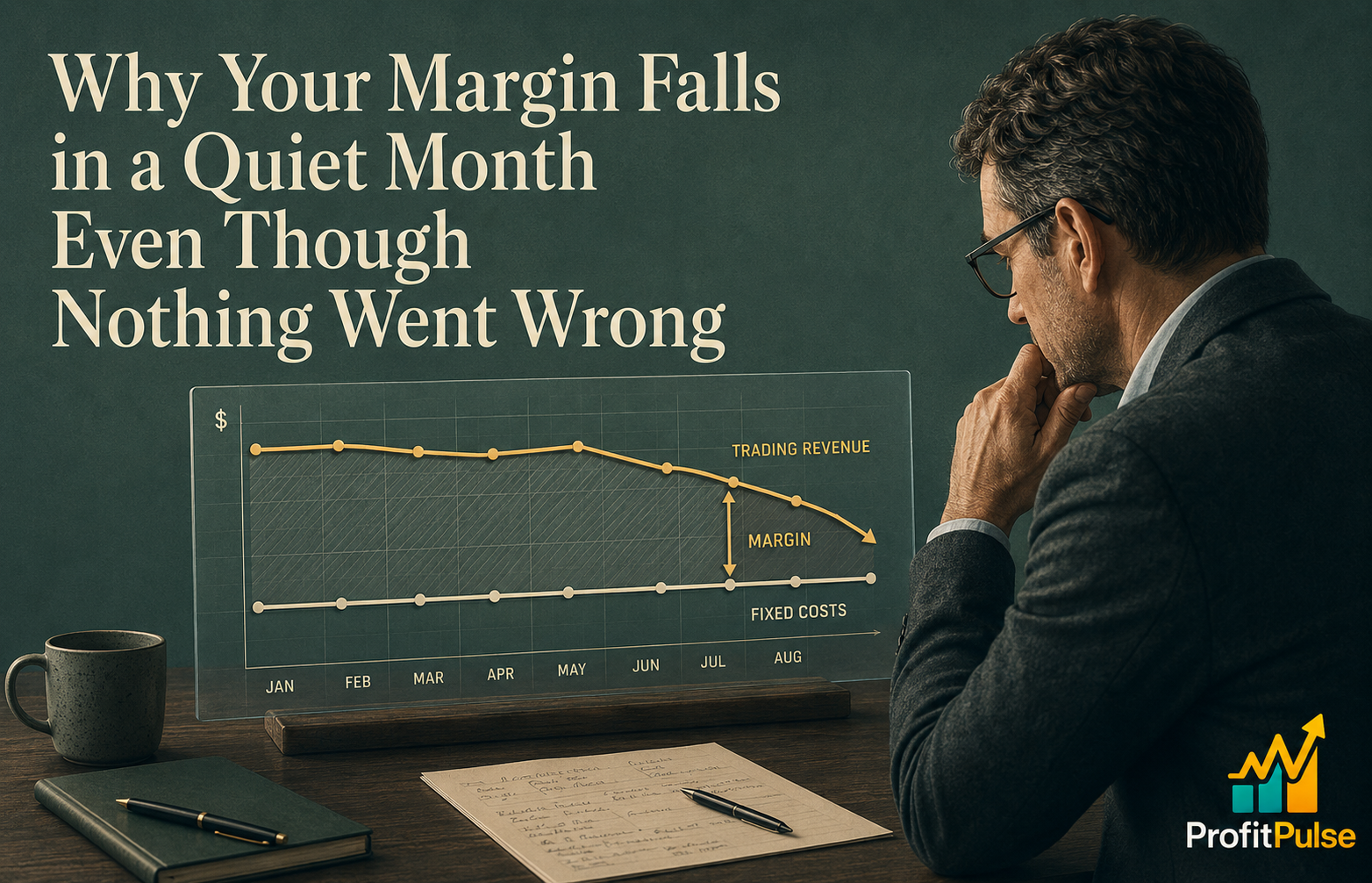
Revenue eases off for a few weeks after the EOFY rush, and most owners brace for a smaller profit. What actually erodes the result is subtler than a slow month suggests. Every job that lands still carries the same gross margin percentage it always has. Quotes are accurate. Costs on each sale sit exactly where they were forecast to sit. And yet, when the numbers are pulled together at month end, the profit line has fallen further than the revenue line did.
That gap is not a pricing problem. It is a cost structure problem, and it is one of the quieter ways a genuinely profitable business can look shakier than it actually is for a month or two, before recovering once trading picks back up. Understanding why it happens is the difference between reacting to a false alarm and knowing precisely what to watch.
Fixed Costs Do Not Notice a Quiet Month
Rent, insurance, loan repayments, software subscriptions, and the salaries of the people who keep the business running day to day do not move when revenue softens. They stay fixed, or close enough to it, regardless of how many jobs go out the door or how many clients walk through reception that week. When trading volume drops even slightly, that same fixed cost pool has to be covered by fewer sales, which means each sale is now carrying a heavier share of it than it was the month before.
This is a normal feature of how a business is built, not a sign that something has gone wrong. But it does mean net margin can fall meaningfully even while every individual transaction remains exactly as profitable as it was designed to be. The business an owner is looking at this month is structurally the same business it was last month. The volume moving through it has simply changed.
The Job Can Be Priced Correctly and the Month Can Still Be Wrong
This is where the confusion usually sits. An owner checks the gross margin on a handful of recent jobs or invoices, sees the percentage holding where it should be, and reasonably concludes that pricing and cost control are both fine. They are, at the transaction level. What that check misses is the relationship between total fixed costs and total volume for the period, which is a business-wide calculation rather than a per-job one.
The businesses that move through a quiet patch calmly are usually the ones that already know their break-even point, the volume of sales required each month before fixed costs are covered and the business starts generating profit. Without that number, a soft month reads as vague unease rather than a specific, quantifiable shift. With it, an owner can look at a quiet July or August and say precisely how much headroom exists before it becomes a genuine concern, which is a very different position to plan from.
The Pattern Shows Up Differently by Business Type
A professional services firm with salaried staff feels this through utilisation, billable hours spread across the same wage bill regardless of how full the diary is. A trade or construction business feels it through fixed plant, insurance and licensing costs that keep running between jobs. A cafe or retail operator feels it through rent and rostered wages that do not shrink just because foot traffic has. The mechanism is identical across all three. Only the specific fixed cost line that bites hardest changes.
What tends to catch owners out is assuming the pattern is unique to their own business or industry, when it is actually one of the most consistent patterns we see across owner-led businesses of very different kinds. Once it is named, most owners recognise it immediately from a previous quiet stretch they could not quite explain at the time.
Building a Cost Base That Moves With the Business
Not every fixed cost can or should become variable. But most businesses carry more fixed cost than they need to, simply because nobody has gone through the structure line by line to ask which costs genuinely have to stay flat and which could flex with volume instead. A Cost and Margin Deep Dive does exactly that, working through the cost base to separate what is truly fixed from what has just never been questioned, and ranking the opportunities to rebuild margin resilience by dollar impact.
The other half of the answer is visibility. Owners who track a rolling forecast alongside actual trading, rather than reviewing profit only once the accountant closes the month, tend to spot a volume dip and its margin consequence weeks before it shows up as a disappointing set of financials. That kind of ongoing cash flow discipline turns a quiet month from a surprise into something already priced in. It is also the kind of forward-looking view a fractional CFO is typically brought in to hold, sitting alongside the bookkeeper or BAS agent who is, quite rightly, focused on keeping the compliance side of the business accurate rather than modelling what next month’s volume will do to margin.
A quiet month after a busy EOFY period is not a verdict on the business. It is a maths problem with a known shape, and once an owner can see the shape, the next quiet month stops feeling like a mystery.
Frequently asked questions
Why does my profit fall when my gross margin percentage on each job hasn’t changed?
When trading volume dips, the fixed costs your business carries, such as rent, insurance and salaried wages, still have to be paid, so they get spread across fewer sales. Each transaction can be priced exactly right and still leave less profit behind, because the cost base sitting underneath it hasn’t shrunk to match. It’s a structural shift, not a pricing mistake.
What is a break-even point and why does it matter for a small business?
Break-even is the level of sales a business needs each month before fixed costs are covered and profit begins. Knowing that number turns a quiet trading period from vague worry into a specific, measurable gap. A Cost and Margin Deep Dive is a practical way to establish it properly against your actual cost structure rather than a rough guess.
Is it normal for Australian small businesses to trade quietly in July and August?
Yes. Many owner-led businesses see a natural lull in the weeks after the EOFY push, as clients and customers pause decisions or return from a break. The pattern itself isn’t the concern. What matters is whether the fixed cost base is understood well enough that a quiet patch doesn’t get mistaken for a deeper problem.
Should I cut fixed costs as soon as trading slows down?
Not automatically. Cutting quickly can remove capacity you need once trading picks back up. The more useful first step is separating which costs are genuinely fixed from those that could flex with volume, then making deliberate decisions rather than reactive ones. That distinction is usually clearer with an outside set of eyes on the cost structure.
What is the difference between gross margin and net margin for a small business?
Gross margin measures profit on each sale after direct costs, like materials or labour on the job. Net margin measures what’s left after every fixed cost in the business is paid, including rent, insurance and overheads. A business can hold a healthy gross margin on every transaction and still see net margin fall if volume drops, because fixed costs are shared across fewer sales.
How can I tell if a slow month is a cash problem or a margin problem?
A cash problem is about timing, money owed to the business that hasn’t landed yet. A margin problem is about the underlying economics, fixed costs no longer being covered by current volume. The two often show up together after a quiet trading patch, which is why it helps to look at cash flow discipline and margin structure side by side rather than as separate questions.
How does a fractional CFO help a business through a slow trading period?
A fractional CFO brings the forward-looking view that sits above day-to-day bookkeeping, tracking volume against the cost base month to month so a quiet period is visible early rather than discovered at financial close. It’s a different function to compliance accounting, built specifically for commercial decision-making. You can book a discovery call to talk through what that looks like for your business.
Leave a Reply