
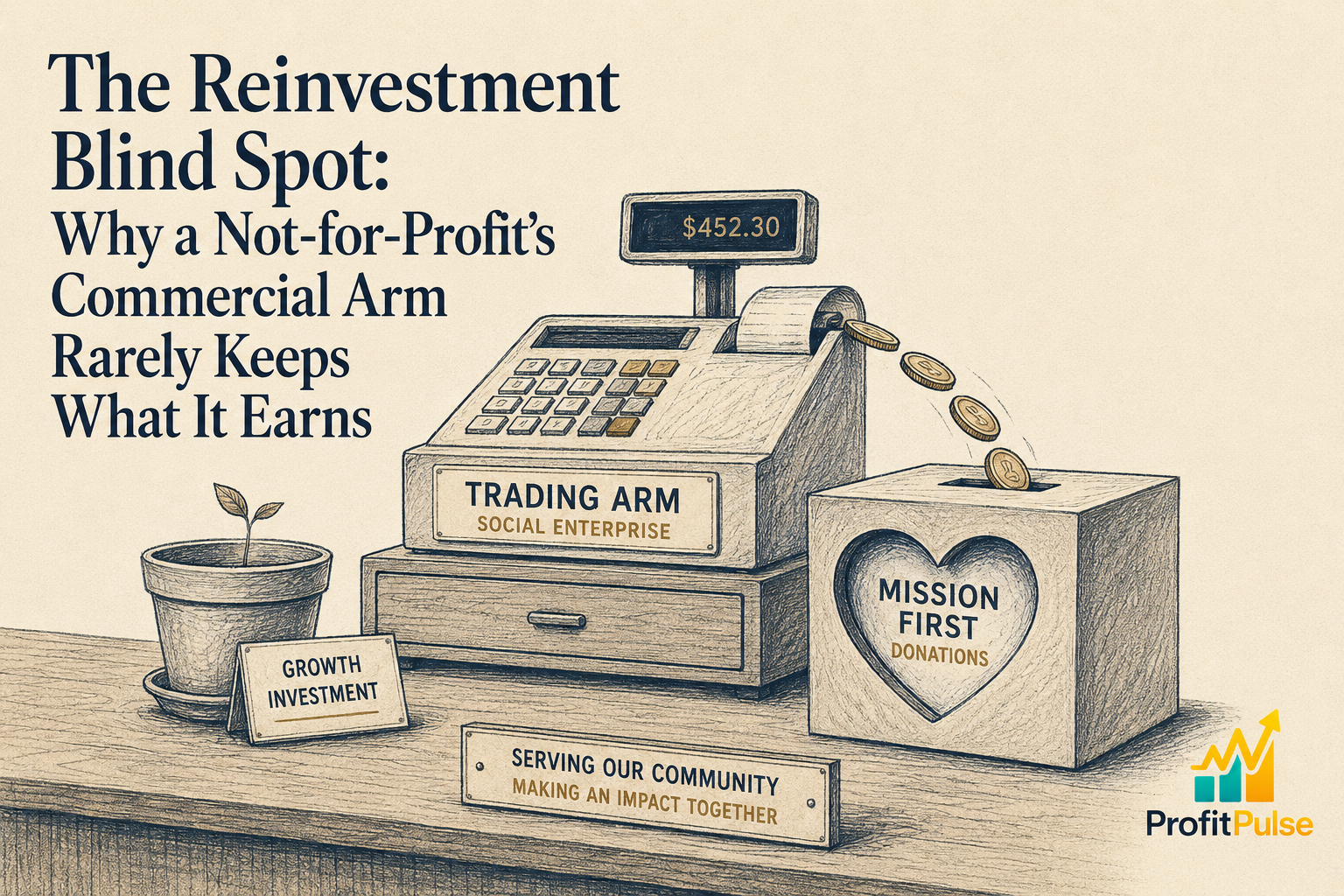
World Humanitarian Day passed on 19 August, a good moment to notice how much genuine commercial activity now sits inside the not-for-profit sector. Op shops, social enterprise cafes, training divisions, consulting arms, licensing and merchandise deals: increasingly, a not-for-profit funds part of its mission with a real trading business bolted onto the side of it.
The pattern we see across these commercial arms is not that they lose money. Most of them trade profitably, sometimes more consistently than the mission side of the organisation ever manages. The pattern is that the surplus rarely stays where it was earned. The moment a trading arm reports a good year, that surplus is treated as capital available for the mission, not as capital the commercial arm needs to keep growing.
That instinct makes sense for a mission-led board. It is also a quiet way to keep a commercial arm permanently undercapitalised, one good year at a time.
A Surplus Is Not the Same as Free Cash
In a standalone business, retained profit does several jobs at once. It funds next year’s stock or working capital, it covers the gap between a slow month and a strong one, and it builds the reserve that lets the owner say yes to an opportunity without going to the bank first. When a commercial arm’s surplus is swept into program spending as soon as the year closes, none of that capacity gets built. The trading arm starts the following year with the same working capital it had twelve months ago, even though the business it needs to run has grown.
Over a few good years this becomes a structural ceiling. The commercial arm cannot expand the op shop network, add a second training cohort, or take on a larger consulting contract, because every dollar it generated has already been allocated to a program before the next opportunity arrives. Growth then has to be funded by a grant application or a fresh appeal, which is a slower and less certain path than reinvesting what the business already earned.
Governance Treats the Commercial Arm as a Given
The other pattern worth naming gently is that a commercial arm attached to a good cause tends to get a lighter governance touch than a standalone SME would. Board papers report the trading result once or twice a year rather than monthly. Pricing, customer profitability and margin by product line get less scrutiny than they would in a business where nobody assumes goodwill will carry the numbers. This is not a criticism of any board or finance team; it is a genuinely difficult balance to strike when the same meeting has to cover mission outcomes, compliance and commercial performance in the time available.
It does mean the commercial arm rarely gets the same disciplined cadence a growing SME would apply to its own trading business, the kind of monthly rhythm a fractional CFO partnership brings to owner-led businesses across Brisbane and the wider east coast. A trading arm that is reviewed with that regularity tends to catch margin drift and pricing erosion well before it shows up as a disappointing annual result.
Restricted Funding Habits Bleed Into Unrestricted Income
Grant and program income comes with rules attached, and NFP finance teams are understandably rigorous about tracking what each dollar is allowed to fund. The habit that builds around restricted income sometimes carries over to trading income that was never restricted at all. Unrestricted surplus from a commercial arm gets treated with the same instinct: spend it on the mission this year, because that is what the money is for. A for-profit business applies a different logic to its own retained earnings, treating some of it as reinvestment capital and some as a buffer, the same cash flow discipline that keeps any owner-led business solvent through a quiet quarter.
None of this argues for spending less on the mission. It argues for deciding, deliberately and in advance, what share of a strong trading year gets reinvested in the business that produced it before the rest is allocated to programs. A capital allocation review across the mission and commercial split gives a board that decision with numbers attached, rather than leaving it to whichever conversation happens last in the meeting.
If your organisation runs a trading arm alongside its mission and the annual result never quite funds next year’s growth, that is worth a proper look before the next budget cycle starts. It is a conversation we are glad to have, whether that starts with a working session or a discovery call.
Frequently asked questions
Should a not-for-profit’s commercial arm keep some of its own profit
Most boards benefit from deciding this deliberately rather than by default. A share of a strong trading year kept as reinvestment capital lets the commercial arm fund its own stock, equipment or staffing growth, rather than starting every year at the same base. A capital allocation review gives the board a clear split to work from.
How often should a board review the finances of its trading arm
A monthly or quarterly cadence tends to catch margin drift long before it shows up in the annual result. Many boards currently review the trading arm once or twice a year alongside broader reporting, which is workable for compliance but leaves commercial performance under-watched between meetings.
What is the difference between restricted and unrestricted income for an NFP
Restricted income comes with conditions attached by the grant or donor and must be spent on the purpose specified. Unrestricted income, including most trading surplus, carries no such condition, which means the board genuinely chooses how it is used. Applying restricted-income habits to unrestricted trading income by default is worth questioning.
Can a fractional CFO work with a not-for-profit’s commercial division
Yes. A fractional CFO partnership is a natural fit where a trading arm needs the same monthly discipline, margin visibility and board-ready reporting that a growing SME applies to its own commercial performance, without adding a full-time executive role.
Why does a profitable trading arm still run short of working capital
This usually happens when surplus is allocated to programs as soon as it is reported, leaving no retained capital behind to fund next year’s stock, staffing or growth. The trading arm ends up relying on grants or appeals to cover gaps a standalone business would normally fund from its own retained profit.
How do commercial arms of NFPs in Brisbane typically fund growth
Many rely on grant applications or fresh appeals rather than reinvested surplus, which is slower and less certain. Businesses across Brisbane and the wider east coast that instead retain a deliberate share of trading profit tend to have more control over the timing of their own growth.
What is a capital allocation review and how does it help a not-for-profit
It is an independent look at where capital is currently deployed against the return it generates, covering people, stock, fit-out and reinvestment. For a not-for-profit with a trading arm it gives the board a clear, numbers-based recommendation for splitting a strong year between mission spending and reinvestment. See our services for more.
Leave a Reply