
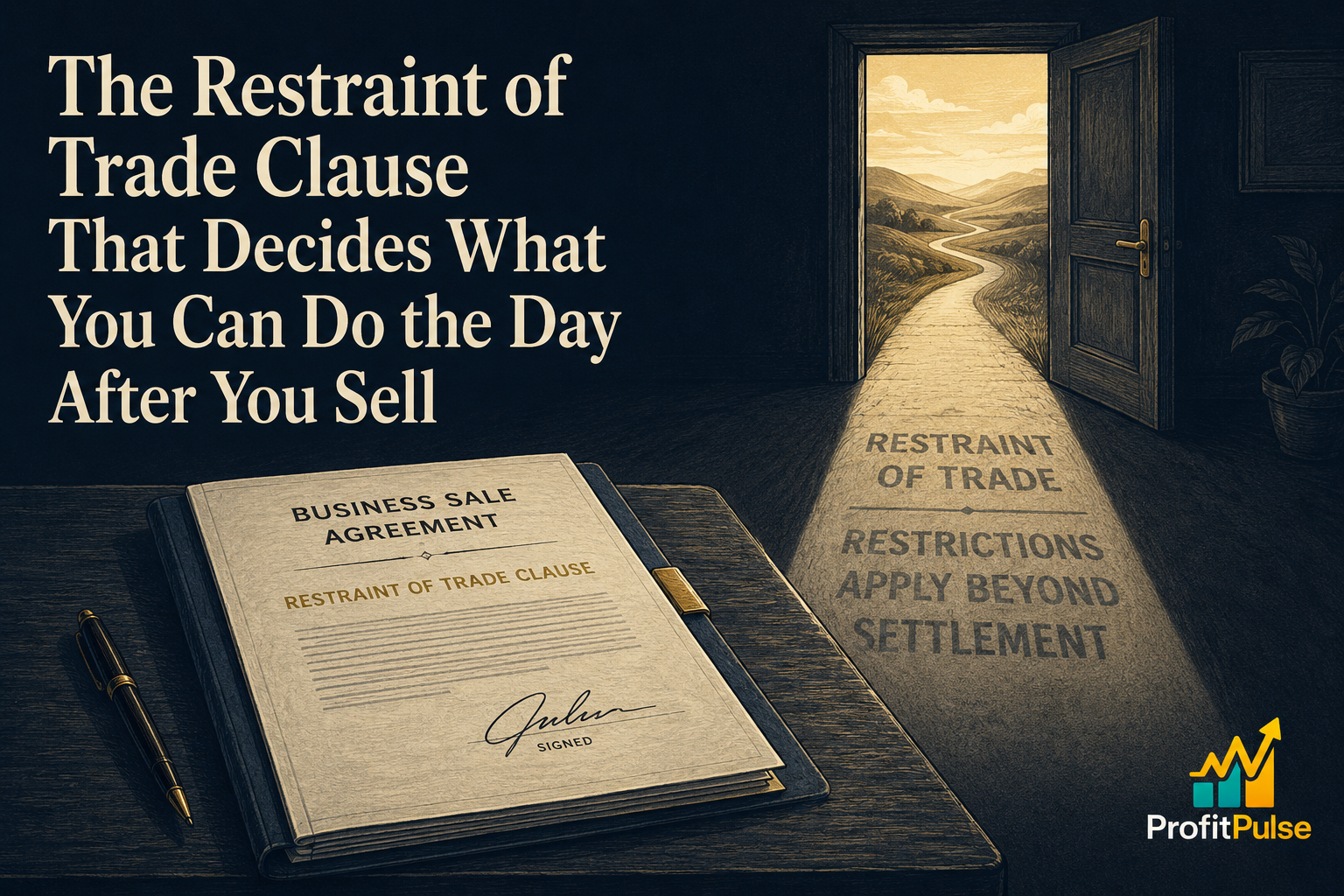
When owners picture the sale of their business, the number that gets all the attention is the multiple. What the contract actually stops a departing owner from doing next rarely gets the same scrutiny, and one clause in particular reaches further into life after the sale than the purchase price ever suggested it would.
The restraint of trade clause sits in almost every Australian SME sale contract, and it is one of the few terms built to survive settlement completely intact. It sets out what a seller cannot do, where, and for how long, and it is usually agreed months before anyone stops to ask what the next chapter actually looks like.
What the Clause Actually Restricts
A restraint of trade clause typically covers three things at once: the type of business the seller can be involved in, the geographic area it applies to, and how long the restriction runs. It usually goes further than simply “no competing business”, reaching into soliciting former customers, approaching former staff, or even consulting to a competitor in an advisory capacity. The drafting matters enormously here. A restraint written around “the industry” is a different animal to one written around “the specific services this business provided to these customers”, and the gap between those two versions can shape an owner’s next five years.
Why Buyers Push Hard on This Term
From a buyer’s side, the logic is straightforward. The price paid assumes the relationships, reputation and know-how walking out the door on settlement day stay out the door. A buyer who has just paid three to four times annual profit for a business is not paying for the fit-out and the customer list alone; they are paying for the assumption that the seller will not reopen two suburbs over under a slightly different name. The restraint clause is how that assumption gets written into something enforceable, and buyers and their lawyers will typically push for the widest version they think a court would uphold, then negotiate down from there.
The shape of the restraint tends to follow the shape of the business. A professional services practice usually attracts a clause built around clients and referral relationships rather than a physical territory, because the goodwill being sold is largely personal. A trades or hospitality business is more likely to see a tight geographic radius, since the goodwill sits closer to location and foot traffic. Neither version is inherently unreasonable; the question is always whether it matches what the buyer is genuinely protecting, rather than what a standard template happened to include, and that question sits close to the same groundwork covered in a proper exit readiness review.
Where the Clause Catches Owners Out
The problems rarely show up on settlement day. They show up eighteen months later, when a former owner gets approached to consult on an unrelated project that a broadly worded clause happens to capture, or wants to start something genuinely different that a vague industry definition still technically covers. A geographic radius that made sense for a single-location business can quietly become a problem if the buyer later expands into new territories the seller never operated in. And where a sale includes an earnout, the restraint period and the earnout period do not always line up, which can leave an owner contractually boxed in for longer than the payment schedule alone would suggest, still tied to performance targets in a business they no longer control day to day.
Negotiating It Before the Signature, Not After
The clause is far easier to shape before a heads of agreement is signed than after. Reasonable is generally judged against what is genuinely needed to protect the goodwill being sold, not what a buyer’s template happens to include by default, and duration and geography that are proportionate to the actual business tend to hold up better on both sides than an overreaching version nobody expected to be tested. This is exactly the kind of term an Exit Readiness Diagnostic is built to surface early, alongside the other seven dimensions a buyer will assess, so it becomes a known and negotiated point rather than something an owner discovers buried in a draft contract with a deadline attached.
None of this changes what the business is worth. It changes what life looks like for the person who built it, for years after the sale price has been banked. An owner who has spent two decades building a reputation in a particular field, only to find the restraint clause quietly puts most of that field off limits for the next three years, has sold more than a business. Getting the restraint clause right is not a legal afterthought bolted onto the commercial negotiation; it is part of the same conversation as a business valuation, about what the business is worth and what selling it should actually buy the owner. That is the conversation worth having early, with the whole picture in view rather than just the number on the front page of the contract.
Frequently asked questions
What is a restraint of trade clause in a business sale contract?
It is the term that sets out what a seller cannot do after settlement, usually covering the type of business they can be involved in, the geographic area it applies to, and how long the restriction lasts. It exists to protect the goodwill a buyer has just paid for. The specific wording matters more than the general concept, since a narrow, well-defined clause and a broad one can affect an owner’s options very differently.
How long can a restraint of trade clause last after a business sale?
There is no fixed rule; courts generally look at whether the duration is reasonable to protect the goodwill actually being sold, which varies by industry and business size. A restraint tied closely to what the business does and where it operates tends to hold up better than one written broadly by default. This is a term worth reviewing closely before signing rather than after.
Can a restraint of trade clause stop me starting an unrelated business?
It should not, if the clause is drafted tightly around the specific business sold, but vague industry definitions can capture more than a seller expects. A clause written around “the industry” rather than the specific services and customers involved is the version most likely to cause a problem later. Reviewing the exact wording before settlement, through a process like an Exit Readiness Diagnostic, is the way to catch this early.
Does a restraint of trade clause affect what a buyer will pay for a business?
Indirectly, yes. A buyer’s price assumes the goodwill they are acquiring, including the seller’s relationships and reputation, stays with the business rather than walking out the door. A weak or unclear restraint clause can make a buyer nervous about that assumption, which can show up in price negotiations or deal terms. A properly scoped business valuation considers this alongside the other value drivers a buyer weighs.
Should restraint of trade terms be negotiated before signing a heads of agreement?
Yes. Once a heads of agreement or letter of intent is signed, an owner’s ability to reshape terms like this drops considerably, because the deal has commercial momentum behind it. Raising duration, geography and scope questions early, while there is still room to negotiate, avoids discovering an unreasonable version buried in the draft sale contract under time pressure.
What happens if a restraint of trade clause overlaps with an earnout period?
It can leave an owner contractually restricted for longer than the payment schedule alone suggests, since the two clauses are often negotiated separately rather than aligned. An owner focused on the earnout’s payment triggers can miss that the restraint period runs on a different timeline. Reading both clauses together, not in isolation, is the only way to see the actual length of the restriction.
Who reviews restraint of trade clauses before an Australian SME sale?
Legal advisors draft and negotiate the exact wording, but the commercial judgement about what is proportionate to the goodwill being sold, and what an owner actually wants their next few years to look like, benefits from being part of the broader exit preparation. An Exit Readiness Diagnostic is a useful way to have that conversation before a contract is on the table, not after.
Leave a Reply