
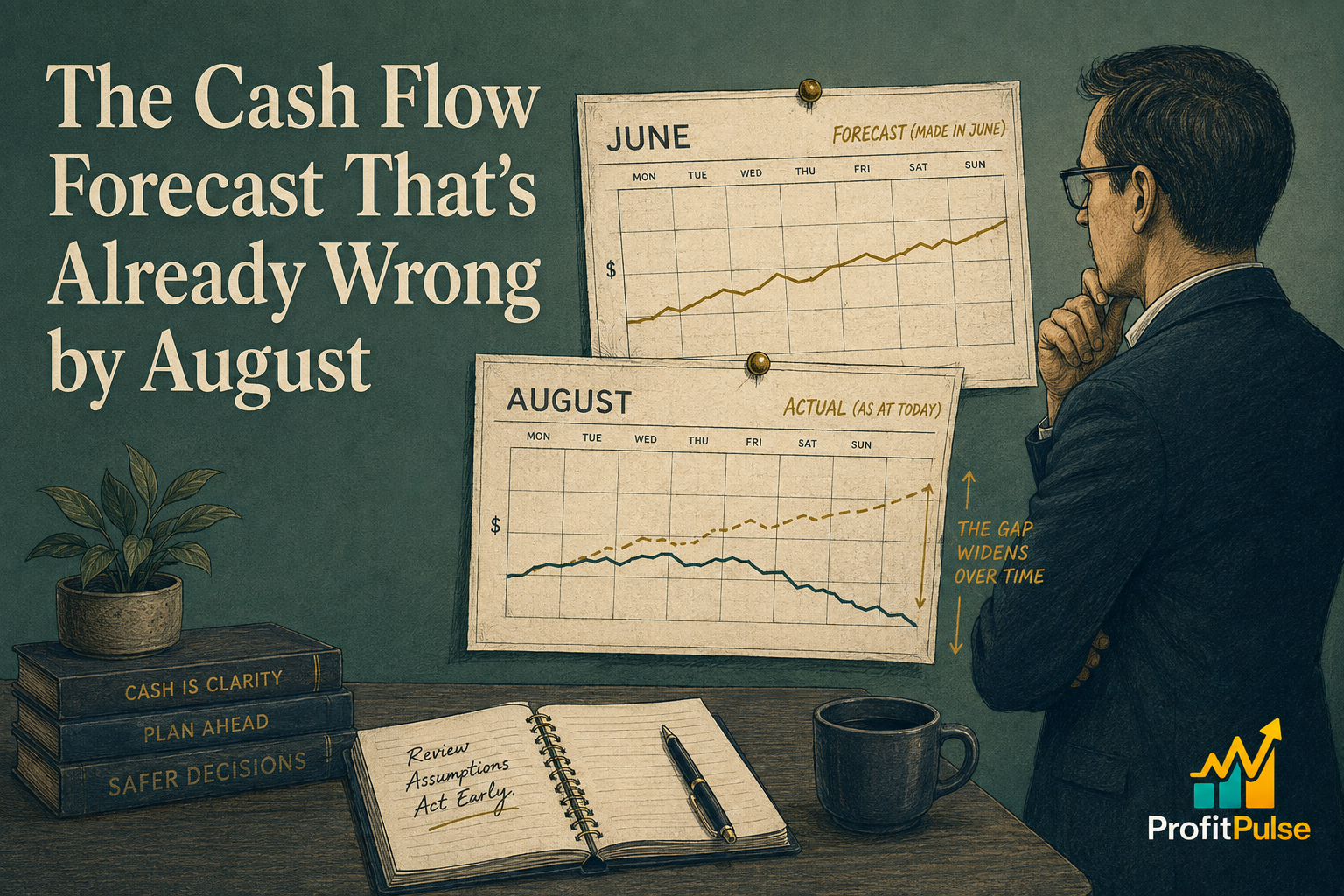
Somewhere around June, most owner-led businesses go through the same ritual. The accountant hands over the new year’s budget alongside the tax return, a cash flow forecast gets built or updated to sit beside it, and for a few weeks it feels like a genuinely useful picture of the year ahead. Then EOFY passes, trading resumes its normal rhythm, and the forecast quietly stops being opened.
By late August, two months of actual trading have happened against that forecast, and in most businesses we work with, the numbers have already started to drift. A customer who used to pay in thirty days is now taking forty five. A supplier renegotiated terms. Stock came in earlier than planned for spring trading. None of that means the June forecast was badly built. It means a forecast built once and left alone was only ever going to be accurate for as long as nothing changed, and something always changes.
None of this tends to register as one obvious event. It shows up as a slightly tighter week here, a payment pushed a few days later there, until the gap between what the forecast said and what the account actually shows becomes too wide to explain away as noise. By the time it is noticed, the forecast has usually stopped being consulted altogether, and the business is running on instinct and the bank balance instead.
The Forecast Was Right in June. That’s the Problem.
A forecast built at EOFY uses the best information available at the time, historical collection patterns, known seasonal dips, whatever wage and supplier costs were locked in for the new year. That’s a reasonable starting point. What it can’t do is account for the decisions and surprises that show up in July and August specifically, because those hadn’t happened yet when the model was built. Treating that June version as the year’s cash flow answer, rather than as a first draft, is where the gap between the forecast and the bank account usually starts to open.
A Static Number Hides the Very Thing It Was Built to Catch
The entire purpose of a cash flow forecast is spotting a squeeze early enough to do something about it, before it shows up as a tight week nobody saw coming. An annual number set in June structurally can’t do that job past the first few weeks, because the pressure that eventually causes a squeeze is usually built from small shifts across July, August and beyond, a large customer quietly stretching payment terms, a restock ordered ahead of a busier season, a cost that crept up and was never re-modelled. None of these show up in a forecast nobody has gone back to update. They only show up in the account balance, usually right when there’s the least room to react.
Take a business that forecast steady thirty-day collections back in June. If its biggest customer has since drifted to forty five days without anyone flagging it, that single change can strip several weeks of expected cash out of the picture by spring, invisibly, because the June forecast has no mechanism for noticing it happened.
What Changes When the Forecast Rolls Every Week
The businesses that don’t get caught out this way generally aren’t doing anything more sophisticated. They’ve just replaced the once-a-year number with a rolling view that gets rebuilt against actuals every week, typically covering the next thirteen weeks rather than the next twelve months. A weekly rolling forecast catches drift while it’s still small enough to manage, a debtor slipping a fortnight, a supplier payment moving earlier, a quieter trading week than usual, and shows exactly which week that pressure is likely to land rather than leaving it as a vague sense that things feel tighter than expected. This is precisely what a 13-Week Cash Flow Build is designed to give an owner: three scenarios, refreshed weekly, so the number in front of them always reflects what’s actually happening in the business rather than an assumption made two months ago. It also turns a vague sense of unease about the quarter ahead into a specific, actionable figure, which week the pressure lands, how large it is, and what lever actually closes the gap, rather than a general instruction to keep an eye on things.
Making It a Habit, Not an Annual Task
The shift that matters most isn’t the model itself, it’s turning cash flow forecasting into a standing weekly habit rather than something that gets built once and filed away. That’s the core of proper cash flow discipline, and it tends to be the first thing that slips once EOFY pressure eases and the business gets busy again. ProfitPulse works with owner-led businesses across Queensland, NSW and Victoria to build exactly this kind of rolling view and keep it running long after the first version is built. If the number in the account has started to feel disconnected from the forecast built back in June, that’s usually the clearest sign it’s worth booking a discovery call with ProfitPulse before the gap gets any wider.
Frequently asked questions
Why does a cash flow forecast built at EOFY stop being accurate by August?
A forecast built in June reflects the information available at that point, historical patterns, known costs, expected seasonal movement. It cannot account for decisions and shifts that happen afterwards, like a customer stretching payment terms or a supplier changing conditions. Left unrevised, the gap between the forecast and the bank balance widens every week it goes unchecked.
What is a rolling 13-week cash flow forecast for a small business?
It is a forecast that covers the next thirteen weeks and is rebuilt weekly against actual trading, rather than a single annual number set once and left alone. A 13-Week Cash Flow Build uses this approach with three scenarios, so an owner can see exactly which week a squeeze is likely to land rather than discovering it in the account balance.
How often should an Australian SME update its cash flow forecast?
Weekly is generally the useful cadence for a business with any real seasonality or growth in its trading. Monthly reviews still leave enough time for a debtor slipping, a supplier term changing, or a cost creeping up to compound into a genuine squeeze before anyone notices the drift.
What’s the difference between an annual budget and a cash flow forecast?
A budget sets expected revenue and cost targets for the year and is largely a planning document. A cash flow forecast tracks the actual timing of money moving in and out week by week, which is what determines whether the business can cover its commitments on any given date, regardless of how the year’s totals are tracking overall.
Can a profitable business still run short of cash between EOFY and Christmas?
Yes, and it is a common pattern across owner-led businesses on the East Coast. Profit is recognised when a sale is made, but cash only lands once it is collected, and the gap between those two events widens whenever trading picks up. Folding this into ongoing cash flow discipline is what keeps a growing, profitable business from being caught out by its own momentum.
When is it worth bringing in outside help to build a cash flow forecast?
Usually once the forecast has been built once, gone stale, and nobody in the business has the time or rhythm to keep rebuilding it weekly. A fractional CFO can build the rolling view and hold the weekly discipline around it, so the forecast stays a working tool rather than a document from June that nobody opens again.
Leave a Reply